


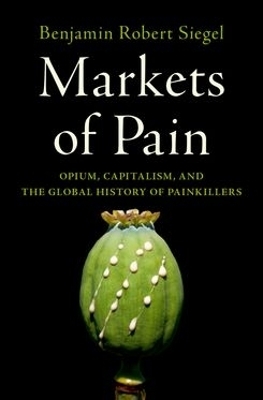
Markets of Pain
Opium, Capitalism, and the Global History of Painkillers
Seiten
2026
Oxford University Press Inc (Verlag)
978-0-19-752782-5 (ISBN)
Oxford University Press Inc (Verlag)
978-0-19-752782-5 (ISBN)
- Noch nicht erschienen (ca. Juli 2026)
- Versandkostenfrei
- Auch auf Rechnung
- Artikel merken
Markets of Pain offers a sweeping history of the business of licit opium--following cultivators, merchants, scientists, and policymakers--and shows how this potent crop reshaped global trade, medicine, and geopolitics.
For centuries, opium has been a source of both profit and peril, its legacy entangled with addiction, imperialism, and the complex interplay of global trade and national development. While the illicit opium trade is infamous, the history of licit opium--how it was farmed, refined, and used to build modern medicine and shape state power--has remained largely untold.
Drawing on archival sources from Asia, Europe, and the United States, Markets of Pain traces the global arc of licit opium from poppy fields and processing plants in India, Turkey, and Australia to the clinics and laboratories of modern medicine. It shows how both the Ottoman Empire and the Turkish Republic treated the opium poppy as a national resource and a means of securing global stature. In postcolonial India, by contrast, nationalist leaders initially rejected opium's imperial legacy before embracing its strategic value amid the shifting currents of the Cold War. At the heart of this story are the cultivators, scientists, bureaucrats, and policymakers who shaped the licit opium trade and grappled with its far-reaching consequences. Their work and visions demonstrate how colonial empires and postcolonial states helped forge the global pharmaceutical industry as it struggled to govern a drug it could not abandon.
Markets of Pain reveals how a seemingly marginal crop became an unlikely engine of modernization, a tool of Cold War geopolitics, and a harbinger of today's global opioid crisis. Blending vivid scenes from opium's fields and factories with incisive analysis of scientific and diplomatic archives, Benjamin Robert Siegel recovers a buried history with urgent relevance for global supply chains, international power, and public health.
For centuries, opium has been a source of both profit and peril, its legacy entangled with addiction, imperialism, and the complex interplay of global trade and national development. While the illicit opium trade is infamous, the history of licit opium--how it was farmed, refined, and used to build modern medicine and shape state power--has remained largely untold.
Drawing on archival sources from Asia, Europe, and the United States, Markets of Pain traces the global arc of licit opium from poppy fields and processing plants in India, Turkey, and Australia to the clinics and laboratories of modern medicine. It shows how both the Ottoman Empire and the Turkish Republic treated the opium poppy as a national resource and a means of securing global stature. In postcolonial India, by contrast, nationalist leaders initially rejected opium's imperial legacy before embracing its strategic value amid the shifting currents of the Cold War. At the heart of this story are the cultivators, scientists, bureaucrats, and policymakers who shaped the licit opium trade and grappled with its far-reaching consequences. Their work and visions demonstrate how colonial empires and postcolonial states helped forge the global pharmaceutical industry as it struggled to govern a drug it could not abandon.
Markets of Pain reveals how a seemingly marginal crop became an unlikely engine of modernization, a tool of Cold War geopolitics, and a harbinger of today's global opioid crisis. Blending vivid scenes from opium's fields and factories with incisive analysis of scientific and diplomatic archives, Benjamin Robert Siegel recovers a buried history with urgent relevance for global supply chains, international power, and public health.
Benjamin Robert Siegel is an Associate Professor of History at Boston University. Siegel is the author of Hungry Nation: Food, Famine, and the Making of Modern India. A former journalist for Time in New Delhi and Hong Kong, his writing has been published in Vice, Public Books, American Heritage, and the Christian Science Monitor.
| Erscheint lt. Verlag | 15.7.2026 |
|---|---|
| Zusatzinfo | 20 black and white illustrations |
| Verlagsort | New York |
| Sprache | englisch |
| Maße | 156 x 235 mm |
| Gewicht | 3 g |
| Themenwelt | Geschichte ► Allgemeine Geschichte ► Neuzeit (bis 1918) |
| Geschichte ► Allgemeine Geschichte ► Zeitgeschichte | |
| Studium ► Querschnittsbereiche ► Geschichte / Ethik der Medizin | |
| ISBN-10 | 0-19-752782-5 / 0197527825 |
| ISBN-13 | 978-0-19-752782-5 / 9780197527825 |
| Zustand | Neuware |
| Informationen gemäß Produktsicherheitsverordnung (GPSR) | |
| Haben Sie eine Frage zum Produkt? |
Mehr entdecken
aus dem Bereich


aus dem Bereich
Geschichte einer wilden Handlung
Buch | Hardcover (2024)
C.H.Beck (Verlag)
CHF 47,60


