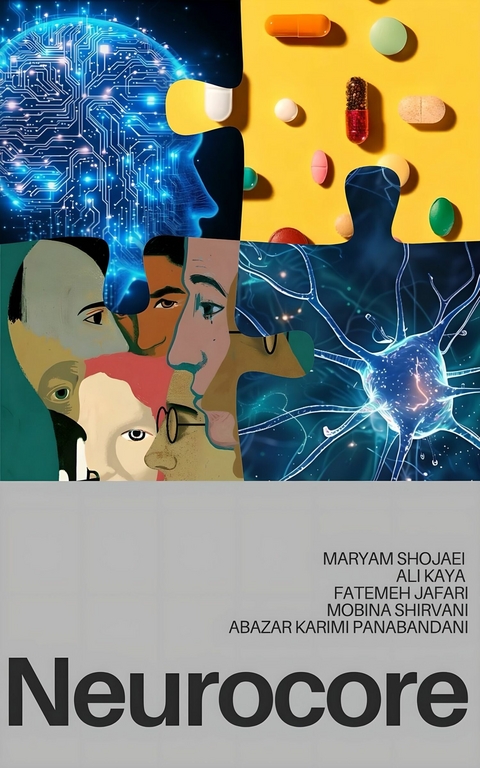
Neurocore (eBook)
234 Seiten
Publishdrive (Verlag)
978-0-00-108773-6 (ISBN)
This book offers an in-depth exploration of neuroscience, the scientific study of the nervous system and its complex interfaces with behavior, thought, and human experience. It examines the structure, function, and development of the brain, spinal cord, and peripheral nerves-the biological foundation of our existence. Bridging disciplines such as biology, chemistry, physics, psychology, and medicine, it reveals how neural networks control everything from basic reflexes to complex emotions and abstract reasoning.
Through historical insights and discussions of modern breakthroughs-including fMRI, EEG, and optogenetics-the book traces neuroscience's evolution from ancient theories to today's cutting-edge research. It also looks at important areas like molecular, cellular, systems, cognitive, behavioral, developmental, and clinical neuroscience, showing how they help us understand the brain and treat brain-related problems.
Definition and importance of neuroscience
The scientific field of neuroscience is concerned with the nervous system, including its development, structure, and function as well as the intricate relationships it has with behavior, thought, and human experience.
At its most fundamental level, neuroscience seeks to provide answers to the problems pertaining to the brain, spinal cord, and peripheral nervous system, which together provide the biological foundation of our existence.
Using cutting-edge tools and theoretical models, this interdisciplinary field, which crosses the boundaries of biology, chemistry, physics, psychology, and medicine, explores how brain networks control everything from basic reflexes to intricate emotions and abstract reasoning.
It's common to refer to the nervous system as the body's command center.
The central nervous system (CNS), which includes the brain and spinal cord, and the peripheral nervous system (PNS), which is made up of the nerves that run throughout the body, are its two primary parts.
This system is made up of specialized cells called neurons that communicate with one another by sending chemical and electrical impulses.
The glial cells provide structural and functional support to the neurons.
In order to understand how these interact to produce the incredible capacities of living beings, neuroscience investigates these at several levels, including molecular, cellular, systemic, and behavioral.
The study of the nervous system has a long history; ancient societies were already attempting to solve this issue, and individuals such as Hippocrates recognized the brain's function in perception and cognition.
Even so, the origins of contemporary neuroscience may be found in the 19th and 20th centuries, thanks to influential theories like Santiago Ramón y Cajal's neo meter theory, which conceptualized neurons as the basic building blocks of the brain.
Neuroscientists can now observe (and in certain situations manipulate) neural activity at previously unheard-of temporal and spatial resolutions thanks to advancements in neuroimaging and physiology, including functional magnetic resonance imaging (fMRI), electroencephalography (EEG), and optogenetics.
These developments have ushered in a golden age of research, shedding light on both neurological illnesses and normal brain function.
The extent of neuroscience
There are numerous subfields within the vast field of neuroscience.
The study of individual cells, particularly neurons, and how they interact with one another through synapses is known as cellular neuroscience.
The study of molecular neuroscience focuses on the biochemical mechanisms behind brain function, such as receptor activation and neurotransmitter release.
Systems neuroscience studies how groups of neurons form circuits that govern certain processes, including motor control or vision.
While cognitive neuroscience studies higher order processes like memory, decision-making, and language, behavioral neuroscience studies the relationship between brain activity and observable behaviors and mental states.
The study of how the nervous system develops and changes is known as developmental neuroscience. Clinical neuroscience uses this understanding to diagnose and treat illnesses.
Neuroscience is essential to scientific inquiry because of its transdisciplinary nature. Genetics reveals inherited variables influencing brain development, psychology describes mental processes, and computational science models neural networks.
It serves as a unifying framework for both microscopic and macroscopic descriptions of life.
The Value of Neuroscience
Almost everything we do as humans is impacted by neuroscience.
Its impact is most profound in the following important areas:
Comprehending the Human Mind
NEUROSCIENCE Speech and Additional Neural Technologies Neuroscience offer the means to decipher the biological basis of personality, emotion, and awareness.
What do we think of the world?
Why do we feel fear, love, or happiness? Why are we special among humans?
By examining brain regions like the amygdala, which is linked to emotional processing, and the prefrontal cortex, which is involved in decision-making, neuroscientists have begun to provide answers to these perennial issues.
Researchers have learned about self-awareness and daydreaming, for instance, by examining the default mode network, a group of brain areas engaged during introspection.
These discoveries enhance our knowledge of identity and mental health in addition to satisfying philosophical curiosity.
Enhancing Medical Care
Perhaps the most tangible medical benefits come from neuroscience. Millions of people worldwide suffer from neurological and mental conditions such as schizophrenia, epilepsy, depression, Parkinson's disease, and Alzheimer's disease.
Neuroscience has generated life-changing medicines including selective serotonin reuptake inhibitors (SSRIs) for depression, which track neurotransmitter levels, and deep brain stimulation for Parkinson's disease, which employs electrical impulses to lessen tremors.
Scientists can focus on specific remedies to increase quality of life and lessen suffering by understanding the neurological correlations of various illnesses.
Moreover, neuroscience informs neurology and neurosurgery.
Research on neuroplasticity—the brain's capacity to remodel itself—holds promise for stroke or traumatic injury recovery, and surgical techniques like brain mapping can help surgeons avoid important areas.
The field's efforts to enable speech for people confined to their bodies are further highlighted by the research of uncommon conditions like locked-in syndrome.
Enhancing Instruction and Learning
Our understanding of memory and learning has evolved because of neuroscience. Experience and repetition are key factors in memory development, according to research on synaptic plasticity, which is the ideal strengthening or weakening of brain connections.
Teachers may and should apply these ideas for practical goals, such as using multimodal instruction and spaced repetition to enhance learning.
To ensure that our educational institutions can accommodate a wide range of demands, research on developmental disorders like dyslexia or ADHD helps us lead specialized solutions.
By revealing how the brain processes information, neuroscience assists educators in more effectively fostering intellectual development.
The Evolution of Artificial Intelligence and Technology
The architecture of the brain serves as an inspiration for advances in machine learning and artificial intelligence (AI).
Much of contemporary AI is based on neural networks, which are modeled after the connections between neurons.
Engineers use insights from neuroscience to create more intelligent algorithms by understanding how biological systems learn, adapt, and handle information more effectively.
For instance, computer vision systems were impacted by visual processing studies conducted in the occipital lobe.
Indeed, neuroscience remains a crucial blueprint for building robots with even more human-like intelligence as AI sets out to explore this new frontier.
Addressing Social Concerns
Neuroscience tackles pressing societal issues, such as addiction and aging.
The reason why dopamine, which is linked to the nucleus accumbent, makes medications like opioids and activities like gambling addicting can be explained by research on the reward system. Usually, we apply the knowledge we acquire to guide rehabilitation initiatives or public health policy.
Similarly, as populations age, neurology investigates neurodegeneration, particularly dementia and related disorders, and how to maintain mental independence and clarity.
Resolving these issues will promote a sustainable economy and society. Legal and Ethical Aspects to Consider
Fundamentally challenging issues regarding our sense of identity, responsibility, and free choice are raised by neuroscience. In criminal situations, courts have used brain scans that demonstrate reduced activity in specific areas to support the claim of impaired capacity. Because our decision-making processes are illogical, they challenge our ideas of fairness and accountability.
To ensure that these technologies can align with human values, a subfield known as neuroleptics studies how brain-computer interfaces and cognitive-enhancing medications affect society.
Problems and Future Directions
Although neuroscience is developing, there are still obstacles to overcome.
The brain is a complex jigsaw with millions of connections made by its 86 billion neurons.
Although ethical constraints prohibit human testing and animal models aren't always fully transferable to humans, test tubes and animal models can occasionally provide valuable information.
Furthermore, there is a continuous demand for interdisciplinary cooperation and finance.
The field has a bright future ahead of it. Advances in gene editing (like CRISPR) hold the potential of eradicating inherited neurological abnormalities, while initiatives like the Human Connectome Project aim to map the brain's wiring in great detail.
AI and neuroscience are two examples of this new combined capacity, which might speed up data analysis in a manner akin to simulation and pave the way for the treatment of incurable diseases.
In the meantime, democratizing neuroscience research and education will guarantee that the advantages are felt by a larger segment of the population.
Neuroscience is a gateway to bettering our world and knowing ourselves, not merely a field of study.
Because it sheds light on...
| Erscheint lt. Verlag | 12.7.2023 |
|---|---|
| Übersetzer | Fatemeh Jafari |
| Sprache | englisch |
| Themenwelt | Medizin / Pharmazie ► Medizinische Fachgebiete ► Psychiatrie / Psychotherapie |
| ISBN-10 | 0-00-108773-8 / 0001087738 |
| ISBN-13 | 978-0-00-108773-6 / 9780001087736 |
| Informationen gemäß Produktsicherheitsverordnung (GPSR) | |
| Haben Sie eine Frage zum Produkt? |
 EPUB (Adobe DRM)
Größe: 1,6 MB
Kopierschutz: Adobe-DRM
Adobe-DRM ist ein Kopierschutz, der das eBook vor Mißbrauch schützen soll. Dabei wird das eBook bereits beim Download auf Ihre persönliche Adobe-ID autorisiert. Lesen können Sie das eBook dann nur auf den Geräten, welche ebenfalls auf Ihre Adobe-ID registriert sind.
Details zum Adobe-DRM
Dateiformat: EPUB (Electronic Publication)
EPUB ist ein offener Standard für eBooks und eignet sich besonders zur Darstellung von Belletristik und Sachbüchern. Der Fließtext wird dynamisch an die Display- und Schriftgröße angepasst. Auch für mobile Lesegeräte ist EPUB daher gut geeignet.
Systemvoraussetzungen:
PC/Mac: Mit einem PC oder Mac können Sie dieses eBook lesen. Sie benötigen eine
eReader: Dieses eBook kann mit (fast) allen eBook-Readern gelesen werden. Mit dem amazon-Kindle ist es aber nicht kompatibel.
Smartphone/Tablet: Egal ob Apple oder Android, dieses eBook können Sie lesen. Sie benötigen eine
Geräteliste und zusätzliche Hinweise
Buying eBooks from abroad
For tax law reasons we can sell eBooks just within Germany and Switzerland. Regrettably we cannot fulfill eBook-orders from other countries.
aus dem Bereich