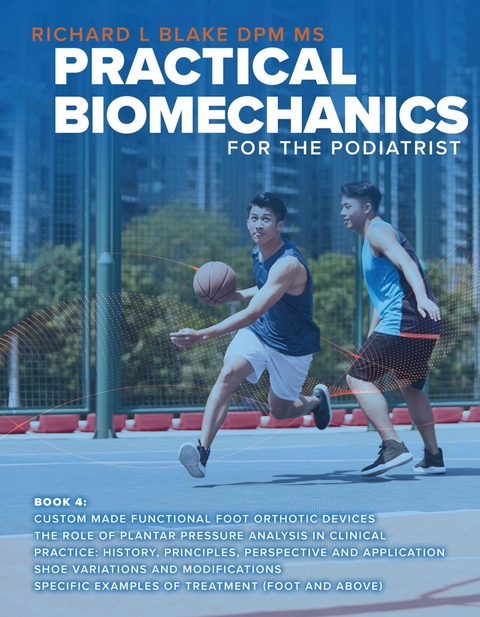
Practical Biomechanics for the Podiatrist (eBook)
212 Seiten
Bookbaby (Verlag)
979-8-3509-9639-5 (ISBN)
Dr. Richard Blake has been a practicing podiatrist for 44 years with a biomechanics and sports medicine sub-specialty. He worked at the Center for Sports Medicine and the Orthopedic and Sports Institute at Saint Francis Memorial Hospital in San Francisco. He has taught at the California College of Podiatric Medicine in San Francisco, and now the students at Samuel Merritt University's College of Podiatric Medicine in Oakland. He has written four other books for podiatrists, a book for lay people on the foot and ankle, and numerous articles. He mentors young podiatrists and lectures both nationally and internationally. Dr. Blake was honored to serve as President with the American Academy of Podiatric Sports Medicine.
"e;Practical Biomechanics for the Podiatrist"e;, from Dr. Richard Blake, is broken up into four sections on podiatry. The first section reviews the types of functional foot orthotic devices in the industry, what are they used for, and how Dr. Blake would order them. The emphasis of this chapter is on the function of "e;functional foot orthotic devices"e;. Using a classification of orthoses, Dr. Blake encourages readers to examine two key questions: What function do we want the orthosis to have? What functional change to the patient's biomechanics do we want to accomplish? The second chapter takes a look into the field of CAGA, or computer assisted gait analysis, by the esteemed Dr. Joseph D'Amico. Dr. D'Amico works with the Department of Orthopedics/Pediatrics at the New York College of Podiatric Medicine, where he was previously a chairman. He eloquently describes the history and clinical application of computer assisted gait analysis from the perspective of treating patients biomechanically this way for over 40 years. In his experience, CAGA is priceless for his biomechanical treatment. He reviews the findings in three ways: pressure analysis, temporal data, and waverform analysis. The reader gets a deep understanding of what is currently available on the market. The third chapter reviews various shoe modifications and styles that help make patients more stable with less pain. The fourth chapter presents 23 case histories of real patients in Dr. Blake's practice and how to approach these patients with a biomechanical mindset. This chapter calls upon information from the series' first three books and is meant to bring this teaching series around to its closure.
Chapter 13: Custom Made Functional Foot Orthotic Devices
Introduction
Welcome to the world of custom inserts. Since most professional laboratories have ample information on materials that can be used, modifications available, etc., I will focus on function. What are the mechanics that we are trying to achieve with our inserts? What patient function are we trying to change, or what functionality should the orthosis have? Typically, these functions are 6 in number in this industry: balance and support, primarily pronation control, primarily supination control, medial/lateral instability control, shock absorption or plastic insensitivity, and sagittal plane facilitation.
Practical Biomechanics Question #529: What are the 6 main functions of custom-made functional foot orthoses?
Accomplishing the goal of matching function to symptoms will require a lot of learning pain syndrome patterns related to abnormal motion. Some of these pain patterns are discussed in Book 3 Chapters 9 (pronation and supination), Chapter 10 (limb length discrepancy), Chapter 11 (weak and tight muscles), and Chapter 12 (poor shock absorption). Some are obvious like the need to give better shock absorption to a patient with multiple overuse stress fractures or joint arthralgias. Some are more subtle as placing less pronation support than necessary for the pronation due to a history of recurrent ankle sprains (called Medial Lateral Instability). However, there is logic in what we can order from our laboratories based on the functionality that we want to achieve. It is my job to help you with that logic.
Practical Biomechanics Question #530: In a long-distance runner with multiple recurrent tibial and femoral stress fractures, what would be the number 1 functionality that you would want to achieve in a custom foot orthotic device?
I want to list 12 common types of orthotic devices that will fit into this schema that I prescribe on a weekly, or at least monthly basis. I hope you will be closer to knowing when to use these 12 types of devices when you have read the chapter completely, with its challenging questions. I will also place the type of orthotic device symbol next to it. I will be going over these types in detail. I do not expect that you would know the indications of any of these now. The 12 typical orthotic devices I prescribe in my practice are:
- 35-degree inverted orthosis with medial Kirby Skive (P5)
- 25-degree inverted orthosis (P3)
- Root Balanced device with forefoot valgus deformity (everted forefoot deformity) B1 and BS devices
- Root Balanced device with medial Kirby Skive and low arch profile (P1)
- Hannaford Plastazote Device and other shock absorbing additions to standard devices (C5 and C1)
- ASIS Balance with Medial Kirby and 3-degree varus rearfoot and forefoot posting (everted forefoot deformity casted) P2
- Root Balanced with Lateral Kirby Skive with valgus rearfoot and forefoot wedging (S3)
- Root Balanced device with Forefoot Varus (B1)
- Kinetic Wedge (™) version (BH to H3)
- Modified Root with 5 degrees intrinsic varus and 3 degrees extrinsic varus forefoot and rearfoot posting (P1)
- 20-degree Inverted Technique with Denton modification and Lateral Phalange (ML3)
- Root Balanced with Forefoot Valgus support, Denton Modification, and Lateral Flange (S1)
Practical Biomechanics Question #531: Imagine a patient with severe genu valgum. As they walk with shoes on, where is the normal point of heel contact (medially or laterally)?
Practical Biomechanics Question #532: In a patient that lands on the medial side of the heel at foot strike, what would be the motion of the contact phase subtalar joint?
Root Balanced Devices with Forefoot Varus Support (#8 above) with Shock Absorbing Additions including soft Birko-cork (™) post, Spenco (™) top cover and forefoot extension
Hannaford plastazote orthosis being re-top covered (#5 above)
I hope as we discuss the general types of custom orthotic devices listed below, you will begin to see why things are done to the casts you take or the scan you send into a lab. But first we must discuss what these 6 types are so you get a firm grip on what types of orthotic devices are available for you to prescribe and should be available from most laboratories that make orthotic devices. The variations can be subtle at times but remember another Golden Rule: Slight changes at the foot can produce substantial changes up the leg. You will know the symbols when we are done, like the difference from BP and P4 or S1 and S3. I will use the example throughout the chapter of the changes I would make to the Rx as I deviate away from my Go-To device, or Gold Standard Device. Besides the difference between B1 and B2 orthoses, which is purely based on the type of impression you make, the rest is arranged from least change to most change in each type. So, for the pronators in your practice, you will get more support as you change the number higher and higher. There is more support for pronation in P5 and P3 for instance, and there is more shock absorption in C6 than C3.
Corrective Orthotic Devices
- Balancing (B): (B1 and B2)
- Pronators (P): BP, P1, P2, P3, P4, P5, and P6
- Supinators (S): BS, S1, S2, S3
- M/L Instability (ML): BML, ML1, ML2, ML3, ML4, ML5, and ML6
- Shock Absorption (C): BC, C1/C2, C3/C4/C5, C6, and C7
- Sagittal Plane (H): BH, H1, H2, and H3
Practical Biomechanics Question #533: What are the 6 main types of functional foot orthotic devices that you can prescribe based on the function you want to change in your patient?
These types are based on measurements, gait assessment, historical review, and patient feedback on your first attempt at helping them. Where I use all these tools to help my patients, some providers may just want to start with their best impression of a patient’s biomechanics. Where a patient falls on the Foot Posture Index score, coupled with their navicular drift and drop tests and supination resistance tests, will help some providers due to their experiences. Others will rely on the gait assessment and what they think is causing the patient’s pain syndrome. I like these approaches, and some understanding of the Root/Kirby based numbers I am always playing with. Your use of measurements, observations, and computer systems should all point to how “normal” or “abnormal” the patient is, and the knowledge of how to fix it to make your patient more stable. Golden Rule: Always make a patient more stable. Improving stability, will speed up most rehabilitation programs, and prevent re-occurrences if instability was the cause of the pain syndrome. This discussion revolves around how to make the patient increasingly stable, and it can start with choosing the correct orthotic device in the first place.
Unfortunately, when you are learning this, and we are all always learning, we learn the most from our failures. This failure may be where the function needing to be corrected does not correlate to the type of orthotic ordered. The patient is not more stable, or at least they are not sufficiently corrected, and/or their mechanically based symptoms do not get better, with your first orthotic attempt. Or, we have chosen the correct function to change, but our correction is too aggressive or not aggressive enough. Golden Rule: Obtaining improvement in symptoms caused by abnormal mechanics can be by slight corrections or complex corrections. This inherent need of a certain amount of mechanical support to achieve in your orthosis is not always readily apparent until after you have begun to work with the patient for a while. This list has a lot of options for us to then choose our next device with deeper thought.
Practical Biomechanics Question #534: Begin to look at the variety of patients that present with pronation tendencies. What would be 3 classifications of over pronation?
Practical Biomechanics Question #535: How could these 3 classifications of over pronation line up with 3 types of P (Pronatory) orthoses? (Hint: It would be logical to choose every other one from BP, P1, P2, P3, P4, P5, and P6, saving the last 5 for extreme cases).
I must mention the above breakdown of abnormal motions into 3 categories, as it is used by so many. For pronation, it would be mild pronation, moderate pronation, and severe pronation. For shock absorption, it would be mildly poor shock absorption, moderately poor shock absorption, and severely poor shock absorption. This classification of your patients can be an intermediary step in your even further exploration of mechanics. If you only make (or know about) one type of orthotic device for pronators that is different from your Gold Standard device now, this will advance you to 3 distinct types for pronators, supinators, etc. Slowly, as you use various devices, you will begin to see the nuisances between...
| Erscheint lt. Verlag | 30.4.2025 |
|---|---|
| Sprache | englisch |
| Themenwelt | Medizin / Pharmazie ► Medizinische Fachgebiete ► Orthopädie |
| ISBN-13 | 979-8-3509-9639-5 / 9798350996395 |
| Informationen gemäß Produktsicherheitsverordnung (GPSR) | |
| Haben Sie eine Frage zum Produkt? |
 EPUB (Ohne DRM)
Größe: 13,6 MB
Digital Rights Management: ohne DRM
Dieses eBook enthält kein DRM oder Kopierschutz. Eine Weitergabe an Dritte ist jedoch rechtlich nicht zulässig, weil Sie beim Kauf nur die Rechte an der persönlichen Nutzung erwerben.
Dateiformat: EPUB (Electronic Publication)
EPUB ist ein offener Standard für eBooks und eignet sich besonders zur Darstellung von Belletristik und Sachbüchern. Der Fließtext wird dynamisch an die Display- und Schriftgröße angepasst. Auch für mobile Lesegeräte ist EPUB daher gut geeignet.
Systemvoraussetzungen:
PC/Mac: Mit einem PC oder Mac können Sie dieses eBook lesen. Sie benötigen dafür die kostenlose Software Adobe Digital Editions.
eReader: Dieses eBook kann mit (fast) allen eBook-Readern gelesen werden. Mit dem amazon-Kindle ist es aber nicht kompatibel.
Smartphone/Tablet: Egal ob Apple oder Android, dieses eBook können Sie lesen. Sie benötigen dafür eine kostenlose App.
Geräteliste und zusätzliche Hinweise
Buying eBooks from abroad
For tax law reasons we can sell eBooks just within Germany and Switzerland. Regrettably we cannot fulfill eBook-orders from other countries.
aus dem Bereich