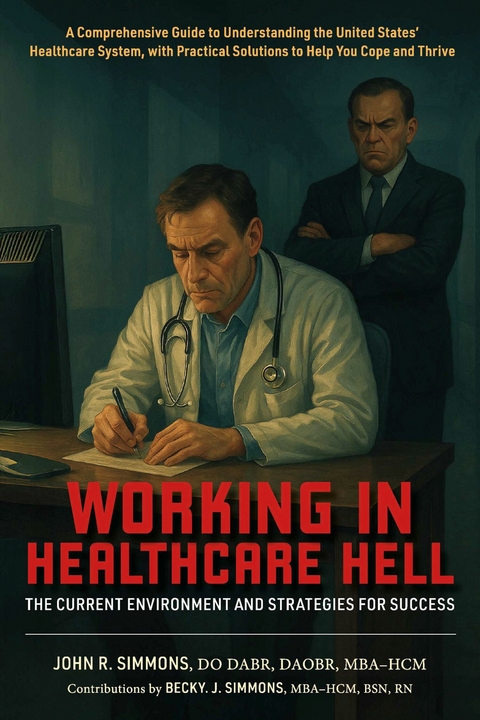
Working in Healthcare Hell (eBook)
396 Seiten
Bookbaby (Verlag)
979-8-3178-1512-7 (ISBN)
Dr. John R. Simmons, DO, DABR,DAOBR, MBA-HCM and Becky Simmons,MBA-HCM, BSN RN are a husband-wife duo with over 50 years of combined experience in healthcare leadership. John, a double board-certified physician in radiation oncology, has led the clinical department through accreditation, innovation, and transformation. Becky, a seasoned healthcare executive and registered nurse, has spent decades driving measurable improvements in quality, Stars performance, and healthy equity across health plans, tribal health systems, and FQHCs. Together, they've seen the inside of the system-its strengths, its failures, and its absurdities. Working in 'Healthcare Hell' is their joint effort to pull back the curtain, expose the pitfalls, and empower others to survive-and even lead-with integrity in a system designed to exhaust the very people it relies on. Raw, insightful, and deeply human, this book is not just a critique-it's a call to arms from two professionals who've lived it, fixed it, and still believe it can be better.
In an industry meant to heal, too many of us are bleeding out. Physicians. Nurses, Executives. Support staff. Patients. Families. No one escapes the fallout of a healthcare system that's increasingly profit-driven, policy-drenched, and performance-metric obsessed. The pressure is relentless. The paperwork is endless. The humanity? Often missing in action. "e;Working in Healthcare Hell"e; is a brutally honest, sharply funny, and unflinchingly real account of what it's like to survive and attempt to lead in the American healthcare system. But this isn't another burnout memoir or dry policy white paper. It's a battle guide, field manual, and truth serum all wrapped into one. Written by Dr. John R. Simmons, DO, MBA, a double-board certified physician in radiology and radiation oncology with over 25 years of clinical and administrative experience, this book brings the reader deep into the labyrinth of healthcare dysfunction and back out the other side. With co-contributions from Becky Simmons, BSN, MBA, a seasoned healthcare executive, registered nurse, and health plan innovator with her own 25-year track record, the Simmons duo blends grit, grace, and gallows humor to expose what really goes on behind the curtains of the clinics, hospitals, and health plans we all depend on. This book is for: Physicians and nurses suffocating under EHRs, prior authorizations, and top-down management that ignores the realities of the front line. Administrators and executives caught in the crossfire between regulator chaos, budget constraints, and a workforce on the brink. Healthcare students and new graduates deserve a roadmap for what's coming and how to hold onto their soul through it. Patients and families who wonder why their doctors seem so rushed, their bills confusing, and their care so fragmented. Consultants, analysts, and policymakers who want a clearer view of what real reform must address. This is the book John and Beckey wish someone had handed them when they were burning out, speaking up, or trying to change a system that rewards silence over solutions. But what makes "e;Working in Healthcare"e; different is its brutally honest but never hopeless approach. Yes, the stories are raw, but they aren't cynical. The Simmons believe in the people working within the system and offer ways to reclaim purpose without sugarcoating the barriers. Throughout the book, the Simmons teach real-world lessons, not ivory tower theories. From the VA to rural hospitals to Medicaid health plans to Fortune 500 mergers, the Simmons have walked the walk. These aren't theoretical critiques they're lived experiences and actionable insights. With dual perspectives John from the perspective of a physician battling care in the face of administrative dysfunction, and Becky focusing the lens from an executive's point of view they are able to tell a fuller story of how the system fails and how it could succeed. And finally, "e;Working in Healthcare Hell"e; is sharp, smart, and surprisingly funny. Full of biting wit, memorable metaphors, and a refusal to take jargon seriously, the book keeps readers engaged, even when the subject matter is heavy.
Foreword:
About the Author
Who am I? Well, that is a good question, requiring a lot of self-reflection. I don’t know if I’m qualified to even write this part of the book, but here it goes, for what it’s worth. I will start at the time in my life when my character, my person, and my desire to practice medicine began.
A little background on my upbringing: I had two great, loving, and supportive parents. They set an example of a strong work ethic and good morals. Most of the time, they worked 80 to 90 hours a week. I was an only child, so I had many chores growing up. Expectations were set at a very early age. I learned how to be self-sufficient before I turned 10. Little did I know then the traits instilled in me at a young age would aid me my entire career. I wanted to acknowledge those two great people before I even started this book. Thank you, Mom and Dad.
Secondly, I am happily married with five adult children. My wife has been an administrative nurse for over 20 years. Without her, my career and this book would not have been possible.
The Beginning
My life changed when I transferred to a new high school in my junior year as part of a move my parents had to make for their new jobs. This change of environment was perfect for me: I was a popular kid for the first time in my life, and that felt good. The new kid in a small rural town can always get attention at first, either good or bad. The first summer was the best: most of us had odds-and-end jobs to make a couple of dollars, and we spent most of our free time cruising the local strip, on the lake, and at bonfires in the backwoods on Friday and Saturday nights.
By the end of summer, 3 weeks before school began, football season would start. My new friends convinced me to try out for the football team. So, I did, without hesitation. However, with football, I started out sitting on the bench.
The first game of the season was against Pocahontas County, West Virginia. We were a very good team and were expected to attend the state finals. In the middle of the first half of the game, our star running back, who was supposed to lead us to the state finals, slipped and broke his ankle. We all returned to the locker room, crushed by what had happened to our friend and our chances of getting to those finals. I vividly remember Coach Roy, madder than hell that our star had gotten hurt, yelling and screaming at the top of his lungs: “Who in the hell will take his place now?!”
Everyone went quiet, and there was an eerie silence in the locker room that seemed to last forever. At that time, I thought many were more talented than me, and most of the new starters had already made the Allstate Team, which was a big deal in West Virginia at that time. You had to earn by demonstrating good character, work ethic, and high performance. I had never done that—I was a bench warmer. So, I sat there in silence with my friends, wondering, Why is no one speaking up? Why is no one answering him—not even the other coaches?
Something inside of me stirred. I may have been the new benchwarmer, but I knew I could do more for the team. This was my opportunity to grow and take a chance on myself. So, with trembling legs and voice, I stood up and said, “I’ll help us win. I’d gladly step in and fill the gap, coach.”
Again, there was another pause. Nobody said a word. This silence seemed like hours, not seconds. Had I outstepped my bounds? I knew more senior people were waiting to take that position. Were my friends going to get mad at me for speaking out? Would they shut the new kid out of the popular crowd?
Suddenly, Coach Roy said: “Damn right, Simmons. We need more people like you. You’re damn right. That’s the kind of leadership we need—people to stand up and make shit happen.”
That moment changed my whole life: my character and work ethic was forever impacted. What came next was a whirlwind of education in how to be a team player. They pulled me into the ranks and put me on the starting team. With no experience, I was given a chance to do something better than I’d ever done in my life at that point. I was scared shitless, but excited. I started the game as a running back, but the other team hadn’t given me the ball yet in the first two quarters. Our opponents had already scored a touchdown.
My friend and I were on the kick-off receiving team. That means the ball is kicked a long way into the air, and you have to catch it and run. It sounds simple, right? However, it wasn’t so simple for me. They kicked the ball high and long, as we’d expected. They didn’t kick it to my friend, who was first team all-state in West Virginia. They knew to kick it to me, because I’d never been in a football game until today. So, the ball came to me, and I dropped the ball. I heard the people in the stands go: “Woooohh!” It was horrible.
However, my friend came over and yelled at me: “Pick the ball up, dumbass, and run!” Well, that’s what I did. In my first high school football game, I ran a 92-yard touchdown. Within 1 minute, people were jeering me because I was horrible to cheering me as a hero. After all, I just scored a touchdown… and a damn good one at that. I was in all the papers in West Virginia, and I was on Cloud 9 after that.
During the remainder of the season, I continued my performance, playing both offense and defense the whole season. My character and work ethic continued to grow that year. I did well in school; I was in the National Honor Society; I had a car to get around; and all was good… until my senior year started.
Now, let’s go to my senior year. I was now a running back, ready to choose a university to attend on a football scholarship. However, our family life was not as pleasant. During the height of my growth, both of my granddads were diagnosed with cancer. The one whom I was named after developed lung cancer very quickly during the football season; the second, whom I spent much time with, developed a brain tumor—a treatable, but not curable, cancer. So, with a heavy heart, I continued my football, performing well. On 16 November 1989 and 23 January 1990, both my granddads died from cancer. It changed who I was and what I wanted so deeply that I was never the same. Despite having scholarships to play football in college, I no longer had the desire to do so. I turned those down. I had decided to go into medicine, but I did not believe I could handle football and pre-med together. I was also a little bit of a partier, and I didn’t want to give that up either.
The next fall, I went to college and focused on pre-med. With a few stumbles along the way, I got into medical school. Medical school was challenging, but very doable. During my first year, I developed a breast tumor. I had ultrasounds, mammograms, and a lumpectomy. Thankfully, it was a benign tumor, but this further enhanced my desire to become an oncologist. During my medical school tenure, I found a great passion for oncology—radiation oncology, to be exact. It was a science and an art that helped people during what I believe to be their greatest time of need. I felt this was right for me, and doors began to open left and right during that season of my life. I treated my first patient alongside my professional dad in December of 1999.
Over the last two and half decades, I’ve had the opportunity to treat thousands of patients. I have worked in big and small hospitals and health care systems across the United States. I started my career at a point when physicians were physicians, and not providers (we’ll get into that later in the book). Medicine was formalized to help the patient, and charting and paperwork came second. Administrators were not as abundant and did not outnumber the people who delivered the healthcare. However, I’ve witnessed a change in healthcare over the last two decades. I’ve worked through the introduction of accreditations; changes in electronic medical records; and now the use of artificial intelligence in healthcare delivery. I’ve seen how the COVID-19 pandemic impacted the quality and expectations of medical care. Most importantly, over this time, I’ve developed a clear and concise understanding of what the healthcare environment is and is not. The stories I will share, the labels I give, and the advice I render are from my heart. This book is set up to be true and real: no bullshit academic philosophies, but real, raw common sense developed after two decades of treating cancer patients and working in healthcare systems.
If any of you have been around as long as I have, I’m sure you understand my frustration. I’m an educated individual, but this book will not be an academic treatise. Instead, this book is about real perspectives (often politically incorrect) and advice for individuals who want to continue to work in their chosen profession and thrive. You can read all the articles you like; however, when you’re in the clinic, you’re on the frontlines, and you must be able to assess things in real terms, in real-time, so that you’re happy in the workplace. That’s what this book is about. We’re going to show you ways to easily assess people’s motives and agendas to keep your ass out of trouble. This is the stuff people don’t talk about but should; the information that everyone choosing the healthcare field should be aware of before they spend tens of thousands of dollars on an education to do so.
Very early in my career, I remember reading a book called House of God, a 1978 novel that addresses the life of medical interns and the impact medicine had on their lives. That book was not very...
| Erscheint lt. Verlag | 24.10.2025 |
|---|---|
| Sprache | englisch |
| Themenwelt | Medizin / Pharmazie |
| ISBN-13 | 979-8-3178-1512-7 / 9798317815127 |
| Informationen gemäß Produktsicherheitsverordnung (GPSR) | |
| Haben Sie eine Frage zum Produkt? |
 EPUB (Ohne DRM)
Größe: 2,2 MB
Digital Rights Management: ohne DRM
Dieses eBook enthält kein DRM oder Kopierschutz. Eine Weitergabe an Dritte ist jedoch rechtlich nicht zulässig, weil Sie beim Kauf nur die Rechte an der persönlichen Nutzung erwerben.
Dateiformat: EPUB (Electronic Publication)
EPUB ist ein offener Standard für eBooks und eignet sich besonders zur Darstellung von Belletristik und Sachbüchern. Der Fließtext wird dynamisch an die Display- und Schriftgröße angepasst. Auch für mobile Lesegeräte ist EPUB daher gut geeignet.
Systemvoraussetzungen:
PC/Mac: Mit einem PC oder Mac können Sie dieses eBook lesen. Sie benötigen dafür die kostenlose Software Adobe Digital Editions.
eReader: Dieses eBook kann mit (fast) allen eBook-Readern gelesen werden. Mit dem amazon-Kindle ist es aber nicht kompatibel.
Smartphone/Tablet: Egal ob Apple oder Android, dieses eBook können Sie lesen. Sie benötigen dafür eine kostenlose App.
Geräteliste und zusätzliche Hinweise
Buying eBooks from abroad
For tax law reasons we can sell eBooks just within Germany and Switzerland. Regrettably we cannot fulfill eBook-orders from other countries.
aus dem Bereich