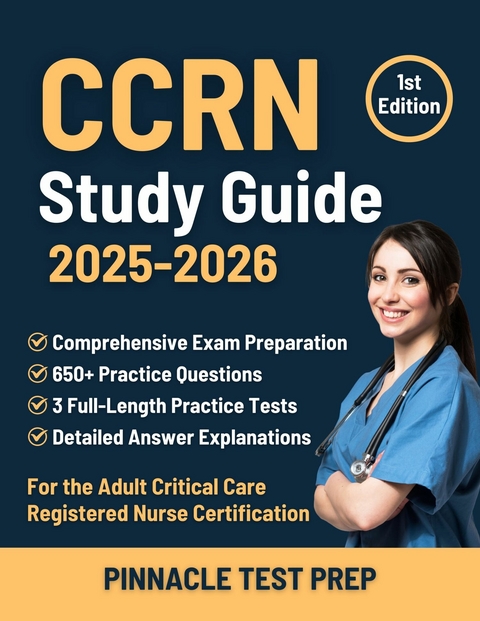
CCRN Study Guide 2025-2026 (eBook)
464 Seiten
Publishdrive (Verlag)
978-0-00-075516-2 (ISBN)
CCRN Study Guide 2025-2026: Your Ultimate Resource for Critical Care Nursing Certification Success
Master the CCRN exam with confidence-even with the most challenging critical care concepts.
Are you a critical care nurse preparing for the CCRN certification? Looking for a comprehensive study resource that covers everything from cardiovascular emergencies to ethical practice? The CCRN Study Guide 2025-2026 from Pinnacle Test Prep delivers exactly what you need to pass your exam on the first attempt.
This meticulously researched study guide is designed specifically for adult critical care nurses seeking certification. Inside, you'll find:
In-depth coverage of all clinical judgment content areas including cardiovascular, pulmonary, neurological, renal, gastrointestinal, endocrine, hematology/immunology, and multisystem topics
Detailed explanations of complex concepts presented in clear, concise language that's easy to understand and retain
Three complete practice tests with 150 questions each to build your confidence and identify knowledge gaps
Step-by-step analysis of ECG rhythms, hemodynamic monitoring, and arterial blood gas interpretation
Evidence-based pharmacological interventions for critical care scenarios
Visual aids, diagrams, and memory tools to help you master difficult concepts
Test-taking strategies specifically designed for the CCRN exam format
Whether you're a first-time test taker or looking to renew your certification, this guide provides the focused review you need. Each chapter builds your knowledge systematically, from basic principles to advanced applications, ensuring you're prepared for every aspect of the exam.
Don't risk your certification with outdated or incomplete study materials. The CCRN Study Guide 2025-2026 reflects the latest AACN test plan and critical care nursing standards, giving you the most current preparation available.
Click Now to take the first step toward CCRN certification and advancing your critical care nursing career!
Chapter 3: Cardiovascular System
Anatomy and Physiology Review
Cardiac Structure and Function
T
he heart is a four-chambered muscular organ located in the mediastinum. It functions as two parallel pumps: the right side receives deoxygenated blood from the body and pumps it to the lungs, while the left side receives oxygenated blood from the lungs and pumps it to the systemic circulation.
Chambers and Valves: The atria are thin-walled receiving chambers that contract to fill the ventricles. The ventricles are thick-walled pumping chambers that eject blood into the pulmonary and systemic circulations. Four valves ensure unidirectional blood flow: tricuspid (right AV), pulmonary (right semilunar), mitral (left AV), and aortic (left semilunar).
Cardiac Wall Layers: The heart wall consists of three layers: endocardium (inner lining), myocardium (middle muscular layer), and epicardium (outer layer). The heart is enclosed in a fibrous sac called the pericardium.
Coronary Circulation: The heart receives its blood supply through the coronary arteries, which originate from the aortic root. The left main coronary artery divides into the left anterior descending (LAD) and circumflex arteries, while the right coronary artery supplies the right ventricle and, in most people, the inferior wall of the left ventricle and SA node.
Cardiac Conduction System
The specialized conduction system coordinates electrical impulses to ensure efficient contraction:
Sinoatrial (SA) Node: The primary pacemaker, located in the right atrium near the superior vena cava, generates impulses at 60-100 beats per minute.
Atrioventricular (AV) Node: Located in the interatrial septum, delays impulses before transmission to the ventricles, allowing atrial contraction to precede ventricular contraction.
Bundle of His and Purkinje Fibers: Rapidly conduct impulses through the ventricles, ensuring coordinated contraction from apex to base.
Cardiac Action Potential: Consists of five phases (0-4) involving sodium, calcium, and potassium ion movements across cell membranes. Different cardiac tissues have distinct action potential characteristics, affecting their response to medications and pathological conditions.
Cardiac Cycle and Hemodynamics
The cardiac cycle consists of systole (contraction) and diastole (relaxation) phases:
Systole: Ventricular contraction ejects blood into the pulmonary and systemic circulations. Characterized by isovolumetric contraction followed by ejection.
Diastole: Ventricular relaxation allows filling from the atria. Includes isovolumetric relaxation, rapid filling, diastasis, and atrial contraction.
Heart Sounds: S1 (lub) occurs with AV valve closure at the beginning of systole. S2 (dub) occurs with semilunar valve closure at the beginning of diastole. S3 and S4 are extra sounds that may indicate pathology.
Cardiac Output (CO): The volume of blood pumped by the heart per minute (CO = HR × SV). Normal range is 4-8 L/min.
Determinants of Cardiac Output:
- Preload: End-diastolic volume that stretches the ventricle before contraction (Frank-Starling mechanism)
- Afterload: Resistance against which the ventricle must pump
- Contractility: Force of myocardial contraction independent of preload
- Heart rate: Number of contractions per minute
Autonomic Regulation
Sympathetic Stimulation: Increases heart rate, contractility, and conduction velocity through β1-adrenergic receptors. Effects include increased cardiac output, blood pressure, and myocardial oxygen demand.
Parasympathetic Stimulation: Decreases heart rate and AV conduction through muscarinic receptors. Predominates at rest, providing a cardioprotective effect by reducing myocardial oxygen consumption.
Assessment and Diagnostic Procedures
Cardiovascular History and Examination
Key History Elements:
- Chest pain characteristics (onset, location, quality, radiation, timing, severity, aggravating/alleviating factors)
- Dyspnea (at rest, with exertion, orthopnea, paroxysmal nocturnal dyspnea)
- Palpitations, syncope, fatigue, edema
- Risk factors (hypertension, diabetes, smoking, hyperlipidemia, family history)
- Medication history and allergies
Physical Examination:
- Vital signs: Blood pressure, heart rate, respiratory rate, oxygen saturation
- Inspection: Skin color, jugular venous distention, edema, chest deformities
- Palpation: Apical impulse, thrills, heaves
- Auscultation: Heart sounds, murmurs, rubs, gallops
- Peripheral pulses: Rate, rhythm, quality, symmetry
Advanced Assessment Techniques:
- Jugular venous pressure assessment for right heart function
- Hepatojugular reflux test for right ventricular function
- Orthostatic vital sign measurement for volume status
- Lung examination for signs of heart failure
Diagnostic Studies
Electrocardiogram (ECG):
- 12-lead ECG records electrical activity from multiple angles
- Evaluates rate, rhythm, axis, intervals, and evidence of ischemia, injury, or infarction
- Continuous monitoring detects intermittent arrhythmias
Cardiac Biomarkers:
- Troponin I and T: Specific for myocardial injury, elevated 3-4 hours after injury
- CK-MB: Less specific but useful for reinfarction detection
- BNP/NT-proBNP: Elevated in heart failure, correlates with severity
Imaging Studies:
- Echocardiography: Assesses chamber size, wall motion, valvular function, ejection fraction
- Stress testing: Evaluates for ischemia during increased cardiac demand
- Cardiac catheterization: Directly visualizes coronary arteries and measures pressures
- CT angiography: Non-invasive coronary artery visualization
- Cardiac MRI: Evaluates tissue characteristics, perfusion, and function
Hemodynamic Monitoring:
- Arterial line: Continuous blood pressure monitoring
- Central venous pressure: Right heart filling pressures
- Pulmonary artery catheter: Measures cardiac output, pulmonary pressures, SVR, PVR
Common Cardiovascular Disorders
Coronary Artery Disease (CAD)
Pathophysiology: Progressive narrowing of coronary arteries due to atherosclerotic plaque formation. Risk factors include hypertension, diabetes, smoking, hyperlipidemia, family history, age, and male gender.
Clinical Presentation:
- Stable angina: Predictable chest pain with exertion, relieved by rest or nitroglycerin
- Unstable angina: New-onset, increasing, or rest angina
- Silent ischemia: Myocardial ischemia without symptoms
Diagnostic Evaluation:
- ECG: May show ST-segment depression or T-wave inversion during ischemia
- Stress testing: Exercise or pharmacological stress with ECG, echocardiography, or nuclear imaging
- Coronary angiography: Gold standard for defining coronary anatomy
Management Strategies:
- Risk factor modification: Smoking cessation, lipid management, blood pressure control
- Pharmacotherapy: Antiplatelet agents, statins, beta-blockers, nitrates, calcium channel blockers
- Revascularization: Percutaneous coronary intervention (PCI) or coronary artery bypass grafting (CABG)
Acute Coronary Syndromes (ACS)
Pathophysiology: Sudden reduction in coronary blood flow due to plaque rupture, thrombosis, vasospasm, or increased oxygen demand.
Clinical Presentation:
- Chest pain: Often severe, crushing, radiating to jaw/arm, associated with diaphoresis, nausea
- Dyspnea, fatigue, lightheadedness, syncope
- Atypical presentations common in women, elderly, and diabetic patients
Initial Assessment:
- Rapid evaluation with focused history and physical examination
- Immediate 12-lead ECG (within 10 minutes of arrival)
- Cardiac biomarkers (troponin)
- Risk stratification using validated tools (TIMI, GRACE scores)
Diagnostic Evaluation:
- Serial ECGs to detect evolving changes
- Serial cardiac biomarkers to detect myocardial injury
- Echocardiography to assess wall motion abnormalities
- Coronary angiography to define coronary anatomy
Management:
- STEMI: Immediate reperfusion with primary PCI (preferred if available within 90 minutes) or fibrinolytic therapy
- NSTEMI/UA: Risk-stratified approach with early invasive strategy for high-risk patients
- Pharmacotherapy: Antiplatelet agents, anticoagulants, beta-blockers, ACE inhibitors, statins
- Supportive care: Oxygen (if hypoxemic), pain management, treatment of complications
Secondary Prevention and Rehabilitation:
- Antiplatelet therapy: Aspirin indefinitely, P2Y12 inhibitor (duration based on stent type and bleeding risk)
- Beta-blockers: Reduce mortality and reinfarction risk
- ACE inhibitors/ARBs: Particularly beneficial for anterior MI, LV dysfunction, or heart failure
- Statins: High-intensity therapy regardless of baseline lipid levels
- Aldosterone antagonists: For patients with LV dysfunction and heart failure
Risk Factor...
| Erscheint lt. Verlag | 5.3.2025 |
|---|---|
| Sprache | englisch |
| Themenwelt | Medizin / Pharmazie ► Pflege |
| ISBN-10 | 0-00-075516-8 / 0000755168 |
| ISBN-13 | 978-0-00-075516-2 / 9780000755162 |
| Informationen gemäß Produktsicherheitsverordnung (GPSR) | |
| Haben Sie eine Frage zum Produkt? |
 EPUB (Adobe DRM)
Größe: 8,2 MB
Kopierschutz: Adobe-DRM
Adobe-DRM ist ein Kopierschutz, der das eBook vor Mißbrauch schützen soll. Dabei wird das eBook bereits beim Download auf Ihre persönliche Adobe-ID autorisiert. Lesen können Sie das eBook dann nur auf den Geräten, welche ebenfalls auf Ihre Adobe-ID registriert sind.
Details zum Adobe-DRM
Dateiformat: EPUB (Electronic Publication)
EPUB ist ein offener Standard für eBooks und eignet sich besonders zur Darstellung von Belletristik und Sachbüchern. Der Fließtext wird dynamisch an die Display- und Schriftgröße angepasst. Auch für mobile Lesegeräte ist EPUB daher gut geeignet.
Systemvoraussetzungen:
PC/Mac: Mit einem PC oder Mac können Sie dieses eBook lesen. Sie benötigen eine
eReader: Dieses eBook kann mit (fast) allen eBook-Readern gelesen werden. Mit dem amazon-Kindle ist es aber nicht kompatibel.
Smartphone/Tablet: Egal ob Apple oder Android, dieses eBook können Sie lesen. Sie benötigen eine
Geräteliste und zusätzliche Hinweise
Buying eBooks from abroad
For tax law reasons we can sell eBooks just within Germany and Switzerland. Regrettably we cannot fulfill eBook-orders from other countries.
aus dem Bereich