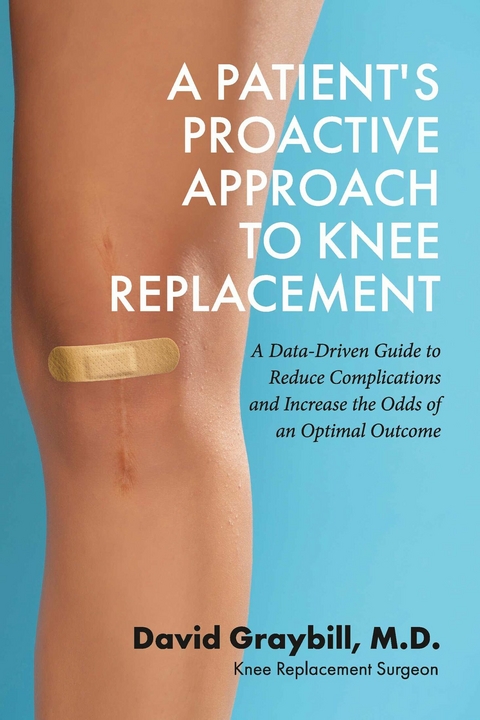
Patient's Proactive Approach to Knee Replacement (eBook)
272 Seiten
Bookbaby (Verlag)
979-8-3178-0771-9 (ISBN)
I am a retired orthopedic surgeon who specialized in hip and knee replacement. I trained in Chicago and practiced in the Indianapolis are for approximately 31 years. I currently live in Miami with my wife, Jianan who is also a physician.
Why you should read this book. Knee replacement is a procedure in which the patient plays a significant role in determining the outcome. Patient satisfaction is generally lower in Total Knee Replacement compared to Total Hip Replacement. Several factors contribute to this, one of the most important being a clear understanding of the likely outcomes and effective communication surrounding the surgical process. In my opinion, achieving an optimal outcome requires that the patient understands what will happen, acknowledges their important role in the result (not just the surgeon's), and maintains realistic expectations. Moreover, complications can be challenging to manage, and preoperative optimization gives the patient the best chance of avoiding problems. If you're the type of person willing to invest some time and effort not only in recovery but also in preparation before the procedure, then I believe you will find this book helpful. Why did I write this book?I spent the last thirty years of my life in a busy private practice. Over the past twenty years, my elective practice focused exclusively on hip and knee replacements, during which I performed thousands of these surgeries. Additionally, I am a patient myself, having undergone bilateral knee replacements. This dual experience, both as a surgeon and a patient, gives me a unique perspective. Recently retired, I continue to have a strong desire to help patients. This book is not intended to replace your physician's guidance but to enhance your understanding of how your lifestyle choices can positively or negatively impact an upcoming surgery. In my experience, when I scheduled patients for surgery, it was often an emotional time for them. As a result, many patients may have missed important details of my instructions. This book is meant to supplement those conversations. After reading this book, you should have a better understanding of knee anatomy and the general knee replacement procedure, enabling you to ask the right questions. We will discuss factors linked to increased risk of complications, as identified in medical literature, and how you can address these modifiable risk factors. We will cover both the preoperative and postoperative periods to ensure you have a solid understanding and realistic expectations. There is an interlude that discusses satisfaction and provides objective statistical outcomes to help provide a solid framework for patient expectations. The final section will focus on caring for your knee replacement. I have reviewed many other books on knee replacement, and I believe this book offers a different approach. It goes beyond rehabilitation, addressing the entire continuum from diagnosis to long after surgery. By the end of this book, you should have a strong foundation of knowledge and realistic expectations. I am hopeful that this will lead to greater patient satisfaction and help minimize complications. If this approach resonates with you, please read on!
Result Detail 2.14
Knee Replacement partial and total:
-
Partial Knee Replacement
This is an AP and Lateral Xray of a medial unicompartmental knee replacement. Two of the compartments and the central ligaments are unaffected.
Also called unicompartmental knee replacement, this procedure involves replacing one of the three compartments of the knee (there is also a bicompartmental implant available). The medial compartment is the one that is most often replaced, though there are implants for the lateral and patellofemoral compartments as well. The main indication for this procedure is severe arthritis in only one compartment. Clinical outcomes are very good, and patient satisfaction is often higher than with total knee replacement. 51
This increase satisfaction may be because all central knee ligaments are preserved, allowing the mechanical function to remain closer to that of a natural knee. However, the durability of unicompartmental knee replacements tends to be shorter than that of total knee replacements, often requiring another surgery sooner. 52 In very well selected patients, the longevity of a partial or unicompartmental knee replacement can be excellent.
One reason for early failure of unicompartmental knee replacement is the progression of arthritis in the other compartments. Implant durability today is generally quite good. The recovery time is also generally shorter than with total knee replacement, as it is a smaller intervention. The physiologic impact on the patient is somewhat less (less blood loss etc.) However, not every patient is a candidate for this procedure. The literature suggests that approximately fifteen to twenty percent of patients may be ideal candidates, typically those with arthritis limited to only one compartment of the knee and with intact ligaments. Some surgeons have a broader selection criterion and yet maintain excellent outcomes.
The implants that I am most familiar with (and used frequently — not an endorsement of a particular company!) are the Oxford, and the MAKO. Both have excellent survival rates.
Partial knee replacements have become more reliable and more common with modern implants and techniques, including robotic-assisted surgery.
This is an x-ray of a medial unicompartmental knee replacement.
-
Total Knee Replacement
In a total knee replacement, an anterior incision is made over the knee. The incision is typically four to six inches in length with the knee straight, though it may be longer if the patient is overweight or has a large bone size. During the procedure, the ends of the femur and tibia are resurfaced by removing about eight to nine millimeters of bone and remaining cartilage from each surface.
The femoral implant is a one-piece metal component, usually made of cobalt chrome, a scratch-resistant alloy. The tibial component is typically a modular two-piece device. The metal tibial tray, usually made of titanium (a bone-friendly metal but too soft for use as a bearing), is attached to the bone. A high molecular weight polyethylene (a type of plastic) insert, with several thickness options, is then locked into the tibial tray. This plastic insert articulates with the femoral metal implant, and the different thicknesses allow for soft tissue balancing, ensuring that the postoperative knee joint isn’t too loose or too tight. There are some one-piece tibial components, but they are used less frequently since the surgeon must commit to a thickness before the end of the procedure.
As for the patella, current practice has been trending toward less frequent resurfacing, particularly in younger patients with normal patellar cartilage. This is because studies show that a significant percentage of complications involve the patella when it is resurfaced, and outcomes are similar whether the patella is resurfaced or un-resurfaced. However, there is still ongoing debate in the literature about when to perform patellar resurfacing. Another factor contributing to this trend is recent literature on medial partial knee replacement, which suggests that patellar arthritis can often be ignored unless it is severe on the lateral side of the patella. Here are some photos:
First an Xray of a total knee
X-ray of Total Knee Replacement on the right.
Here are two photos of sample implants
The femoral implants are on the right. The left side is the tibia.
FURTHER DETAIL ON KNEE REPLACEMTS:
How Long will a total knee replacement last?
Data from a meta-analysis of national registry data from Australia and Finland showed the following re-operation-free survival rates for total knee replacement: ninety-three percent at fifteen years, ninety percent at twenty years, and eighty-two percent at twenty-five years. For partial knee replacement, the re-operation-free survival rates were seventy-six percent at fifteen years, seventy-two percent at twenty years, and seventy percent at twenty-five years. 53 Widespread use of the newer cross-linked polyethylene is well under twenty years, so this data is mostly on older bearing types. The literature consistently shows lower amounts of wear in cross-linked polyethylene, so that likely (not certainly) will translate into longer implant survival. 54 There is an increase in brittleness of polyethylene after cross linking. Most studies have shown equal or higher survival rates in cross linked polyethylene knees, the following study was registry based minimum ten year follow up and showed lower failure rate with the newer polyethylene. This study was performed in Australia and Finland, not in the USA. The findings are reassuring that any mechanical weakening in the process is unlikely to be clinically impactful. 55
These survival rates are longer than what surgeons have generally expected. Both Australia and Finland have socialized healthcare systems, where the threshold to offer surgery might differ from what we see in elderly patients in the USA. Nonetheless, knee replacements are statistically quite durable.
How and why do knee replacements fail?
Early failures are mostly infection related. The next section of the book titled “Optimization as a Way to Reduce the Risks of Early Complications” is primarily based towards helping patients avoid infection and wound issues. There is also discussion on avoiding stiffness, maximizing range of motion and getting the best pain control after surgery. Prosthetic infection rates are low, generally less than one percent at one year post op -in healthy patients, but they are devastating. The literature quotes a rate of 0.51 percent at one year increasing up to 1.4 percent by two years. Some sites have documented even lower infection risk. 56 Infections also are associated with higher rates of five-year mortality (see refence under Deep Infection in section III). Late infections do occur but are much less frequent in most studies. 57
Late failures are typically caused by wear of the polyethylene, loosening, and instability. Instability is becoming a more common cause of intermediate and late failure. One contributing factor may be that patients today are much more active after knee replacement compared to historical data, where patients were primarily walking and more sedentary. The failure rate due to wear issues is decreasing, likely due to improvements in the durability of the polyethylene. In the last section of this book, titled “How to Care for Your Knee Replacement,” I will cover late failures in more Detail.
What are the current ways that surgeons use to align a knee replacement? (This also applies to partial knee replacement)
There are three primary techniques in use today.
-
Standard Instrumentation:
This technique involves the surgeon selecting a fixed angle to cut both the tibia and femur. On the femoral side, typically a rod is placed into the shaft of the femur to determine the angle of the cut. The thickness is chosen, and a cutting block is pinned to the bone, allowing the saw to make the cuts for the femoral component. Rotation of the femur can be adjusted in several different ways.
On the tibial side, either an intramedullary rod or an extramedullary guide (clamped at the ankle) can be used to determine the cutting angle. In either case, a cutting block is pinned to the proximal tibia, and the saw is used to cut the bone. The range of accuracy for these cuts is typically within about three degrees in any direction for each bone. 58
In rare cases where maximum error occurs in the same direction, the knee alignment could be off by as much as six degrees from the intended position, though this is uncommon.
Surgeon making a tibial cut with standard instrumentation.
-
Navigation:
This technique uses either several cameras or an accelerometer to determine the hip center. Once the hip center is established, a cutting block is pinned in place to guide the saw for bone cuts. The advantage of this method is the wide choice of angles it offers, which can accommodate various situations, such as a previous fracture with residual deformity.
Additionally, the accuracy is superior. In a study, twenty-five percent of knees operated on with standard instrumentation deviated more than three degrees from the plan, compared to only about eight percent in the navigated group. Furthermore, there were no extreme outliers in the navigated group. 59Other studies have demonstrated similar accuracy across different types of navigation systems....
| Erscheint lt. Verlag | 8.10.2025 |
|---|---|
| Sprache | englisch |
| Themenwelt | Medizin / Pharmazie ► Medizinische Fachgebiete ► Orthopädie |
| ISBN-13 | 979-8-3178-0771-9 / 9798317807719 |
| Informationen gemäß Produktsicherheitsverordnung (GPSR) | |
| Haben Sie eine Frage zum Produkt? |
 EPUB (Ohne DRM)
Größe: 8,9 MB
Digital Rights Management: ohne DRM
Dieses eBook enthält kein DRM oder Kopierschutz. Eine Weitergabe an Dritte ist jedoch rechtlich nicht zulässig, weil Sie beim Kauf nur die Rechte an der persönlichen Nutzung erwerben.
Dateiformat: EPUB (Electronic Publication)
EPUB ist ein offener Standard für eBooks und eignet sich besonders zur Darstellung von Belletristik und Sachbüchern. Der Fließtext wird dynamisch an die Display- und Schriftgröße angepasst. Auch für mobile Lesegeräte ist EPUB daher gut geeignet.
Systemvoraussetzungen:
PC/Mac: Mit einem PC oder Mac können Sie dieses eBook lesen. Sie benötigen dafür die kostenlose Software Adobe Digital Editions.
eReader: Dieses eBook kann mit (fast) allen eBook-Readern gelesen werden. Mit dem amazon-Kindle ist es aber nicht kompatibel.
Smartphone/Tablet: Egal ob Apple oder Android, dieses eBook können Sie lesen. Sie benötigen dafür eine kostenlose App.
Geräteliste und zusätzliche Hinweise
Buying eBooks from abroad
For tax law reasons we can sell eBooks just within Germany and Switzerland. Regrettably we cannot fulfill eBook-orders from other countries.
aus dem Bereich