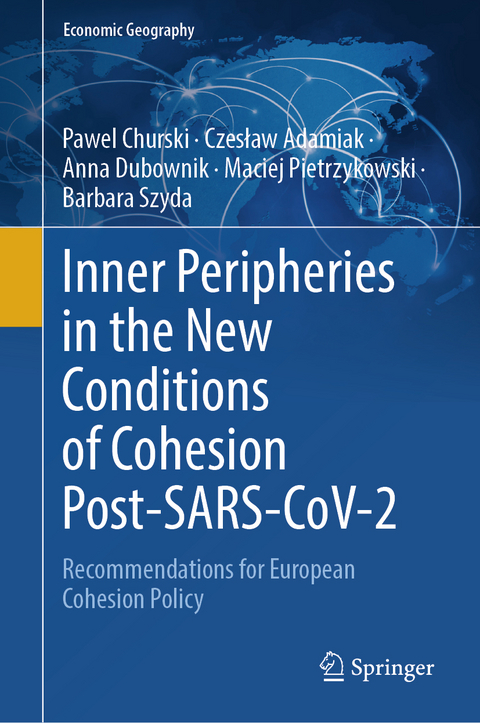
Inner Peripheries in the New Conditions of Cohesion Post-SARS-CoV-2
Springer International Publishing (Verlag)
978-3-032-10935-4 (ISBN)
- Noch nicht erschienen - erscheint am 24.01.2026
- Versandkostenfrei
- Auch auf Rechnung
- Artikel merken
The book highlights the significance of a distinct category of underdeveloped areas, known as the inner periphery, in understanding contemporary spatial disparities in socio-economic development and the challenges posed to future cohesion policy. The origins, conditions, and evolving disparities in regional development are frequently analyzed from the perspectives of economics and economic geography, where effective strategies for achieving spatial convergence in social and economic development are explored. This book contributes to this ongoing dialogue by focusing on persistently marginalized areas, commonly referred to as inner peripheries in relevant literature. These areas are widespread across Europe, regardless of a country s or region s development level. The peripheral status of these areas is primarily due to their limited connectivity with surrounding environments, which significantly impacts their developmental processes. In recent years, numerous significant developmental shocks have occurred, one of which is the SARS-CoV-2 pandemic. These shocks have shaped the social and economic consequences that affect local development in specific areas. These consequences are likely to alter the characteristics of the territorial capital of individual 4 areas, the condition of public finances, and the local development policies influencing them. The book's objective is to present research findings on the patterns of socio-economic development changes in selected inner peripheries, particularly focusing on their vulnerability and resilience to the impacts of the SARSCoV-2 crisis. It also aims to offer recommendations for modifying the directions and methods of implementing development policy interventions. The research results from Poland, the largest beneficiary of European cohesion policy, serve as a foundation for proposing recommendations regarding the challenges of targeting development intervention post-2027.
PAWEL CHURSKI, Professor of Social Science, Habilitation in Earth Sciences (Economic Geography), PhD in Earth Sciences (Economic Geography), specialisms: Socio-Economic Geography, Spatial Management, Regional Growth, Regional Policy. He is an economic geographer working at the Faculty of Human Geography and Planning, Adam Mickiewicz University Poznan (Poland), now holds the position of the Dean of Faculty, and since 2009, the Head of the Regional and Local Studies Department. He has the honour and pleasure of working in the Spatial Planning Committee of the Polish National Academy of Sciences framework, acting in its structure as the Vice-President. He is active in the Union of Universities for the Development of Spatial Management Programs, chairing its Executive Team and coordinating the work of the group focused on improving educational programs. He is a member, among others, of the Association of European Schools of Planning (AESOP), the European Regional Studies Association - Polish Section (ERSA), and the American Association of Geographers. He has authored over 250 scientific publications, including 15 monographs and 26 editorials of collective works. His research interests include issues of local and regional development in Poland and Europe, particularly related to climate change and the just transition process, transformations of development factors and regional policy in Poland and the European Union, as well as the challenges of responsible research and innovation, including the role of universities in their implementation. He applies econometrics and geographic information systems to spatial analyses, exploring living standards, quality of life, and labour market conditions during the socio-economic transformation period in Poland and Europe.
CZESLAW ADAMIAK, PhD in geography, is an associate professor in the Department of Spatial Planning and Tourism, Faculty of Earth Sciences and Spatial Management, at the Nicolaus Copernicus University in Torun. He now holds the vice-dean position of the Faculty of Earth Sciences and Spatial Management, managing education in geography, spatial planning, urban studies and tourism. Previously, he worked as a researcher and visiting lecturer at Umeå University (Sweden) and the University of Eastern Finland in Joensuu. His research fields include tourism geography, regional development, and applying geographic information systems and big data in social sciences. He has authored papers in leading international interdisciplinary journals in spatial planning (Landscape and Urban Planning) and tourism (Annals of Tourism Research, Journal of Travel Research, Tourism Geographies). He has participated in several international and domestic research and applied projects related to tourism and development policy.
ANNA DUBOWNIK, is a socio-economic geographer at the Faculty of Earth Sciences and Spatial Management, Nicolaus Copernicus University in Torun, Poland. Her research focuses on local and regional development, with particular emphasis on the impact of European Union funds on urban and rural transformation processes. She has extensive experience in both desk and field research on post-industrial areas, especially in relation to disparities in human and social capital development. She has been involved in the preparation of local government development strategies and has facilitated social consultations related to strategic planning. Beyond academia, she serves as Vice President of a regional association promoting active lifestyles across all age groups and fostering gender equality in science and education. Her engagement with non-governmental organizations provides her with a grounded perspective on local development processes.
MACIEJ PIETRZYKOWSKI, PhD is an Assistant Professor at the International Competitiveness Department of the Institute of International Business and Economics, Poznan University of Economics and Business. His work has long focu
Introduction.- Inner peripheries in contemporary spatial development differences.- Navigating Shocks.- A theoretical conceptual model and its application in researching inner peripheries.- Inner peripheries in Poland.- Development processes of the inner periphery in the period of development shocks.- Conclusions and Recommendations.
| Erscheinungsdatum | 29.11.2025 |
|---|---|
| Reihe/Serie | Economic Geography |
| Zusatzinfo | IX, 396 p. 49 illus., 47 illus. in color. |
| Verlagsort | Cham |
| Sprache | englisch |
| Maße | 155 x 235 mm |
| Themenwelt | Medizin / Pharmazie ► Medizinische Fachgebiete ► Arbeits- / Sozial- / Umweltmedizin |
| Naturwissenschaften ► Geowissenschaften ► Geografie / Kartografie | |
| Schlagworte | european cohesion • Functional urban areas • Socio-Economic Development • Socio-Economics • Territorial Cohesion |
| ISBN-10 | 3-032-10935-3 / 3032109353 |
| ISBN-13 | 978-3-032-10935-4 / 9783032109354 |
| Zustand | Neuware |
| Informationen gemäß Produktsicherheitsverordnung (GPSR) | |
| Haben Sie eine Frage zum Produkt? |
aus dem Bereich