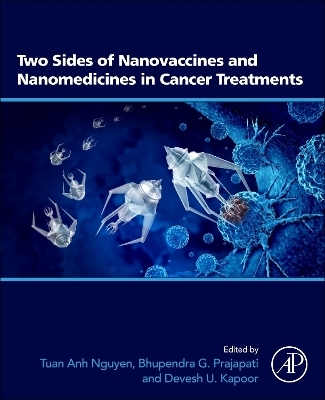
Two Sides of Nanovaccines and Nanomedicines in Cancer Treatments
Academic Press Inc (Verlag)
978-0-443-44579-8 (ISBN)
- Noch nicht erschienen (ca. April 2026)
- Versandkostenfrei
- Auch auf Rechnung
- Artikel merken
Tuan Anh Nguyen is a Senior Principal Research Scientist at the Institute for Tropical Technology, Vietnam Academy of Science and Technology, Hanoi, Vietnam. He received a BS in physics from Hanoi University in 1992, a BS in economics from Hanoi National Economics University in 1997, and a PhD in chemistry from the Paris Diderot University, France, in 2003. He was a Visiting Scientist at Seoul National University, South Korea, in 2004, and the University of Wollongong, Australia, in 2005. He then worked as a Postdoctoral Research Associate and Research Scientist at Montana State University, United States in 2006-09. In 2012 he was appointed as the Head of the Microanalysis Department at the Institute for Tropical Technology. His research areas of interest include smart sensors, smart networks, smart hospitals, smart cities, complexiverse, and digital twins. He has edited more than 74 books for Elsevier, 12 books for CRC Press, 1 book for Springer, 1 book for RSC, and 2 books for IGI Global. He is the Editor-in-Chief of Kenkyu Journal of Nanotechnology & Nanoscience. Dr. Bhupendra Gopalbhai Prajapati is a Professor (Research Cadre) at Parul Institute of Pharmacy, Parul University, Gujarat, India. He is also acting as Adjunct Professor at Department of Industrial Pharmacy, Faculty of Pharmacy, Silpakorn University, Thailand. With over 22 years of experience in academia, research, and industry, he specializes in lipid-based formulations, nano/microparticulate drug delivery, and bioavailability enhancement. A recipient of several prestigious awards including the AICTE Young Teacher Award and Ganpat University's Staff Excellence honors, Dr. Prajapati has published over 350 research/review papers, and has contributed to more than 170 book chapters. He actively mentors Ph.D. and PG scholars and serves as editor or section editor for several international publications in pharmaceutical sciences. Dr. Devesh U. Kapoor is currently serving as a Professor at Dr. Dayaram Patel Pharmacy College, Bardoli, District Surat, Gujarat. The institution is funded by the Directorate of Technical Education (DTE), Government of Gujarat, and is affiliated with Gujarat Technological University. Dr. Kapoor is alumnus of University of Rajasthan, Jaipur and Department of Pharmaceutics, BN College of Pharmacy, Rajasthan University of Health Sciences, Jaipur, Rajasthan, India. He was awarded a Ph.D. in Pharmaceutical Sciences in 2013. Dr. Kapoor serves as an Associate Editor for Naunyn-Schmiedebergs Archives of Pharmacology (Springer Nature), Future Journal of Pharmaceutical sciences (Springer Open), Scientific Reports (Springer Nature), Recent Advances in Drug Delivery & Formulation (Bentham Science) and PLOS One, Frontiers in Medicine - Precision Medicine and Frontiers in surgery. He is a Consulting Editor for Cytotechnology (Springer). He has peer-reviewed manuscripts for approximately 135 prestigious journals from publishers such as Elsevier, MDPI, Springer, Wiley, Frontiers, Dove Press, Bentham Science, Taylor & Francis, Wolters Kluwer (Medknow), and De Gruyter. With over 20 years of experience in teaching and academic administration, Dr. Kapoor has published more than 175 research and review articles in reputed national and international journals. In addition to his editorial responsibilities, Dr. Kapoor is currently editing 18 international books with publishers such as Elsevier, Springer, Wiley, Taylor & Francis, CRC Press, RSC. He has also contributed 50 book chapters published by renowned publishers including Elsevier, Bentham Science, MDPI, Springer, RSC and Wiley. He is currently supervising four Ph.D. students, focusing on nanodrug delivery systems and modified drug release from Gujarat Technological University, Ahemdabad. He fetched research and event organization grants from various government bodies including the Gujarat Council of Science & Technology (GUJCOST), Gujarat State Biotechnology Mission (GSBTM), and AICTE-ATAL for national seminars and faculty development programs. Dr. Kapoor holds 8 design patents and has delivered over 20 expert talks. He is frequently invited to speak at scientific sessions in national conferences, seminars, and workshops.
Part 1: Fundamentals
1. Introduction to nanovaccine in cancer treatments
2. Introduction to nanomedicine in cancer treatments
3. Sensors for Cancer Detection
4. Current Perspectives of Nanomedicines (in Cancer Treatment)
5. Current Perspectives of Nanovaccines and Nanomedicines (in Cancer Treatment)
Part 2: Advantage and Application of Nanovaccine and Nanomedicine
6. Advantage of cancer Nanomedicine
7. Advantage of Targeted Nanomedicine (in Cancer Treatment)
8. Advantage of nanovaccine (in cancer treatment)
9. Nanovaccines and Nanomedicines in cancer treatment: Current Landscape
Part 3: The Other Side of Nanovaccine and Nanomedicine
10. Side Effect and Toxicity of Nanovaccine (in Cancer Treatment)
11. Side effect and toxicity of nanomedicine (in cancer treatment)
12. Crossing the Barrier, Crossing the Line: Neurotoxicity of Nanomedicines in Brain Cancer Therapy
13. Side effects and toxicity of nanoparticles in cancer treatment
14. Toxicity of Metal Oxide Nanoparticles in Nanomedicine. Mechanisms and Implications
15. Nanotoxicity, safety assessment, regulatory aspect and clinical trial of nanovaccines/nanomedicine
16. Nanotoxicity/nano-genotoxicity in cancer care
17. Toxicity evaluation and management for nanoparticles used in the cancer therapy
18. Nanoparticle Toxicity in Cancer Nanomedicine
Part 4: Challenge and Perspectives
19. Nano-medicines and Nano-vaccines Manufacturing
20. Ethics in Nanomedicine and Nanovaccine in Cancer Treatment
21. Ethics in Cancer Nanomedicine
22. Ethics and regulations in nanomedicine/nanovaccines
23. Regulating nanomedicine: challenges and opportunities
24. Safety Assessment for Nanomedicines and Nanovaccines
25. Manufacturing of nanomedicine/nanovaccine on Large Scale: Challenges and Issues
26. Future perspectives of nanovaccines and nanomedicines
| Erscheint lt. Verlag | 1.4.2026 |
|---|---|
| Verlagsort | San Diego |
| Sprache | englisch |
| Maße | 216 x 276 mm |
| Gewicht | 450 g |
| Themenwelt | Studium ► Querschnittsbereiche ► Infektiologie / Immunologie |
| Studium ► Querschnittsbereiche ► Prävention / Gesundheitsförderung | |
| ISBN-10 | 0-443-44579-6 / 0443445796 |
| ISBN-13 | 978-0-443-44579-8 / 9780443445798 |
| Zustand | Neuware |
| Informationen gemäß Produktsicherheitsverordnung (GPSR) | |
| Haben Sie eine Frage zum Produkt? |
aus dem Bereich