


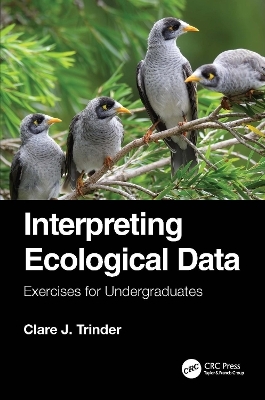
Interpreting Ecological Data
Exercises for Undergraduates
Seiten
2026
CRC Press (Verlag)
978-1-041-08174-6 (ISBN)
CRC Press (Verlag)
978-1-041-08174-6 (ISBN)
- Noch nicht erschienen (ca. April 2026)
- Versandkostenfrei
- Auch auf Rechnung
- Artikel merken
With over 70 exercises containing more than 270 questions, Interpreting Ecological Data allows students to apply ecological theory learned in classes to ‘real’ data from the scientific literature. Rather than simply rote learning word-perfect answers, they're empowered to apply their knowledge and develop critical thinking skills.
With over 70 exercises containing more than 270 questions, Interpreting Ecological Data: Exercises for Undergraduates allows students to apply ecological theory learned in classes to new, ‘real’ data from the scientific literature. Rather than simply rote learning word-perfect answers, students are empowered to apply their knowledge and develop critical thinking skills: core attributes for science undergraduates.
The book covers ecological principles such as predation, competition, mutualism, food webs and biogeochemical cycling. With numerous examples on each theme, students can gain plenty of practice across a wide range of topics, providing a solid foundation for their ecological knowledge and developing transferable skills in data interpretation. Almost all the exercises use ‘real’ data from published papers, sometimes messy and not always supporting the hypotheses they were designed to investigate—just like in real life! The answers are all included in the final chapter, with detailed explanations where relevant.
The exercises can also be used for assessment, enabling students to demonstrate their understanding, and lecturers can quickly convert them for use in lectures, workshops or assessments. Most importantly, Interpreting Ecological Data: Exercises for Undergraduates aims to stimulate student enthusiasm for ecology and what researchers actually do, starting an unexpected and exciting new journey.
With over 70 exercises containing more than 270 questions, Interpreting Ecological Data: Exercises for Undergraduates allows students to apply ecological theory learned in classes to new, ‘real’ data from the scientific literature. Rather than simply rote learning word-perfect answers, students are empowered to apply their knowledge and develop critical thinking skills: core attributes for science undergraduates.
The book covers ecological principles such as predation, competition, mutualism, food webs and biogeochemical cycling. With numerous examples on each theme, students can gain plenty of practice across a wide range of topics, providing a solid foundation for their ecological knowledge and developing transferable skills in data interpretation. Almost all the exercises use ‘real’ data from published papers, sometimes messy and not always supporting the hypotheses they were designed to investigate—just like in real life! The answers are all included in the final chapter, with detailed explanations where relevant.
The exercises can also be used for assessment, enabling students to demonstrate their understanding, and lecturers can quickly convert them for use in lectures, workshops or assessments. Most importantly, Interpreting Ecological Data: Exercises for Undergraduates aims to stimulate student enthusiasm for ecology and what researchers actually do, starting an unexpected and exciting new journey.
Clare J. Trinder is Emeritus Senior Lecturer in the School of Biological Sciences, University of Aberdeen, UK. She worked as a research plant ecologist from 2007 to 2011 at the University of Aberdeen in collaboration with the James Hutton Institute, and has practical experience in both national and international nature conservation as an environmental education officer and conservation officer.
Introduction. 1. Biodiversity 2. Communities and disturbance. 3. Energy, matter and decomposition.. 4. Intraspecific competition and life histories. 5. Interspecific competition. 6. Mutualism and parasitism. 7. Predation and herbivory. 8. Food webs & complex interactions. 9. Impacts of climate change. 10. References, answers and explanations.
| Erscheint lt. Verlag | 1.4.2026 |
|---|---|
| Zusatzinfo | 18 Tables, color; 79 Line drawings, color; 1 Halftones, color; 80 Illustrations, color |
| Verlagsort | London |
| Sprache | englisch |
| Maße | 156 x 234 mm |
| Themenwelt | Studium ► Querschnittsbereiche ► Epidemiologie / Med. Biometrie |
| Naturwissenschaften ► Biologie ► Ökologie / Naturschutz | |
| ISBN-10 | 1-041-08174-X / 104108174X |
| ISBN-13 | 978-1-041-08174-6 / 9781041081746 |
| Zustand | Neuware |
| Informationen gemäß Produktsicherheitsverordnung (GPSR) | |
| Haben Sie eine Frage zum Produkt? |
Mehr entdecken
aus dem Bereich



aus dem Bereich
Health Information for International Travel
Buch | Softcover (2025)
Oxford University Press Inc (Verlag)
CHF 85,50
ein überfälliges Gespräch zu einer Pandemie, die nicht die letzte …
Buch | Hardcover (2024)
Ullstein Buchverlage
CHF 34,95


