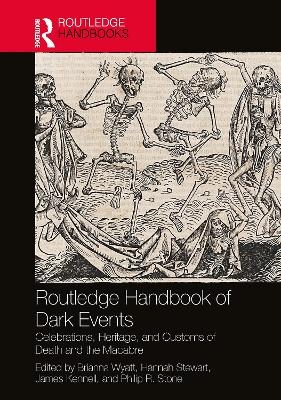
Routledge Handbook of Dark Events
Routledge (Verlag)
978-1-032-76670-6 (ISBN)
- Noch nicht erschienen (ca. März 2026)
- Versandkostenfrei
- Auch auf Rechnung
- Artikel merken
This handbook explores and critically evaluates key debates and controversies in the emerging field of Dark Events. It brings together leading specialists from a range of disciplinary backgrounds and geographical regions to provide state-of-the-art theoretical reflection and empirical research on celebrations, heritage and customs of death (events) and the macabre.
Divided into ten parts, the book explores traditions of dark festivals and events; the display of the dead; commemoration and authenticity within the context of dark events; dark events from the past; dark events in popular culture; controversial dark events; grief and memory; managing dark event experiences; decolonisation and equality for the dead; and dark event futures. This significant volume offers the reader a comprehensive synthesis of this emerging field, conveying the latest thinking and research. The text is international in focus, encouraging dialogue across disciplinary boundaries and areas of study, providing an invaluable resource for all those with an interest in Dark Events.
This is essential reading for students, researchers and academics of Dark Events, as well as those of related studies such as tourism, cultural studies, leisure, geography, sociology, death studies and museums.
Brianna Wyatt is an Assistant Professor in the Department of Tourism, Events, Entertainment and Attractions at the Rosen College of Hospitality Management, University of Central Florida, USA. She is also a Visiting Researcher for Oxford Brookes University, UK. Her publications, primary research interests and industry experience centre on interpretation and experience design in heritage and dark tourism. Brianna is a consulting academic, with her most recent work pertaining to interpretation and visitor experience development for penal heritage attractions in the UK. Hannah Stewart is a cultural events specialist and PhD candidate at the Institute for Dark Tourism Research (iDTR), University of Lancashire, UK. Her doctoral research critically examines Halloween heritage in Salem (USA) and Pendle (UK), exploring supernatural placemaking, cultural imperialism and the commodification of historical trauma through the lens of Dark Event Tourism. She has also designed, produced and delivered large-scale events across Canada, the UK and the Middle East. James Kennell is the Head of Surrey Hospitality and Tourism Management at the University of Surrey, UK, where he is also an Associate Professor in Events and Hospitality. His research explores issues associated with the relationships between the events, tourism and hospitality industries and society, and he has particular interests in the fields of policy and governance, political and protest events, dark tourism and exploration of events connected to conflict and tragedy. Philip R. Stone is the Director of the Institute for Dark Tourism Research (iDTR) at the University of Lancashire, UK. He is an internationally recognised scholar in the field of dark tourism and "difficult heritage" and has published extensively about the subject. Philip is also a Media Consultant on dark tourism, with clients including the BBC, CNN, The New York Times, The Guardian and The Washington Post.
Introduction
PART I Cultural celebrations, traditions and honouring the dead in dark events
1 A play to banish the darkness: the domestication of death in Bulgarian folk traditions
2 Sacred shadowed pathways: Kūkai and the Shikoku pilgrimage
3 Rituals of remembrance: exploring mortuary and mourning rites among the Akan of Ghana
4 Nigeria Indigenous community and befitting burial for the deceased going-to-the-spirit land
5 Sacred sustenance: culinary death rituals and mourning events among Assamese Hindus and Christian Nagas
PART II Interpretation, representation and display of the dead for dark events
6 Commemorating the deceased through the Hungry Ghosts Festival in Hong Kong
7 Representing Samhain: symbols, semiotics and Halloween
8 Fact or fiction: Walpurgis Night and the commemoration of the victims of Germany’s witch trials
9 Italy’s martyrs for peace: representing suffering and patriotic sacrifice after the Nasiriyah Massacre of 2003
PART III Negotiating commemoration, commodification and authenticity in dark events
10 Re-enacting the Gulag: authenticity and commemoration of the Soviet penal heritage in Kazakhstan
11 Dark commemorative events and selective amnesia in Cambodia
12 Death, ritual and deification: examining the commemorative procession of Kerala’s iconic politician, Oommen Chandy
13 Ritual returns: commemoration, commodification and the evolution of UK Halloween festivals
PART IV Historicising dark events through memory and meaning
14 ‘More like the first exhibition at a playhouse, than the solemnity of a Funeral’: spectating urban funeral events in late 18th-century London
15 Seeing justice done: a day at the Tyburn Fair in the long 18th century
16 At the dark edge of life and death: sin-eating rituals in Britain (1640–1900)
17 Shadows of the departed: post-mortem photography and mourning rituals in Victorian society
18 Immortalising the premature death: commemorating talented daughters in Ming-Qing China (16th to early 20th centuries)
19 Honour and sacrifice: the socio-cultural dynamics of Jauhar and co-cremation in medieval South Asian traditions
PART V Dark events in popular culture and media
20 Manifesting ghosts and mimicking ghost hunters: media and the rise of ghost hunting events
21 Heroism to horror: the reception and transformation of the ‘blood eagle’ in popular culture
22 If they come, we must build it: popular culture, tradition and the Hollywoodization of Día de Muertos in Mexico City
23 Celebration, cultural appropriation, or something else? La Catrina, Barbie dolls, and Day of the Dead
24 La Santa Compaña: a demonstration of the literary and ritualistic richness surrounding death in Galician folklore
PART VI Culture, controversy and dark events
25 Navigating culture, religion, and controversy: the Penitensya rituals in the Philippines as a dark event
26 Death as a celebration of spiritual liberation: the controversial pathways of Aghorī Sādhus in India
27 Multivalent organised commemoration of the Great War: building transcultural memory with (embedded) fissures
28 Dark events and media controversies: Remembrance Sunday in the United Kingdom
PART VII Grief, memory and the affective dimensions of dark events
29 The Dust Parlour: speaking to the dead
30 Death at play: celebration and memorialisation of motorsport’s dead
31 Eternal troupers: circus death memorialisation and community identity
32 Managing death rites and mourning rituals in the modern era: the evolution of Brazilian funeral rites
PART VIII Managing dark event experiences
33 Managing collective memory through funeral events: an experience design perspective
34 Cultivating a death network through dark academic and pedagogical events
35 Managing Black Metal festivals
36 Managing event spaces and visitor experiences: entering liminal worlds at the Whitby Goth Weekend and Dublin’s Bram Stoker Festival
37 Managing subcultural capital dynamics for dark events: the case of the Moonlight Goth Music Festival (Italy, 2009–2011)
PART IX Legacy, decolonisation and equality for the dead within dark events
38 Murder mystery and mayhem: digging up the human stories lurking in 19th-century cemeteries
39 Considering the legacy of cultural genocide: commemorating the colonial expulsion of the Garifuna from their Caribbean homeland
40 Glocal perspectives on the dark heritage of Indigenous reconciliation events
PART X Dark event futures
41 Royal funerals as dark events: organisational and emotional challenges
42 Tea and hammers: new weapons in the battle with death anxiety
43 Glacier funerals as dark events of the Anthropocene
44 Bringing out the dead: body worlds exhibits as touchstones for reflection
Dark events and remaking our lifeworld: an afterword
| Erscheint lt. Verlag | 31.3.2026 |
|---|---|
| Zusatzinfo | 6 Tables, black and white; 13 Line drawings, black and white; 56 Halftones, black and white; 69 Illustrations, black and white |
| Verlagsort | London |
| Sprache | englisch |
| Maße | 174 x 246 mm |
| Themenwelt | Studium ► Querschnittsbereiche ► Prävention / Gesundheitsförderung |
| Wirtschaft | |
| ISBN-10 | 1-032-76670-0 / 1032766700 |
| ISBN-13 | 978-1-032-76670-6 / 9781032766706 |
| Zustand | Neuware |
| Informationen gemäß Produktsicherheitsverordnung (GPSR) | |
| Haben Sie eine Frage zum Produkt? |
aus dem Bereich