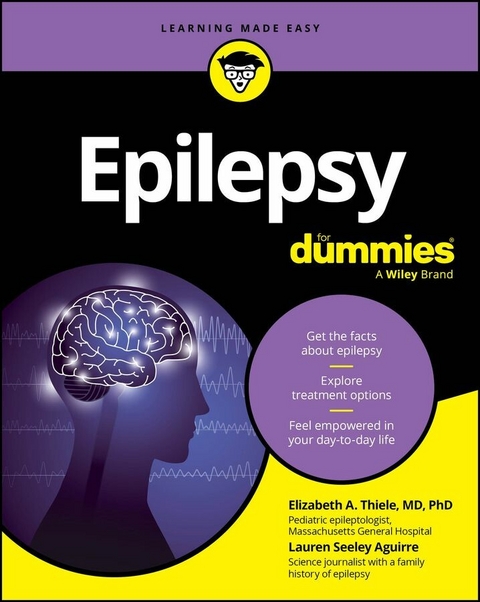
Epilepsy For Dummies (eBook)
468 Seiten
For Dummies (Verlag)
978-1-394-33368-4 (ISBN)
A conversational guide to understanding and living with epilepsy
Millions of people around the world have epilepsy, but the condition is widely misunderstood. Epilepsy For Dummies breaks through outdated stigmas surrounding this complex neurological disease. The book offers a 360-degree view by incorporating medical, social, and other perspectives to help you cope with epilepsy or support someone who has been diagnosed. You'll learn about triggers and risk factors, different types of seizures, and getting a diagnosis. You'll also explore various treatment options, including medications, surgery, therapy, and neuromodulation. Beyond the basics, this guide addresses staying safe and managing associated conditions, empowering you to live well.
- Get up-to-date facts about epilepsy, written in terms anyone can understand
- Learn about the causes, symptoms, and treatments for different seizure types
- Discover how family and friends can support their loved ones with epilepsy
- Find advice for feeling in control and living a fulfilling life
Epilepsy For Dummies is invaluable for anyone with epilepsy, as well as their caretakers, family, and friends. It's also a great resource for educators and medical professionals.
Elizabeth A. Thiele, MD, PhD, is an epileptologist who treats children and young adults who have complex cases of epilepsy. She's the Director of Pediatric Epilepsy at the Massachusetts General Hospital and Professor of Neurology at Harvard Medical School.
Lauren Seeley Aguirre is an award-winning science journalist and former producer for the PBS series NOVA. She is the author of The Memory Thief and the Secrets Behind How We Remember: A Medical Mystery.
A conversational guide to understanding and living with epilepsy Millions of people around the world have epilepsy, but the condition is widely misunderstood. Epilepsy For Dummies breaks through outdated stigmas surrounding this complex neurological disease. The book offers a 360-degree view by incorporating medical, social, and other perspectives to help you cope with epilepsy or support someone who has been diagnosed. You'll learn about triggers and risk factors, different types of seizures, and getting a diagnosis. You'll also explore various treatment options, including medications, surgery, therapy, and neuromodulation. Beyond the basics, this guide addresses staying safe and managing associated conditions, empowering you to live well. Get up-to-date facts about epilepsy, written in terms anyone can understand Learn about the causes, symptoms, and treatments for different seizure types Discover how family and friends can support their loved ones with epilepsy Find advice for feeling in control and living a fulfilling life Epilepsy For Dummies is invaluable for anyone with epilepsy, as well as their caretakers, family, and friends. It's also a great resource for educators and medical professionals.
Chapter 1
Making Sense of Epilepsy
IN THIS CHAPTER
Looking at the scope of epilepsy
Recognizing and diagnosing epilepsy
Looking at treatment paths
Living safely while living fully
Finding supportive community
Epilepsy is a condition that affects the brain — the most intricate organ we have — and no two people experience epilepsy in the same way. Causes, symptoms, treatments, and outcomes can vary widely, which can make the condition feel unpredictable and overwhelming.
This chapter offers a roadmap to help you make sense of it all for yourself or people you care for. You find out about what seizures are, what epilepsy is, and how it can begin at any age. The chapter also tells you what treatment options look like and why so many people who receive a diagnosis of epilepsy go on to lead full, active lives. Most importantly, you discover that you're not alone.
Seeing the Many Sides of Epilepsy
Saying “I have epilepsy” doesn’t tell your listener much because epilepsy is so different from one person to the next. Some people have seizures so mild that they can carry on a conversation during a seizure, and no one even notices. Others have seizures so intense that they fall to the ground and convulse. And there are hundreds of variations in between those extremes.
The official definition of epilepsy is a medical condition in which the brain has a tendency to experience unprovoked, repeated seizures. But what does that really mean?
Here’s a breakdown of the definition:
- Medical condition: A disease, illness, or disorder that affects the functioning of the brain or other parts of the body and that requires medical care
- Tendency: Something that's likely to happen again
- Unprovoked: Not caused by something transient and identifiable, such as a high fever or head injury
- Repeated: Involves more than one seizure — not a single event
- Seizure: A sudden burst of abnormal electrical activity in the brain that disrupts normal brain function
Unpacking what seizures are
Seizures happen when neurons in your brain fire in a sudden, storm-like burst. That uncontrolled activity interrupts normal brain function. Doctors group seizures into two main types:
- Generalized: These seizures involve both sides of the brain from the beginning of the seizure. By sides, we mean both halves of the brain — the left and right hemispheres. (We give you the big picture of brain anatomy in Chapter 5.) Because generalized seizures affect so much of the brain, people are typically unaware of what's happening and don't have control over their bodies during the seizure. They may suddenly drop to the floor and shake, and most people don't remember the seizure afterward. Six subtypes of generalized seizures exist.
- Focal: These seizures start in one small area of the brain called the seizure focus. What you feel or do depends on where that spot is. The three kinds of focal seizures cause different experiences for the person who has them.
- In some, you are fully aware of what's going on around you, but you have a weird sensation that is not “real,” such as smelling burnt rubber even when nothing is burning.
- Another type of focal seizure can make you confused, less aware of what's going on, and unable to respond to people.
- In the third kind, seizures can spread to other brain areas and become generalized seizures.
In addition to seizure types, epilepsy syndromes also exist, and we explain more about seizure types and syndromes in Chapter 7. Understanding the type of seizure or syndrome you’re dealing with is your doctor’s first step in figuring out the correct medical treatment. The “Understanding Treatment Possibilities” section later in this chapter explains more.
Discovering who gets epilepsy and why
Around 50 million people around the world have epilepsy. Anyone can get it — the cashier at the grocery store, a newborn, or an Olympic athlete. Even doctors get epilepsy. While epilepsy can begin at any time, children under two years of age or adults over 65 years of age are the most likely to be newly diagnosed. In many lower-income countries, people are more likely to develop epilepsy from preventable causes, such as malaria, head injuries, or birth complications.
People are born with epilepsy or acquire it for many reasons:
- Genetic: Close to 1,000 genes may be connected to epilepsy. Some mutations directly cause seizures, while others just increase your risk. Epilepsy can often run in families.
- Structural: Areas of the brain that developed unusually, scar tissue, or abnormal blood vessels can cause epilepsy.
- Acquired: Anything that damages the brain can cause epilepsy, including complications during birth, traumatic brain injuries, brain infections (such as meningitis), tumors, or strokes.
Attitudes toward epilepsy
For much of history, seizures were misunderstood as signs of demonic possession or madness. Unfortunately, myths and misconceptions about what epilepsy is have been around ever since people have had epilepsy. Which is forever.
But today, more people feel comfortable talking openly about their seizures, and public understanding that epilepsy is just another medical condition is growing. Unfortunately, about half of people living with epilepsy still feel judged, excluded, or treated unfairly. That stigma can sometimes take as much of a toll on a person’s mental and physical health as the seizures themselves. See Chapter 4 for more information about the myths and stigmas surrounding epilepsy.
Getting a Diagnosis
Many people understand the feeling of avoidance — when they don’t want to listen to the voice in their heads telling them that something’s wrong. But when it comes to epilepsy, ignoring that voice and waiting to take action can make the situation worse in the long run.
The sooner you trust your instincts and get the symptoms you notice checked out, the sooner you can either stop worrying or take steps to get the care you need. Here’s what’s involved:
- Start with your primary doctor: Tell them what's going on and ask for a referral to a neurologist who could help you figure out what's happening.
- Get ready for your first visit: Gather your medical records, write down details about any suspected seizures, and keep track of any other unusual symptoms, even if they seem hard to explain.
- Prepare to share: At your first visit, the neurologist asks about your family history, reviews your medical history and records, examines you, and talks through suspected seizures and triggers.
To confirm a diagnosis, your doctor may order follow-up tests such as an EEG or a brain scan. We explain what to expect from follow-up testing in Chapter 8.
Understanding Treatment Possibilities
A century ago, treatment options for epilepsy were limited to a drug or two that had serious side effects and didn’t work particularly well. Today, you have dozens of medications to choose from, as well as surgical procedures, devices that act like pacemakers for the brain, and therapeutic diets. In Part 3, we walk you through these treatment options in detail.
Medication: The first line of defense
As you find out in Chapter 10, for most people who have epilepsy, treatment with medication is the best place to start. That's because around seven out of ten people can get complete seizure control from medication alone.
Here are a few facts about antiseizure medications:
- How they work: Antiseizure medications help by calming the brain's electrical activity in different ways. They make neurons less likely to fire out of control.
- How doctors choose: No one-size-fits-all “pill” exists, so doctors take various factors into account when choosing your medication. They first consider what type of seizure you have, then factor in your age, any other medical conditions, and medications you're already taking. They also consider possible side effects and how well you're likely to tolerate them.
- What side effects they have: Like any medication, antiseizure medications can cause side effects, such as feeling tired, dizzy, or slow. Pay attention to how you feel and let your doctor know. Some side effects can be serious, so always tell your doctor if you experience anything out of the ordinary.
- What form medications take: Most antiseizure medications come in tablets, capsules, or liquids in a variety of strengths. You take some medications once a day, but you take others more frequently.
Finding the right medication can take time. Doctors often use a trial-and-error approach to figure out what works best. You may need to try more than one medication or use a combination of medications before getting seizures under control. So if the first attempt doesn't work, don’t give up hope.
Brain surgery
For about one-third of people with epilepsy, medication alone doesn’t fully control their seizures. For them, surgery may be a...
| Erscheint lt. Verlag | 15.9.2025 |
|---|---|
| Sprache | englisch |
| Themenwelt | Medizin / Pharmazie ► Allgemeines / Lexika |
| Medizin / Pharmazie ► Medizinische Fachgebiete ► Neurologie | |
| Schlagworte | child epilepsy • childhood epilepsy book • Epilepsy • Epilepsy answers • Epilepsy book • Epilepsy Care • epilepsy parent • Epilepsy treatment • Epileptic • Living with Epilepsy • seizure books • treating epilepsy naturally • what is epilepsy |
| ISBN-10 | 1-394-33368-4 / 1394333684 |
| ISBN-13 | 978-1-394-33368-4 / 9781394333684 |
| Informationen gemäß Produktsicherheitsverordnung (GPSR) | |
| Haben Sie eine Frage zum Produkt? |
 EPUB (Adobe DRM)
Kopierschutz: Adobe-DRM
Adobe-DRM ist ein Kopierschutz, der das eBook vor Mißbrauch schützen soll. Dabei wird das eBook bereits beim Download auf Ihre persönliche Adobe-ID autorisiert. Lesen können Sie das eBook dann nur auf den Geräten, welche ebenfalls auf Ihre Adobe-ID registriert sind.
Details zum Adobe-DRM
Dateiformat: EPUB (Electronic Publication)
EPUB ist ein offener Standard für eBooks und eignet sich besonders zur Darstellung von Belletristik und Sachbüchern. Der Fließtext wird dynamisch an die Display- und Schriftgröße angepasst. Auch für mobile Lesegeräte ist EPUB daher gut geeignet.
Systemvoraussetzungen:
PC/Mac: Mit einem PC oder Mac können Sie dieses eBook lesen. Sie benötigen eine
eReader: Dieses eBook kann mit (fast) allen eBook-Readern gelesen werden. Mit dem amazon-Kindle ist es aber nicht kompatibel.
Smartphone/Tablet: Egal ob Apple oder Android, dieses eBook können Sie lesen. Sie benötigen eine
Geräteliste und zusätzliche Hinweise
Buying eBooks from abroad
For tax law reasons we can sell eBooks just within Germany and Switzerland. Regrettably we cannot fulfill eBook-orders from other countries.
aus dem Bereich