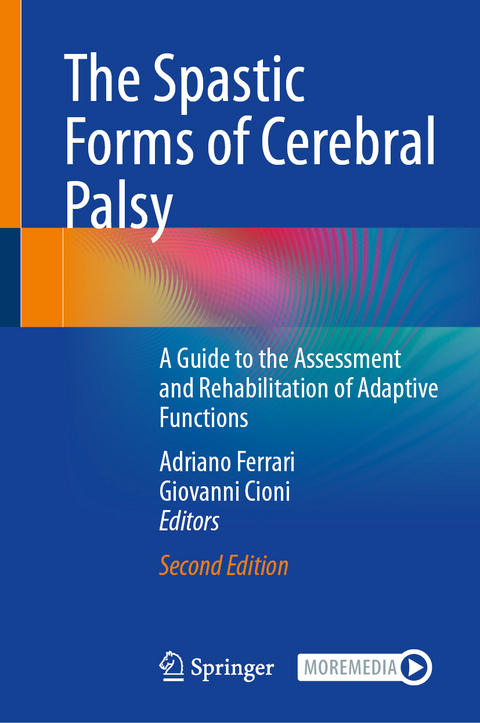
The Spastic Forms of Cerebral Palsy
Springer International Publishing (Verlag)
978-3-032-09210-6 (ISBN)
- Noch nicht erschienen - erscheint am 05.01.2026
- Versandkostenfrei
- Auch auf Rechnung
- Artikel merken
This textbook, the second edition following the first published in 2009, provides a comprehensive and detailed analysis of all spastic forms of cerebral palsy, examining each aspect of the condition from various perspectives, such as motor, perceptual, and emotional.
In cerebral palsy rehabilitation, the therapeutic approach should begin with an evaluation of the child's resources and the strategies they employ to build their adaptive functions, despite their central and peripheral impairments. The use of a pre-established universal model of motor performance (the so-called typical motor development), ordered by an obligatory sequence acquired in rigid and constant progression (the so-called milestones), is no longer acceptable. Instead, it is crucial to analyze the cognitive and motor resources of the child with cerebral palsy, marked by the pathology regardless of any applied therapy, to plan a tailored rehabilitation program with the child and their family. This requires an understanding of how the child's brain responds to internal and external demands for adaptation.
For this reason, it is necessary that the therapists acquire specific knowledge of the natural history of the form of cerebral palsy and its rules, to design and pursue the most effective adaptive changes (understood as stable and favorable modifications of the natural history) achievable in that specific case and specific physical, social and cultural context. This approach should not only consider motor re-education but also other therapeutic interventions, such as drugs, functional surgery, orthoses, aids, and adaptive modifications of the environment.
This textbook, enriched by clinical cases and videos, will be of interest for those who already work in this field (doctors, child neuropsychiatrists and physiatrists, rehabilitation therapists), as well as for students of the first and second level degrees in the area of rehabilitation and specialization medical schools.
In this second edition, all chapters have been updated and, in some cases fully rewritten. Moreover, in the new chapters the general concepts of CP re-education, the reasons that justify early treatment, the importance of the active role of family, the panorama of therapeutic tools, the description of combined treatment (re-education, drugs, orthotics, functional surgery )and of Assistive Technologies were added.
Prof. Adriano Ferrari is a highly accomplished professor of Physical and Rehabilitation Medicine with over 40 years of experience in the field. After receiving his degree in Medicine and Surgery with honors from the University of Parma in 1975, he went on to specialize in Neurology and Orthopaedic Rehabilitation at the same university. He began his career as a researcher at the Neurological Clinic at the University of Parma in 1975, and later served as the Director of the Child Rehabilitation Centre in Parma and the Director of Child Neuropsychiatry in Scandiano (Reggio Emilia).
In 1995, Prof. Ferrari became the Director of the Regional Reference Centre for Childhood Rehabilitation in Reggio Emilia, where he remained until 2006. During this time, he was also a teacher of Rehabilitation Medicine at various scientific institutions and health services for kinesis therapists, psychomotor therapists, occupational therapists, physiatrists, neurologists, and child neuropsychiatrists.In 2006, he was appointed as a Full Professor of Physical Medicine and Rehabilitation at the University of Modena and Reggio Emilia, where he also served as the President of the Physiotherapy Graduate Degree Program and the Director of the Specialization Program in Childhood Rehabilitation and Research Methodology. Throughout his career, he has also taught childhood seminars for Rehabilitation Medicine in cerebral palsy, neuromuscular disease, and spina bifida in various European scientific institutions and universities, including those in Germany, Sweden, Switzerland, and others.
As an expert in the field, Prof. Ferrari served as a reviewer for various publications, including the Journal of Paediatric Rehabilitation and the European Journal of Physical Medicine and Rehabilitation. Additionally, he has been the Director of Tecnica Ortopedica Internazionale, a specialized journal focused on orthoses, prostheses, and other devices used to assist with motion deficiencies.
His expertise in childhood rehabilitation has also led to his appointment as the Coordinator of the Childhood Rehabilitation Section of the Scientific Society of Physiatrists. He has authored over 250 scientific publications in Italian and international journals, as well as university textbooks translated into multiple languages, all of which focus on neurological disabling pathologies.
He has been invited to speak at over 800 seminars both in Italy and abroad on childhood neurorehabilitation. His knowledge and experience have also led him to become a patent holder of innovative orthoses and walking devices specifically designed for disabled children.
Finally, he also served as the Coordinator and first investigator of Research Projects financed by the Italian Ministry of Health and other national and international Institutions, helping to advance the field of rehabilitation medicine and improve outcomes for patients.
Prof. Giovanni Cioni, is former Full Professor of Child Neurology and Psychiatry at the University of Pisa and currently fulltime Scientific Director of IRCCS Fondazione Stella Maris, National Biomedical Research Hospital for neurodevelopmental disorders, located in Calambrone (Pisa, Italy).
Born in Pistoia, Tuscany (Italy), he received MD at the University of Florence and Specializations in Child Neurology and Psychiatry and in Rehabilitation Medicine at the University of Pisa and training in child neurology and rehabilitation in many Centres in Europe.
Part I Nature of the defect.- Cerebral palsy detection: from John Little to the present.- Guide to the interpretation of cerebral palsy.- Part II Function analysis.- Functional diagnosis in infants and in very young children: early predictive signs.- Motor defects and deficits.- Perceptive defects.- Praxic organization disorders.- Visual and oculomotor disorders.- Neuropsychological evaluation.- Emotional, behavioral and social disorders in children and adolescents with cerebral palsy.- Observing interactions.- Part III Classification of spastic syndromes and clinical forms.- Critical aspects of traditional classifications.- Kinematic classification.- Tetraplegic clinical forms.- Dysperceptive clinical forms.- Diplegic clinical forms.- Hemiparetic clinical forms.- Part IV Rehabilitation of spastic forms.- The rehabilitation concept in cerebral palsy.- The posture treatment in tetraplegic forms.- The gait treatment in diplegic forms.- The manipulation treatment in hemiplegic forms.- The combined treatment (drugs, orthoses and aids, functional surgery, assistive technologies.- Family centred or child centred approach?.- Semeiotics manoeuvres.- Rational glossary.
| Erscheinungsdatum | 29.11.2025 |
|---|---|
| Zusatzinfo | XV, 597 p. 61 illus., 5 illus. in color. With online files/update. |
| Verlagsort | Cham |
| Sprache | englisch |
| Maße | 155 x 235 mm |
| Themenwelt | Medizin / Pharmazie ► Gesundheitsfachberufe |
| Medizinische Fachgebiete ► Chirurgie ► Unfallchirurgie / Orthopädie | |
| Medizin / Pharmazie ► Medizinische Fachgebiete ► Neurologie | |
| Medizin / Pharmazie ► Physiotherapie / Ergotherapie | |
| Schlagworte | Assessment • clinical classification • motor vs perceptual disorders • Natural History • rehabilitation of motor functions |
| ISBN-10 | 3-032-09210-8 / 3032092108 |
| ISBN-13 | 978-3-032-09210-6 / 9783032092106 |
| Zustand | Neuware |
| Informationen gemäß Produktsicherheitsverordnung (GPSR) | |
| Haben Sie eine Frage zum Produkt? |
aus dem Bereich