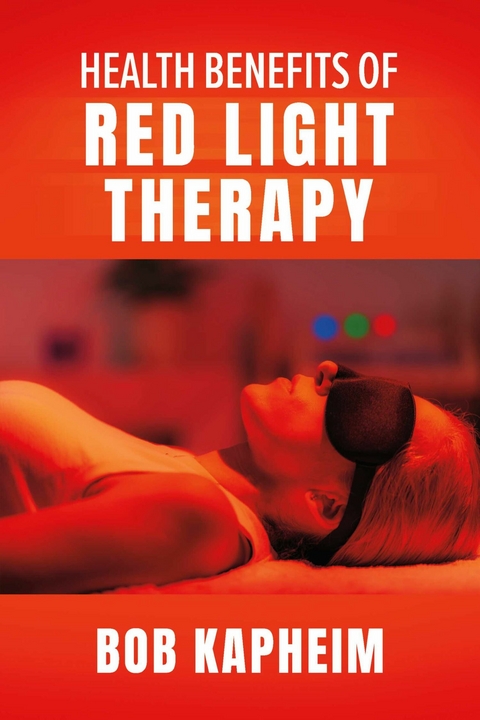
Health Benefits of Red Light Therapy (eBook)
172 Seiten
Bookbaby (Verlag)
979-8-3178-1253-9 (ISBN)
Bob Kapheim is an experienced professor of human anatomy and physiology. He has been professionally trained in massage with emphasis in athletic pre and post performance massage and athletic injury rehabilitation. On top of this he has served as a standardized patient, where he acted the role of a patient with an illness at medical schools, where the students had to interview him and diagnose his illness. With this background Kapheim is well positioned to understand the health benefits of red light therapy and its relationship to the human body. Dr. Bob Kapheim began his career as a high school advanced biology teacher and football and wrestling coach. In 1994 he retired from high school teaching, earned a doctor's degree and taught at the university level. Dr. Kapheim has previously published ten books. His most recent are HFC Hydrogen Fuel Cell Cars The next generation of electric cars, and The Lithium Rush is on, a book on the lithium-ion powered electric cars. In addition to writing , Bob is a professional artist and photographer. Bob is available for presentations and interviews. Bob lives wife his wife of 48 years, Lynn, in Pingree Grove, Illimoois.
Over the past couple of years, red light therapy has been gaining popularity among dermatologists, chiropractors, spas, and health-oriented individuals. "e;Health Benefits of Red-Light Therapy"e; is a thoroughly researched book that provides insight into the different red light therapy treatments for skin and body issues, major organ problems, mental and sexual health issues, and weight loss programs. Backed by thorough research and the author's personal experience, discover how red-light therapy really works and what benefits you can gain from it. Some benefits include Healthier skin. Increased blood flow. Reduced inflammation. Quicker recovery. Pain reduction. Weight loss. Mental health benefits. Additionally, discover the various kinds of treatments offered, how they work, and how they can affect your results. "e;Health Benefits of Red-Light Therapy"e; is a must-read for those looking for an alternative option to current treatments.
Chap. 1
WHAT is RED LIGHT
THERAPY?
The science of light therapy:
“Light-emitting diode (LED) therapy has been a mainstay in the medical and cosmetic fields since NASA started studying its ability to help heal and grow tissues and cells in the 1990s.” (Smith, 2021) “Red light is visible and is most effective for use on the surface of the skin. Red light occupies the long end’ of the visible spectrum with wavelengths of 630nm-700nm. Infrared light is invisible and is effective for use on the surface of the skin and penetration of ab out 1.5 inches into the body. Infrared light sits next to red light on the electromagnetic spectrum.” (Light Tree, 202024)
Light is the visible portion of the electromagnet spectrum. Probably in grade school you became familiar with the memory aid ROY G BIV, which stands for the colors of the visible spectrum, Red, Orange, Yellow, Green, Blue, Indigo, and Violet. White light can be separated into these colors because each color has a different wavelength. Of these Violet has the shortest wavelength and red has the longest wavelength. Wavelengths are measured in nanometers. A nanometer is defined as a metric unit equal to one billionth of a meter. If you continue on the electromagnetic spectrum from violet, next is ultraviolet, commonly referred to as UV light. UV light is shorter than violet light and is not visible. You are familiar with UV light because that is what your skin is exposed to when you sunbathe. Extending from red light the next wavelength is called infrared light. Infrared light has a longer wavelength than red light and is not visible. Restaurants used infrared light to keep the food warm until the waiter picked it up and brought it to your table. Artists refer to Blue, Indigo and Violet as cool colors and Red, Orange and Yellow as warm colors.
“Red light therapy (RLT) combines the principles of modern medicine and photobiomodulation. Photobiomodualtion: Photo- light, Bio-life and modulation-change. It heals and prevents diseases by deeply irradiating body cells or tissues using specific red and near-infrared light at concentrated wavelengths.” (Bestqool R&D Team, 2020) “Red light ranges from 600 to 700 nm and is visible and bright. Infrared or near-infrared light is in the 700 to 900 nm range, which isn’t visible to the naked eye.” (Lundberg, 2024) Near-infrared light in the range of 830-850 nm have the most impact on cellular respiration providing the highest level of light absorption. Light modulates cellular functions and biological processes by a procedure called photobiomodulation (PBM). PBM can be used in a variety of medical applications because it is non-invasive and has minimal side effects.
Photobiomodulation triggers a chain of chemical reactions due to exposure to light. “Two major events occur when the respiratory electron transport chain is stimulated:
Reduction/oxidation of the mitochondria is changed which creates an enhanced ATP synthesis
The cell membrane permeability to the flow of calcium is altered due to the activation of sodium/potassium
Because of these events, the cell is provided with more energy and the cell is able to pay its natural part in the healing process.” (Miller, 2024)
How does red light therapy work?
“Red light therapy -also referred to as RLT, low level laser light therapy, cold laser therapy or phototherapy – sends visible red and near-infrared light energy to your body’s cells. This infusion of energy stimulates cell repair and tissue growth. “(Lundberg, 2024) “Red Light Therapy works by using specific wavelengths of red light to penetrate the skin and stimulate cellular repair and rejuvenation. These wavelengths of light are absorbed by the mitochondria, which are the energy-producing powerhouses of our cells.” (Serrano,2023) “Red light therapy utilizes wavelengths of light to penetrate the skin without causing harm. These wavelengths are absorbed by mitochondria, the powerhouses of cells, where they stimulate energy production. This boost in cellular energy promotes healing and reduces inflammation. Moreover, red light affects the brain by increasing blood flow and promoting the release of serotonin, a neurotransmitter associated with mood regulation.” (Mental Health, 2024) “What it does is basically energize your cells.” Dr. Billy Huh, University of Texas. (Sweeney, 2025)
“Residing right next to near infrared on the spectrum. Many red-light therapy systems use small amounts of infrared along with LED lights, and as we’ve uncovered, infrared penetrates deeply while red light works on the surface of the skin. While penetrating the surface, this light energy works on rejuvenating facial skin, smoothing skin tone, building collagen, reducing wrinkles, and repairing sun damaged skin.” (Light Tree, 2024) “We need the sun to be healthy. And red and near-infrared light are a big part of the reason why. In short, the human body needs red and near-infrared light to function optimally.” (Whitten, 2018)
The physiology of red-light therapy:
Collagen
“Collagen is the most abundant protein in the human body, making up around 30% of total body protein. It plays a crucial role in building skin, muscle, bones, tendons, ligaments, organs, blood vessels, and intestinal lining. Comprised of amino acids like proline, glycine, and hydroxyproline, collagen forms a unique triple helix structure in the skin, it provides both structure and elasticity, constituting 75-80% of its day weight. However, collagen production naturally decreases as we age, especially with declining estrogen levels leading to wrinkles and sagging skin.” (Weber. 2025) “Collagen is important – not just for giving us youthful skin and helping us avoid that saggy “schnauzer” look around the neck and jowls – collagen is needed to keep the entire body youthful, resilient, strong, and vital. In fact, collagen is the most abundant protein in the entire body. Even more important than what we can see on the surface, collagen is also what gives our muscles, skin, blood vessels, bones and digestive system the healthy tissues that they need to keep us strong and free from disease. “ (Whitten, 2018) Our skin is flexible or elastic. The expansive and contractive quality of our skin is a result of connective tissue. Our connective tissue contains a protein called collagen that provides structure to our skin. Collagen and elastin are abundant proteins your body produces. But in your mid-20s your production slows down, and eventually, you begin noting the effects – wrinkles, saggy skin and dryness. As we age, the production of collagen decreases, and our skin loses elasticity and wrinkles form. Cells called fibroblasts are needed to create collagen that keeps skin resilient and healthy. Collagen is the main type of protein found in the human body and is primarily found between cells and joints. Skin, tendons, and ligaments make up the majority of collagen deposits in the body. Healthy cells produce and break down the right amount of collagen. “Collagen and elastin are abundant proteins your body naturally produces, but in your mid-20s, your production slows down, and eventually you begin noticing the effects – wrinkles, lines, saggy skin, and dryness. LED light therapy boosts your protein production without breaching your skin by using the power of light.” (Smith,2021) Low-level red and infrared light increases expression of collagen, elastin, and hyaluronic acid in skin. Hyaluronic acid is a natural substance found in fluids in the eye and joints. It acts as a cushion and lubricant in the joints. It can treat burns, bed sores, wounds, and skin ulcers. It can also be injected to treat severe knee pain from osteoarthritis. A key regulator of collagen production in the body is progesterone.
The main structural protein found in the skin and other connective tissues, widely used in purified form for cosmetic surgical treatments. Each type of collagen has a specific role. So, what does collagen do?
Helping fibroblasts form in your dermis (middle skin layer).
Playing a role in replacing dead skin cells
Providing a protective covering for organs
Giving structure strength and elasticity to your skin
Helping your blood to clot
28 types of collagens have been identified. They differ by how the molecules are assembled- the cell components that have been added to the collagen. If each type of collagen has a specific role, then what are the different types of collagens?
Type I This type makes up 90% of your body’s collagen. Type I are densely packed and used to provide structure to your skin, bones, tendons, and ligaments.
Type II This type is found in elastic cartilage which provides support.
Type III This type is found in muscles, arteries, and organs.
Type IV This type is found in the layers of your skin.
Type V This type is found in the cornea of your eye, some layers of your skin, hair and tissues of the placenta.
(Cleveland clinic staff, 2025)
What happens to collagen as you age? Your body produces less as you age. The existing collagen breaks down faster. Collagen that is produced is of lower quality as you age. Women experience a significant reduction in collagen after menopause. It is normal for everyone to have decline after the age of 60. How can you tell that your body’s collagen level is decreasing?
Your skin is wrinkly, crepey, or saggy.
Hallowing occurs in and...
| Erscheint lt. Verlag | 15.9.2025 |
|---|---|
| Sprache | englisch |
| Themenwelt | Medizin / Pharmazie ► Naturheilkunde |
| ISBN-13 | 979-8-3178-1253-9 / 9798317812539 |
| Informationen gemäß Produktsicherheitsverordnung (GPSR) | |
| Haben Sie eine Frage zum Produkt? |
 EPUB (Ohne DRM)
Größe: 394 KB
Digital Rights Management: ohne DRM
Dieses eBook enthält kein DRM oder Kopierschutz. Eine Weitergabe an Dritte ist jedoch rechtlich nicht zulässig, weil Sie beim Kauf nur die Rechte an der persönlichen Nutzung erwerben.
Dateiformat: EPUB (Electronic Publication)
EPUB ist ein offener Standard für eBooks und eignet sich besonders zur Darstellung von Belletristik und Sachbüchern. Der Fließtext wird dynamisch an die Display- und Schriftgröße angepasst. Auch für mobile Lesegeräte ist EPUB daher gut geeignet.
Systemvoraussetzungen:
PC/Mac: Mit einem PC oder Mac können Sie dieses eBook lesen. Sie benötigen dafür die kostenlose Software Adobe Digital Editions.
eReader: Dieses eBook kann mit (fast) allen eBook-Readern gelesen werden. Mit dem amazon-Kindle ist es aber nicht kompatibel.
Smartphone/Tablet: Egal ob Apple oder Android, dieses eBook können Sie lesen. Sie benötigen dafür eine kostenlose App.
Geräteliste und zusätzliche Hinweise
Buying eBooks from abroad
For tax law reasons we can sell eBooks just within Germany and Switzerland. Regrettably we cannot fulfill eBook-orders from other countries.
aus dem Bereich