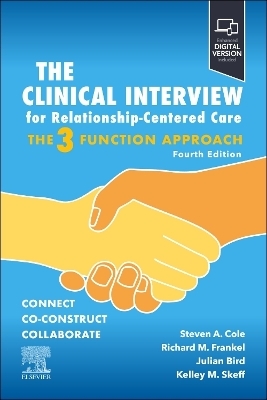
The Clinical Interview for Relationship-Centered Care: The Three Function Approach
Elsevier - Health Sciences Division (Verlag)
978-0-323-82941-0 (ISBN)
- Noch nicht erschienen (ca. Juni 2026)
- Versandkostenfrei
- Auch auf Rechnung
- Artikel merken
Describes three core functions of the clinical interview-connect, co-construct the illness narrative, and collaborate for care-with updated evidence-base to facilitate relationship-centered care throughout day-to-day practice
Introduces three “meta-skills”-connect to self in context, connect with values, and connect non-verbally-higher-order skills to facilitate learning and clinical implementation
Provides a new biopsychosocial tool, “the three pillars,” for co-constructing the clinical narrative: chronology of the present illness, ecology of the illness, and affirmation of strengths and resources
Includes a new section on Professional Identity Formation, with research and clinical perspectives, and related chapters on Mindfulness, Use of Self, and Approach to Patient/Family and Student Concerns-all designed to help clinicians and educators understand transformative role transitions that mature during a practice lifetime
Integrates Motivational Interviewing and Health Coaching with new chapters on Brief Action Planning (BAP), BAP-MI (Advanced Skills), and the Spirit of Motivational Interviewing
Adds chapters on advanced topics and applications such as using digital technology (computers and virtual visits), presentation and documentation, language and cultural barriers, health literacy, elderly patients, mitigating burnout, team-based care, and applications across health systems
Addresses challenges of chronic and life-limiting illness with new chapters on Optimizing Three Function Presence Over Time, Sharing Difficult News While Exploring Hope, and Collaborating for Care in Discussing Limitations of Treatment
An eBook version is included with purchase. The eBook allows you to access all of the text, figures, and references, with the ability to search, customize your content, make notes and highlights, and have content read aloud
Steven Cole, MD is Professor of Clinical Psychiatry, Emeritus at S.U.N.Y. Stony Brook Health Sciences Center. He has been awarded grants from the National Institute of Mental Health and the John D. and Catherine T. MacArthur Foundation for clinical, disease management and educational work on depression in general medical settings. He has published more than 40 peer-reviewed journal articles and 30 book chapters, mostly related to psychiatric disorders in medical patients. https://webcampus.drexelmed.edu/doccom/db/assets/authors/StevenCole.htm;
UNIT 1 Three Functions of the Medical Interview
1. Learning to Interview Using the Three Function Approach: Introduction and Overview
2. Three Functions: The Basic Model
3. Function One: Build the Relationship
4. Function Two: Assess and Understand
5. Function Three: Collaborate for Management
UNIT 2 Meeting the Patient
6. Ten Common Concerns
UNIT 3 Structure of the Interview
7. Opening the Interview
8. Chief Complaint, Problem Survey, Patient’s Perspective, and Agenda Setting
9. History of Present Illness
10. Past Medical History
11. Family History
12. Patient Profile and Social History
13. Review of Systems
14. Mental Status
UNIT 4 Presentation and Documentation
15. Presentation and Documentation
UNIT 5 Understanding Patients’ Emotional Responses to Chronic Illness
16. Understanding Chronic Illness: Normal Reactions
17. Understanding Chronic Illness: Maladaptive Reactions
UNIT 6 Advanced Applications
18. Stepped-Care Advanced Skills for Action Planning
19. Communicating with Patients with Chronic Illness
20. Health Literacy and Communicating Complex Information for Decision Making
21. Sexual Issues in the Interview
22. Interviewing Elderly Patients
23. Culturally Competent Medical Interviewing
24. Family Interviewing
25. Troubling Personality Styles and Somatization
26. Communicating with the Psychotic Patient
27. Breaking Bad News
28. Disclosure of Medical Errors and Apology
29. Risky Drinking and Interviewing About Alcohol Use
UNIT 7 Higher Order Skills
30. Nonverbal Communication
31. Use of the Self in Medical Care
32. Using Psychological Principles in the Medical Interview
33. Integrating Structure and Function: Diagnostic Reasoning, Clinical Inference, Communication Flexibility, and Rules
| Erscheint lt. Verlag | 1.6.2026 |
|---|---|
| Verlagsort | Philadelphia |
| Sprache | englisch |
| Maße | 152 x 229 mm |
| Themenwelt | Medizin / Pharmazie |
| ISBN-10 | 0-323-82941-4 / 0323829414 |
| ISBN-13 | 978-0-323-82941-0 / 9780323829410 |
| Zustand | Neuware |
| Informationen gemäß Produktsicherheitsverordnung (GPSR) | |
| Haben Sie eine Frage zum Produkt? |
aus dem Bereich