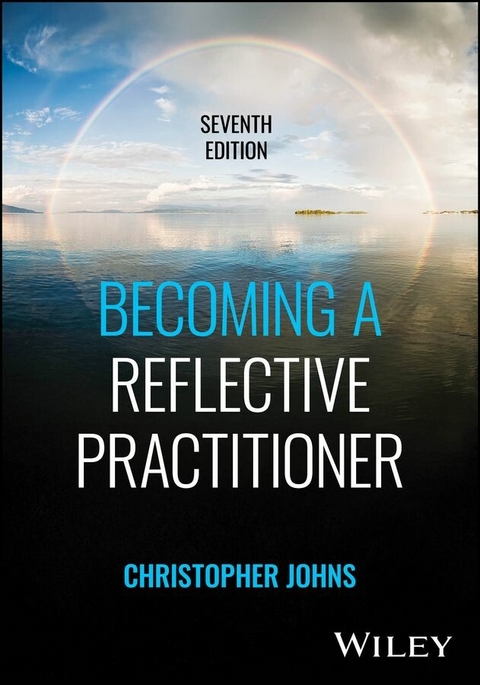
Becoming a Reflective Practitioner (eBook)
781 Seiten
Wiley (Verlag)
978-1-394-34332-4 (ISBN)
Fully updated edition of a seminal text in the field providing an in-depth guide to reflection and its real-life application
The Seventh Edition of Becoming a Reflective Practitioner offers an in-depth exploration of reflective practice, bringing the process of guided reflection to life. The book emphasises the importance of person-centred practice aligned with the latest developments in holistic healthcare and features a variety of case studies and real-life scenarios that illustrate the application of reflective practice in clinical settings.
The book is structured into five parts, moving from the concept of reflection and its application in clinical practice to its integration into formal education, narrative representation, and performance. The new edition includes significant updates and expansions on topics such as the development of guidance in reflective practice, as well as the inclusion of new chapters that highlight the reflexive process of guiding practitioners over the course of a year.
Becoming a Reflective Practitioner, Seventh Edition includes information on:
- The Six Dialogical Movements and their assimilation within the Model for Structured Reflection (MSR)
- Experience, vision, knowing in practice, the prerequisites for reflection, the reality wall, and the movement of reflective learning through understanding, empowerment, and transformation
- The nature of guidance and the dynamic process of guidance
- Narratives of guiding practitioners within the clinical setting constructed through guided reflection dialogue
- Leadership development through establishing a clinical learning culture based on the learning organisation and clinical supervision
Becoming a Reflective Practitioner continues to be an essential resource for students, educators, and practitioners aiming to enhance their reflective practice and achieve their visions of person-centred care.
Christopher Johns is Honorary Professor of Nursing at the Academy of Nursing, University of Exeter. He is an Honorary Scholar of the Global Academy of Holistic Nursing, and a member of The Person-centred Practice International Community of Practice. He was awarded a National Teaching Fellowship in 2010 based on his work developing reflective practice within the curriculum.
Fully updated edition of a seminal text in the field providing an in-depth guide to reflection and its real-life application The Seventh Edition of Becoming a Reflective Practitioner offers an in-depth exploration of reflective practice, bringing the process of guided reflection to life. The book emphasises the importance of person-centred practice aligned with the latest developments in holistic healthcare and features a variety of case studies and real-life scenarios that illustrate the application of reflective practice in clinical settings. The book is structured into five parts, moving from the concept of reflection and its application in clinical practice to its integration into formal education, narrative representation, and performance. The new edition includes significant updates and expansions on topics such as the development of guidance in reflective practice, as well as the inclusion of new chapters that highlight the reflexive process of guiding practitioners over the course of a year. Becoming a Reflective Practitioner, Seventh Edition includes information on: The Six Dialogical Movements and their assimilation within the Model for Structured Reflection (MSR)Experience, vision, knowing in practice, the prerequisites for reflection, the reality wall, and the movement of reflective learning through understanding, empowerment, and transformationThe nature of guidance and the dynamic process of guidanceNarratives of guiding practitioners within the clinical setting constructed through guided reflection dialogueLeadership development through establishing a clinical learning culture based on the learning organisation and clinical supervision Becoming a Reflective Practitioner continues to be an essential resource for students, educators, and practitioners aiming to enhance their reflective practice and achieve their visions of person-centred care.
PREFACE
I adopted the fern as a symbol for reflective practice. It’s unfurling symbolises new growth from its old roots and with its strength, resilience and enduring power.
The important thing about a book is that its ideas reach everyone.
Welcome to the seventh edition of this book. It has been nearly four years since the previous edition was published. Hardly any time and yet the world is ever changing. Writing a new edition, the canvas is already filled with words from previous editions. I approach each new edition from a reflexive perspective – how have new ideas emerged from old ones? As such, each subsequent edition is like new skin on an old animal. I have not completely discarded the old skin; its remnants can clearly be seen for the reader moving between editions, like a historian plotting the emergence of my perspective on becoming a reflective practitioner.
I ask myself – what has changed with regard to ideas about reflective practice since the previous edition? Reading through professional journals, I detect very little of significance. It is as if the dust has settled and reflective practice has ‘been done’.
I imagine Plato’s cave, the way the people only see what they see and cannot imagine another world. Technical rationality is the modern Plato’s cave. Despite the heat of the licking flames and the hardness of the rock floor, it is a relatively comfortable place to be. I imagine the occupant’s cry – ‘I’ve found my place and I am not moving!’ ‘The old cliché – better the devil you know…’
This revised edition is another invitation for the reader to step outside.
Out beyond
the shadows of our thinking
a wholly different world appears;
a world of infinite possibility.
Reflective practice is being open to new possibilities. It makes clinical practice and education stimulating. Everything becomes alive. The reflective practitioner is like a new puppy, sniffing at everything, curious, questioning, turning things over, in their effort to realise their visions of practice as a lived reality. The reflective practitioner is Newton’s child.
Okri [1, p. 28] writes
‘We are like Newton’s child, playing on the shore, turning over pebbles, whilst great wonders stretch out ahead of us into eternity. This is the beauty of it all. The full potential of human creativity has not yet been tapped’.
The reflective practitioner strives to reach their full potential. They open the can and play with the worms! Yet, it is so easy for the practitioner to get stuck in a rut and miss the beauty of it all. They need a guiding hand to step out of the rut and move beyond, towards realising their visions of practice. In current healthcare ideology, this vision is a person-centred or holistic practice. I use these two terms interchangeably. The vision of holistic practice and realising it through reflective practice has been the constant focus of ‘Becoming a Reflective Practitioner’ from its first edition in 2000.
In a practice world that becomes ever more technical and robotic with the advance of AI alongside the constant economic strain to adequately fund health and social services, the person of the patient or client and their family can easily become obscured in the organisational machinery. Through reflective practice, the persons of both the patient and the healthcare practitioner are brought into focus and attention, and with it, the possibilities of better outcomes for all involved.
Although I believe statistics are limited to demonstrate the impact of reflective practice on patient outcomes and staff morale because of the variables involved, I do offer a contribution from Ibis that suggests in ‘fact’ it does have positive outcomes.
They note that:
- 70% of healthcare professionals believe that reflective practice improves patient outcomes
- 90% of health and social care professionals believe that reflective practice improves job satisfaction
They comment –
‘Overall, the importance of reflective practice in health and social care management cannot be overstated. It is a powerful tool that empowers professionals to grow, learn, and excel in their roles, ultimately benefiting both the individuals they serve and the organizations they work for’i.
Encouraging words, although I do not know how Ibis arrived at these statistics. The real proof of the positive impact of reflective practice is revealed in practitioner narratives as illuminated throughout the book.
The book is a guide for students and practitioners, educators and managers, whatever their level of experience or academic achievement, to become reflective practitioners and towards realising their visions of practice as a lived reality.
I have endeavoured to write this seventh edition as previously in a reflective rather than authoritative style, illuminated through the use of journal entries and narratives. The book is not intended to be prescriptive of how to ‘do reflective practice’ or ‘become a reflective practitioner’. What is offered are pointers along the journey to becoming both a reflective and person-centred practitioner. Indeed, I assert that one cannot be a person-centred practitioner without being a reflective practitioner, an assertion that stems from a deep conviction and considerable experience.
Structure of the Book
There are many changes from the previous edition due to giving more attention to the notion of guiding reflection both within clinical and educational settings, illuminated through the use of reflexive narratives. Narratives evidence the impact of guidance on enabling practitioners towards realising their visions. Their subjective and contextual nature renders them easy for readers to relate to and reflect on to inform their own practices.
The book is structured through four parts:
Part 1 sets out the basic scheme.
Chapters 1–9 set out my conception of reflection, reflective practice and guided reflection. Chapter 1 offers a broad sweep on the concept of reflection, reflective practice, experience, vision, knowing in practice, the prerequisites for reflection, the reality wall and the movement of reflective learning through understanding, empowerment and transformation.
In Chapter 2, I set out the ‘Six Dialogical Movements’ and their assimilation within the ‘Model for Structured Reflection’ (MSR). Many people grasp a model of or for reflection as the essence of reflection, but that is only its technical edge. As the book illuminates, reflection is much more than that.
Chapters 3–5 apply the MSR cues in writing descriptions of experience and reflection-on-experience towards drawing tentative insights in Chapter 5. Chapter 6 is a transitional chapter between the book and ‘Holistic practice in healthcare’ [2] that sets out an organisational structure to develop a reflective learning culture based on the Burford NDU person-centred model notably the ‘9 Reflective cues’ developed as a system to ‘Know the person’ to appreciate the pattern of a person’s needs that tube the practitioner into the hospital’s person-centred vision of practice. Chapter 7 considers the substance of theoretical sources to inform reflection and the development of the practitioner’s knowing in practice.
Chapter 8 sets out the nature of guidance while Chapter 9 reveals the dynamic process of guidance. In Chapter 10, I apply the MSR cues to my reflection on my practice, emphasising the significance of initially working systematically working through the cues to appreciate the breadth and depth of reflection.
Chapters 11 and 12 are narratives of guiding practitioners within the clinical setting constructed through guided reflection dialogue. Both narratives extend over a period of a year. They illuminate the process of guidance and reflexive learning as the practitioners strive towards becoming leaders and realising their espoused vision of person-centred practice.
Chapter 13 is based on a leadership student’s assignment to develop her leadership through establishing a clinical learning culture based on the Learning Organisation and clinical supervision.
Part 2 moves the book’s narrative into formal education (Chapters 14–20).
Chapter 14 offers a potential structure of the person-centred reflective curriculum. In previous editions, I termed this as just ‘the reflective curriculum’. However, I want to emphasise that reflection is a means towards enabling students to realise person-centred practice, given that person-centred practice is the fundamental ideology for all healthcare curricula. It considers the necessary change process to shift towards realising the curriculum as a lived reality, considering its impact on teachers and students in shifting from a teacher-centric curriculum to a co-centric curriculum.
Chapter 15 looks at contrasting ways of teaching stroke care, one from a traditional technical rational perspective and one from a reflective perspective. It gives a flavour of difference and possibility, notably through the use of performance and cross-discipline collaboration.
Chapters 16 and 17 are exemplars of guiding first-year and third-year nursing students through guided reflection. The exemplars are...
| Erscheint lt. Verlag | 2.9.2025 |
|---|---|
| Sprache | englisch |
| Themenwelt | Medizin / Pharmazie ► Pflege |
| Schlagworte | Guided reflection • Healthcare leadership • healthcare narratives • healthcare performance • holistic healthcare • reflection education • reflective healthcare • Reflective leadership • reflective learning • reflective practice |
| ISBN-10 | 1-394-34332-9 / 1394343329 |
| ISBN-13 | 978-1-394-34332-4 / 9781394343324 |
| Informationen gemäß Produktsicherheitsverordnung (GPSR) | |
| Haben Sie eine Frage zum Produkt? |
 EPUB (Adobe DRM)
Kopierschutz: Adobe-DRM
Adobe-DRM ist ein Kopierschutz, der das eBook vor Mißbrauch schützen soll. Dabei wird das eBook bereits beim Download auf Ihre persönliche Adobe-ID autorisiert. Lesen können Sie das eBook dann nur auf den Geräten, welche ebenfalls auf Ihre Adobe-ID registriert sind.
Details zum Adobe-DRM
Dateiformat: EPUB (Electronic Publication)
EPUB ist ein offener Standard für eBooks und eignet sich besonders zur Darstellung von Belletristik und Sachbüchern. Der Fließtext wird dynamisch an die Display- und Schriftgröße angepasst. Auch für mobile Lesegeräte ist EPUB daher gut geeignet.
Systemvoraussetzungen:
PC/Mac: Mit einem PC oder Mac können Sie dieses eBook lesen. Sie benötigen eine
eReader: Dieses eBook kann mit (fast) allen eBook-Readern gelesen werden. Mit dem amazon-Kindle ist es aber nicht kompatibel.
Smartphone/Tablet: Egal ob Apple oder Android, dieses eBook können Sie lesen. Sie benötigen eine
Geräteliste und zusätzliche Hinweise
Buying eBooks from abroad
For tax law reasons we can sell eBooks just within Germany and Switzerland. Regrettably we cannot fulfill eBook-orders from other countries.
aus dem Bereich