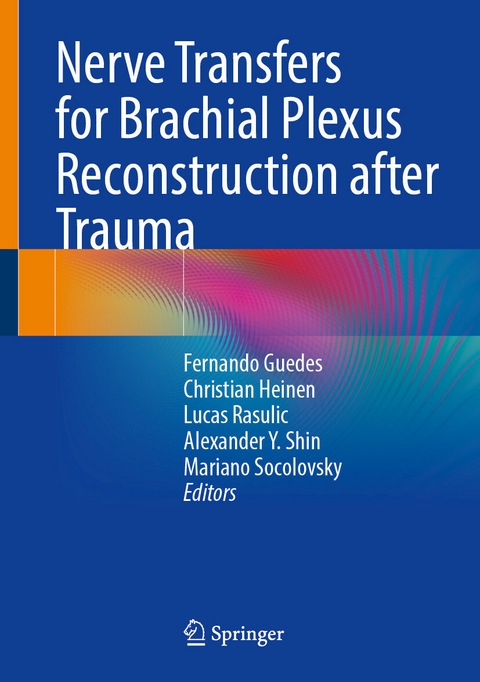
Nerve Transfers for Brachial Plexus Reconstruction after Trauma (eBook)
240 Seiten
Springer (Verlag)
978-3-031-92445-3 (ISBN)
Brachial plexus injury (BPI) is one of the most functionally devastating injuries, as it causes substantial debilitation and long-term difficulties in daily activities. The burden for the patient and the caregiver may arise not only from neurological disability but also from psychosocial and socioeconomic factors.
This injury is more prevalent among young men aged 15 to 25 and is primarily caused by road accidents, especially those involving motorbikes. Other significant causes include obstetric injuries, severe trauma from falls, direct or blunt blows, penetrating injuries, forced traction, and compression injuries.
If a nerve has been divided by a sharp laceration, it can usually be repaired with a direct suture. If a nerve tract has been damaged, as is often the case when it has been subjected to severe traction injuries, repair will require a nerve graft.
Brachial plexus nerve grafts are typically required for lacerations to achieve a tension-free repair. While neurolysis, nerve repair, and nerve grafting have been employed to address stretching plexus injuries, nerve transfers utilize an undamaged nerve to provide motor input over a relatively short distance to reinnervate a denervated muscle. This approach has become the preferred and most extensively studied technique for nerve repair today, with numerous pathways aiming to enhance functional outcomes.
So far, no comprehensive effort has been made to categorize and classify the various nerve transfer techniques and procedures for BPI patients; this is the first book to accomplish that. Neurosurgeons, plastic surgeons, orthopedic surgeons, and hand surgeons must understand and select the most effective methods for treating their BPI patients.
| Erscheint lt. Verlag | 28.8.2025 |
|---|---|
| Zusatzinfo | XV, 240 p. 90 illus., 84 illus. in color. |
| Sprache | englisch |
| Themenwelt | Medizin / Pharmazie ► Medizinische Fachgebiete ► Chirurgie |
| Schlagworte | denervated muscle • Nerve grafting • nerve reconstruction • neurolysis • post-ganglionic lesions • pre-ganglionic lesions • traumatic nerve jnuries |
| ISBN-10 | 3-031-92445-2 / 3031924452 |
| ISBN-13 | 978-3-031-92445-3 / 9783031924453 |
| Informationen gemäß Produktsicherheitsverordnung (GPSR) | |
| Haben Sie eine Frage zum Produkt? |
 PDF (Wasserzeichen)
DRM: Digitales Wasserzeichen
Dieses eBook enthält ein digitales Wasserzeichen und ist damit für Sie personalisiert. Bei einer missbräuchlichen Weitergabe des eBooks an Dritte ist eine Rückverfolgung an die Quelle möglich.
Dateiformat: PDF (Portable Document Format)
Mit einem festen Seitenlayout eignet sich die PDF besonders für Fachbücher mit Spalten, Tabellen und Abbildungen. Eine PDF kann auf fast allen Geräten angezeigt werden, ist aber für kleine Displays (Smartphone, eReader) nur eingeschränkt geeignet.
Systemvoraussetzungen:
PC/Mac: Mit einem PC oder Mac können Sie dieses eBook lesen. Sie benötigen dafür einen PDF-Viewer - z.B. den Adobe Reader oder Adobe Digital Editions.
eReader: Dieses eBook kann mit (fast) allen eBook-Readern gelesen werden. Mit dem amazon-Kindle ist es aber nicht kompatibel.
Smartphone/Tablet: Egal ob Apple oder Android, dieses eBook können Sie lesen. Sie benötigen dafür einen PDF-Viewer - z.B. die kostenlose Adobe Digital Editions-App.
Buying eBooks from abroad
For tax law reasons we can sell eBooks just within Germany and Switzerland. Regrettably we cannot fulfill eBook-orders from other countries.
aus dem Bereich