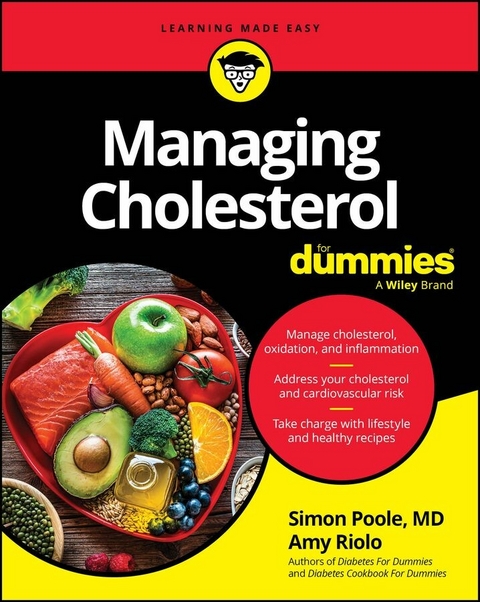
Managing Cholesterol For Dummies (eBook)
381 Seiten
Wiley (Verlag)
978-1-394-33107-9 (ISBN)
Take charge of your heart health with this guide to managing cholesterol
Managing Cholesterol For Dummies demystifies cholesterol and clearly offers effective solutions for prevention, management, and lowering it which have changed in recent years.
This approachable guide helps you understand why balancing overall cholesterol is important, and what you can do to improve your numbers and keep them in check. It also navigates the latest lifestyle tips, medical treatments, complementary therapies, and culinary nutrition research available to keep your heart in shape. You'll also learn what cholesterol really is, how it's formed and linked to inflammatory processes you can reverse, and why it's never too early to think about keeping cholesterol regulated. If you're managing an existing condition, this book will help you make sure you're on a treatment path that works for you. This Dummies guide lays it all out in a clear way, so you can get your cholesterol questions answered without feeling overwhelmed.
- Learn how to maintain good health and reduce the risk of diseases linked to high cholesterol
- Get the latest cholesterol insights, like oxidized LDL cholesterol and why it matters
- Make mouthwatering recipes packed with fiber, antioxidants, and healthful fats to fight inflammation
- Decide on a treatment plan, including medications and complementary therapies, that's right for you
For anyone dealing with elevated cholesterol or helping a loved one manage their numbers-and for people who want to avoid high cholesterol altogether-Managing Cholesterol For Dummies covers all the must-know information for staying healthy.
Simon Poole, MD, has more than 30 years' experience as a doctor, teacher, and researcher. He's an award-winning author and a Senior International Collaborator with the Global Centre for Nutrition and Health in Cambridge (UK).
Amy Riolo is a bestselling author, award-winning chef, television host, and Mediterranean lifestyle ambassador.
Take charge of your heart health with this guide to managing cholesterol Managing Cholesterol For Dummies demystifies cholesterol and clearly offers effective solutions for prevention, management, and lowering it which have changed in recent years. This approachable guide helps you understand why balancing overall cholesterol is important, and what you can do to improve your numbers and keep them in check. It also navigates the latest lifestyle tips, medical treatments, complementary therapies, and culinary nutrition research available to keep your heart in shape. You'll also learn what cholesterol really is, how it's formed and linked to inflammatory processes you can reverse, and why it's never too early to think about keeping cholesterol regulated. If you're managing an existing condition, this book will help you make sure you're on a treatment path that works for you. This Dummies guide lays it all out in a clear way, so you can get your cholesterol questions answered without feeling overwhelmed. Learn how to maintain good health and reduce the risk of diseases linked to high cholesterol Get the latest cholesterol insights, like oxidized LDL cholesterol and why it matters Make mouthwatering recipes packed with fiber, antioxidants, and healthful fats to fight inflammation Decide on a treatment plan, including medications and complementary therapies, that's right for you For anyone dealing with elevated cholesterol or helping a loved one manage their numbers and for people who want to avoid high cholesterol altogether Managing Cholesterol For Dummies covers all the must-know information for staying healthy.
Chapter 1
Why Cholesterol Matters for Health
IN THIS CHAPTER
Understanding the basics of cholesterol and the new science of cholesterol and health
Recognizing the importance of risk
Exploring the benefits of lifestyle and culinary medicine
Odds are, you hear a lot about cholesterol. It’s one of the most common blood tests recommended by doctors and requested by patients — about two-thirds of U.S. adults say they’ve had their cholesterol checked within the last five years. According to the World Health Organization (WHO), approximately 40 percent of adults worldwide have high cholesterol. In 2024, the U.S. Centers for Disease Control and Prevention (CDC) estimated that 86 million adults in the United States have cholesterol levels that are considered borderline or high. In 2024, the value of cholesterol-lowering medications produced by the pharmaceutical industry was $34 billion and it’s predicted to rise to $50 billion by 2033.
But what does this mean for you? To answer that question, you need to know the role of cholesterol in the body, the risks associated with high cholesterol, the latest research that’s changing our understanding of the link between cholesterol and disease, and the role of lifestyle and medications in keeping our cholesterol levels and blood vessels healthy.
In this chapter, you begin to appreciate the importance of cholesterol and why it’s appropriate to ask questions and perhaps challenge some of the previous assumptions about how best to manage your results. Many people feel disempowered by a lack of understanding of the risks of high cholesterol and the pros and cons of taking medication. With the help of the different approach of this book, you can take back that control!
What Cholesterol Means for You
If you’ve had your cholesterol measured, it was probably done in the form of a full lipid panel or full lipid profile, which is a test of circulating fats that include different types of cholesterol. (We describe the elements that make up this complete result and their significance in Chapter 2.)
You may have requested a blood test because you heard it’s important to know your cholesterol level, or your doctor may have ordered the blood test as part of an annual checkup or possibly because you have symptoms of an illness, whether associated with cholesterol or not.
The importance of knowing your cholesterol level stems from the association of high levels of some types of circulating cholesterol with vascular pathology (a disease of the blood vessels that can lead to many different illnesses, including the most common causes of death and sickness in most countries — heart disease and stroke).
But there is much more to the story of cholesterol and the risk of heart disease and stroke than first meets the eye. There is certainly more than is known to many physicians and much more than can be explained in a brief consultation, which may result in a patient committing to lifelong medication. Many aspects of cholesterol remain poorly understood. Not everyone with high cholesterol will end up getting sick. Given that cholesterol levels can vary along a spectrum, the definition of a high cholesterol is inevitably somewhat arbitrary. Plus, there is debate about what causes high cholesterol for many people, as well as controversy about the extent to which highly effective cholesterol medications may cause significant side effects.
During 35 years of clinical practice as a physician in primary care, Simon has had countless consultations with patients about cholesterol — discussing blood tests, risk assessment, and possible treatment for high cholesterol. The challenge for all doctors is to provide enough accurate and up-to-date information within the constraints of the time available, so every patient is in a position to make a fully informed and individual decision about what’s best for them and how to consider if those judgments may change over time.
What Causes Heart Disease
All parts of the body — whether it’s the heart, brain, muscles, lungs, kidneys, or any other organ — depend on a healthy blood supply to fulfill their various functions. The blood vessels that supply oxygen, nutrients, immune support, and hormones to effectively sustain the cells that perform the tasks for life are called arteries. Together with veins, which take the blood back to the heart, they’re collectively described as the vascular system.
Larger blood vessels, which carry blood over longer distances, are part of the macrovascular system. Branches of blood vessels get smaller as they approach the cells they support; here, the arteries become arterioles and capillaries and are described as the microvascular system.
Arteriosclerosis is a condition in which the arteries are hardened and thickened, with fatty or calcified deposits known as plaques. A similar term, atherosclerosis, is more specifically used when describing plaques in larger arteries. (See the nearby sidebar for more on the coining of this term and the study of heart disease over the past couple hundred years.) The changes visible in blood vessels affected by atherosclerosis are shown in Figure 1-1.
© John Wiley & Sons, Inc.
FIGURE 1-1: A blood vessel showing signs of developing changes of atherosclerosis.
So, what does cholesterol have to do with it? Years ago, doctors believed that cholesterol (and saturated fat, which leads to cholesterol production) in the diet caused excess circulating fats, or lipids, and those excess lipids were deposited in blood vessel walls as plaques. The result was damage to and narrowing of the blood vessels, and ultimately blockage of blood supply to vital organs like the heart and brain. But today we know that the process by which cholesterol may be associated with heart disease, stroke, or other organ damage is complex. And the consequences of this understanding are significant.
The path to heart disease or any other vascular disease must be dependent on other factors. After all, not everyone with high cholesterol will develop problems. Plus, because of the complexity of the multiple risk factors for atherosclerosis and how they interact, people with identical cholesterol profiles may well have very different likelihoods of developing disease. It’s obvious that there must be something else (or many other things) going on.
But the story is even more complicated: Cholesterol in the diet doesn’t actually contribute most to blood cholesterol levels, and different fats can have adverse or beneficial effects. Other factors — including carbohydrate metabolism, diabetes, obesity, physical inactivity, some medications, and smoking — can affect cholesterol levels as well.
There have been numerous recent advances in research into the formation, structure and chemistry of blood vessel plaques and it is now possible to explain much more about their relationship with circulating cholesterol. We offer an up-to-date description of how plaques in blood vessels develop, become unstable, and lead to disease in more detail in Chapters 5, 9, and 10. When you understand this subject, you have the opportunity to make actionable changes in the management of your cholesterol.
Perhaps the greatest change in approach has come from the appreciation that plaque progression occurs as a result of chronic inflammation, and that a process called cholesterol oxidation contributes to this process — a phenomenon that has its own underlying causes and can vary significantly between individuals and over time.
Bottom line: The development of atherosclerosis is not just a matter of cholesterol. It relates to oxidation of cholesterol and inflammation of plaques, which can occur where there are excessive reactive oxygen atoms, described as oxidative stress and chronic inflammation. We explore this subject more extensively in Chapter 3. In addition, Chapters 4 and 10 focus on how you may be able to reduce that oxidation and inflammation with relatively easy changes to diet and lifestyle.
THE HISTORY OF THE STUDY OF HEART DISEASE: A CHANGING STORY
In the 17th and 18th centuries, anatomists began to explore the relationship between postmortem changes and diseases. In 1829, Jean Lobstein, a French pathologist, coined the term arteriosclerosis. Lobstein linked this condition to aging and disease, but the mechanism was unclear.
A few decades later, Rudolf Virchow, a German physician and scientist, proposed that plaques resulted from lipid accumulation and inflammation. He described how cholesterol deposits and cellular debris contributed to arterial blockage, forming the foundation for the modern understanding of atherosclerosis.
Early 20th-century researchers, including Nikolai Anichkov, demonstrated experimentally that dietary cholesterol could lead to arterial plaques in animals. This understanding solidified the connection between lipids, plaques, and vascular disease. By the mid-20th century, epidemiological studies, such as the Framingham Heart Study, connected high cholesterol levels and plaque buildup to cardiovascular events like heart attacks and strokes.
From the University of Washington, Seattle, Professor Russell Ross’s 1999 article “Atherosclerosis — An Inflammatory...
| Erscheint lt. Verlag | 26.8.2025 |
|---|---|
| Sprache | englisch |
| Themenwelt | Medizin / Pharmazie ► Medizinische Fachgebiete ► Innere Medizin |
| Schlagworte | bad cholesterol • Cholesterol • Cholesterol Diet • cholesterol lifestyle • cholesterol medication • cholesterol test • good cholesterol • Heart health • heart healthy book • high cholesterol • low cholesterol recipes • preventing heart disease • statins |
| ISBN-10 | 1-394-33107-X / 139433107X |
| ISBN-13 | 978-1-394-33107-9 / 9781394331079 |
| Informationen gemäß Produktsicherheitsverordnung (GPSR) | |
| Haben Sie eine Frage zum Produkt? |
 EPUB (Adobe DRM)
Kopierschutz: Adobe-DRM
Adobe-DRM ist ein Kopierschutz, der das eBook vor Mißbrauch schützen soll. Dabei wird das eBook bereits beim Download auf Ihre persönliche Adobe-ID autorisiert. Lesen können Sie das eBook dann nur auf den Geräten, welche ebenfalls auf Ihre Adobe-ID registriert sind.
Details zum Adobe-DRM
Dateiformat: EPUB (Electronic Publication)
EPUB ist ein offener Standard für eBooks und eignet sich besonders zur Darstellung von Belletristik und Sachbüchern. Der Fließtext wird dynamisch an die Display- und Schriftgröße angepasst. Auch für mobile Lesegeräte ist EPUB daher gut geeignet.
Systemvoraussetzungen:
PC/Mac: Mit einem PC oder Mac können Sie dieses eBook lesen. Sie benötigen eine
eReader: Dieses eBook kann mit (fast) allen eBook-Readern gelesen werden. Mit dem amazon-Kindle ist es aber nicht kompatibel.
Smartphone/Tablet: Egal ob Apple oder Android, dieses eBook können Sie lesen. Sie benötigen eine
Geräteliste und zusätzliche Hinweise
Buying eBooks from abroad
For tax law reasons we can sell eBooks just within Germany and Switzerland. Regrettably we cannot fulfill eBook-orders from other countries.
aus dem Bereich