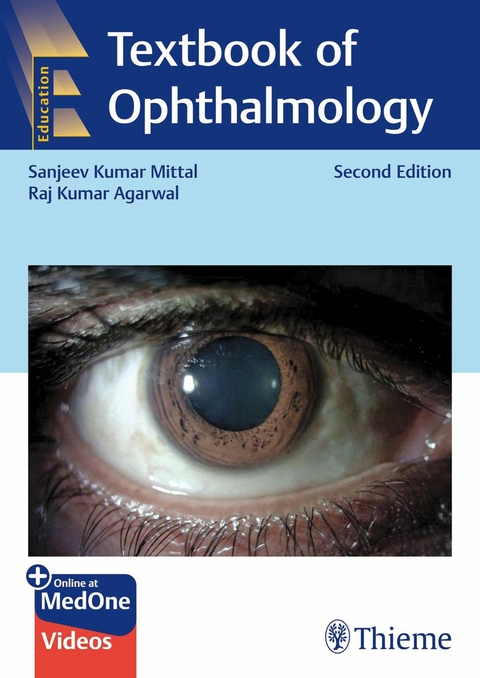
Textbook of Ophthalmology (eBook)
912 Seiten
Thieme Publishers Delhi (Verlag)
978-81-981094-0-8 (ISBN)
This 2nd edition of Textbook of Ophthalmology is updated keeping in view the advancements in diagnostics and treatment. It is an essential book written to cater to the needs of MBBS students, those preparing for PG medical entrance, postgraduate residents, ophthalmic faculty, and practicing ophthalmologists. It covers all theoretical and practical aspects in ophthalmology. It employs gradual progression of content complexity, covering all required aspects of anatomy, physiology, clinico-pathology of eye disorders, necessary investigations, and recommended latest management.Consisting of 28 chapters, the topics begin with anatomy and physiology of vision and further describe all the intraocular structures and their related disorders, intraocular tumors, and injuries.Separate chapters have been included for ocular manifestations in neurological and systemic disorders. The chapter on ocular symptomatology will be helpful to understand the clinical approach to eye diseases. The last chapter on community ophthalmology highlights the latest updates in the "e;National Program for Control of Blindness & Visual Impairment"e; and tele-ophthalmology.Key Features:The text is as per the latest (September 2024) competency based NMC curriculum.It is written in simple language with gradual progression of the content from basics of anatomy, physiology, and clinico-pathology to latest management of different disorders.Understanding and recollection of topics are made easier with algorithms, tables, and flow diagrams along with more than 300 clinical images and illustrations.Applied aspects have been highlighted in boxes.The Competency Mapping Chart is updated.Clinical vignettes are also added at the end of each chapter.A link of videos for various procedures as per the revised competency-based curriculum is also included.
Competency Mapping Chart
| Competency Code | Competency | Chapter No. | Page No. | Video |
| Topic 1: Visual Acuity Assessment |
| OP1.1 | Describe the physiology of vision, optics of eye, and anatomy of visual pathway | 2 3 16 |
| OP1.2 | Define, classify, and describe the types and methods of correcting refractive errors | 3 5 |
| OP1.3 | Demonstrate the steps in performing the visual acuity assessment for distance vision, near vision, color vision, the pinhole test, and the menace and blink reflexes | 2 5 |
| OP1.4 | Enumerate the indications and describe the principles of refractive surgery | 3 26 27 |
| OP1.5 | Define amblyopia, enumerate the types of amblyopia, and describe the prevention and treatment of refractive amblyopia | 18 |
| Topic 2: Lids and Adnexa, Orbit |
| OP2.1 | Describe and discuss the etiology and clinical features, investigations, and treatment of hordeolum externum, hordeolum internum, ectropion, entropion, lagophthalmos, blepharitis, and preseptal cellulitis | 21 23 27 |
| OP2.2 | Demonstrate under supervision, the clinical procedure performed—Bell’s phenomenon, ptosis evaluation, epilation; massage technique in congenital dacryocystitis | 21 27 22 |
| OP2.3 | Describe the etiology, clinical presentation, complications, and management of thyroid eye disease | 23 |
| OP2.4 | Describe the etiology and clinical presentation, discuss the complications and management of orbital cellulitis | 23 |
| OP2.5 | Describe the clinical features on ocular examination and management of a patient with cavernous sinus thrombosis | 23 |
| OP2.6 | Enumerate the causes and describe the differentiating features and clinical features and management of proptosis | 23 |
| OP2.7 | Classification and clinical presentation of various types of orbital tumors | 19 |
| OP2.8 | Describe the investigations, management, and indications for referral of orbital tumors | 23 19 |
| Topic 3: Conjunctiva |
| OP3.1 | Demonstrate history taking in a patient with “red eye,” enumerate the causes for red eye | 5 6 9 |
| OP3.2 | Describe the etiopathogenesis, clinical features, and treatment of acute bacterial and viral conjunctivitis | 6 |
| OP3.3 | Enumerate the causes for chronic conjunctivitis Describe the etiology, pathophysiology, ocular features, differential diagnosis, complications, and management of trachoma | 6 |
| OP3.4 | Enumerate the causes for allergic conjunctivitis; describe the etiology, pathophysiology, ocular features, complications, and management of vernal catarrh | 6 |
| OP3.5 | Describe the etiology, pathophysiology, ocular features, differential diagnosis, complications, and management of pterygium | 6 |
| OP3.6 | Demonstrate correct technique of removal of foreign body from the eye in a simulated environment | 20 |
| OP3.7 | Demonstrate under supervision the technique of instillation of eye drops and counseling of patients you put on topical ocular medications | 4 |
| Topic 4: Corneas |
| OP4.1 | Describe the applied anatomy and physiology of cornea and the factors maintaining corneal transparency | 7 |
| OP4.2 | Enumerate various congenital anomalies and inflammations of cornea | 7 |
| OP4.3 | Enumerate the differential diagnosis of corneal ulcer (infective keratitis) and describe the etiopathogenesis, clinical features, and management of each type of infective keratitis | 7 |
| OP4.4 | Identify corneal opacity and different grades of corneal opacity; enumerate various management modalities of corneal opacity | 7 |
| OP4.5 | Describe tear film; enumerate the causes of dry eyes and describe the clinical features and management of dry eyes | 22 |
| OP4.6 | Define blindness; enumerate the causes of corneal blindness | 28 |
| OP4.7 | Enumerate the types and the indications of keratoplasty | 27 |
| OP4.8 | Describe the importance of eye donation and eye banking and enumerate the various protocols involved in eye donation and eye banking | 27 |
| OP4.9 | Identify corneal foreign body and demonstrate techniques of removal of corneal foreign body in simulated environment | 20 |
| OP4.10 | Counsel patients and family in a simulated environment about eye donation and teach them how to preserve the eye in the deceased till enucleation is done | 27 |
| Topic 5: Sclera |
| OP5.1 | Describe the etiopathogenesis, classification, clinical features, complications, and management of episcleritis | 8 |
| OP5.2 | Enumerate the systemic conditions associated with episcleritis and scleritis, and indications for their referral | 8 |
| Topic 6: Iris and Anterior Chamber |
| OP6.1 | Define uveitis; describe the anatomical classification of uveitis; describe the clinical features of iridocyclitis; distinguish granulomatous iridocyclitis from non-granulomatous iridocyclitis | 9 5 20 |
| OP6.2 | Describe the complication of iridocyclitis, and investigations and treatment of iridocyclitis | 9 |
| OP6.3 | Distinguish hyphema from hypopyon clinically and enumerate their... |
| Erscheint lt. Verlag | 18.12.2025 |
|---|---|
| Sprache | englisch |
| Themenwelt | Medizin / Pharmazie ► Allgemeines / Lexika |
| Medizin / Pharmazie ► Medizinische Fachgebiete ► Augenheilkunde | |
| Medizin / Pharmazie ► Studium | |
| Schlagworte | clinical ophthalmology • cornea • eye surgery • glaucoma • MBBS student • Ocular Diseases • postgraduate entrance • theoretical and practical topics of ophthalmology |
| ISBN-10 | 81-981094-0-4 / 8198109404 |
| ISBN-13 | 978-81-981094-0-8 / 9788198109408 |
| Informationen gemäß Produktsicherheitsverordnung (GPSR) | |
| Haben Sie eine Frage zum Produkt? |
 EPUB (Wasserzeichen)
DRM: Digitales Wasserzeichen
Dieses eBook enthält ein digitales Wasserzeichen und ist damit für Sie personalisiert. Bei einer missbräuchlichen Weitergabe des eBooks an Dritte ist eine Rückverfolgung an die Quelle möglich.
Dateiformat: EPUB (Electronic Publication)
EPUB ist ein offener Standard für eBooks und eignet sich besonders zur Darstellung von Belletristik und Sachbüchern. Der Fließtext wird dynamisch an die Display- und Schriftgröße angepasst. Auch für mobile Lesegeräte ist EPUB daher gut geeignet.
Systemvoraussetzungen:
PC/Mac: Mit einem PC oder Mac können Sie dieses eBook lesen. Sie benötigen dafür die kostenlose Software Adobe Digital Editions.
eReader: Dieses eBook kann mit (fast) allen eBook-Readern gelesen werden. Mit dem amazon-Kindle ist es aber nicht kompatibel.
Smartphone/Tablet: Egal ob Apple oder Android, dieses eBook können Sie lesen. Sie benötigen dafür eine kostenlose App.
Geräteliste und zusätzliche Hinweise
Buying eBooks from abroad
For tax law reasons we can sell eBooks just within Germany and Switzerland. Regrettably we cannot fulfill eBook-orders from other countries.
aus dem Bereich