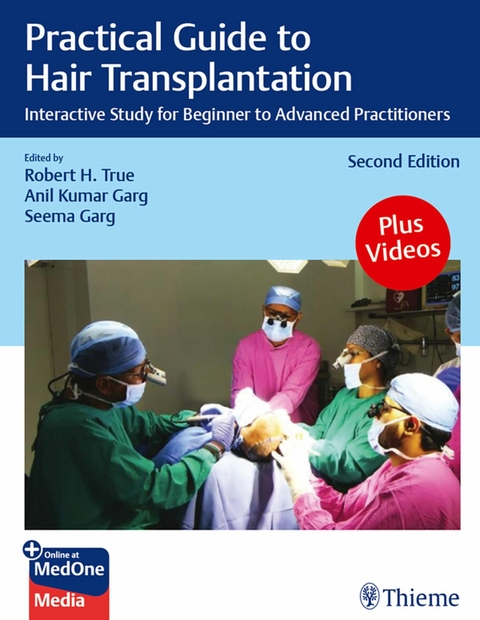
Practical Guide to Hair Transplantation (eBook)
778 Seiten
Thieme Medical Publishers (Verlag)
978-81-972990-2-5 (ISBN)
Written for doctors new to the field of hair transplantation and designed to help them develop their understanding and skills. Practical details on performing all aspects of hair transplant surgery are clearly described.Divided into three parts, Part A focuses on the principal, techniques, and steps, which, when meticulously followed, result in successful hair restorations. Part B provides the basic knowledge vital for new hair restoration surgeons, it is also important for practicing surgeons. Part c comprises chapters on the advanced state-of-the-art knowledge and techniques beyond what the novice must master in the beginning, which will become the important components of the therapeutic armamentarium as the surgeon progresses to expert status.Key HighlightsAll graft harvesting and implantation techniques are presented with description and videos by renowned surgeons.Practical details for performing all aspects of hair transplant surgery are clearly described in a step-by-step manner and illustrated in detail with high-quality photographs, illustrations, and videos.The latest follicular unit excision (FUE) concepts and techniques are presented.The guide is authored by a group of distinguished doctors from around the world, many of whom have pioneered the techniques they describe.
CHAPTER 1 Consultation with the Patient
Seema Garg
Overview
Keypoints
•History plays the most important role in evaluating the process of alopecia.
•Proper history along with the local and systemic examinations and investigations is needed to make the final diagnosis.
•The decision to undertake a hair transplant shall be taken in the interest of the patient, considering the patient’s requirements and short- and long-term benefits.
•A patient must understand that hair loss is an ongoing process. Hair transplant cannot prevent loss of existing hair.
•For coverage of the future balding area or to increase density he or she may need more than one session of surgery.
•A surgeon must refuse the patient if he or she has unrealistic goals, is not fit medically for the surgery, or is not satisfied with the technique of the hair transplant.
Introduction
The components of consulting with a hair loss patient are the following: history, examination, diagnostic testing, development of a treatment plan, and patient education. This chapter will focus on the history, general medical examination, and patient education. Chapter 2 is on scalp examination, Chapter 3 on long-term planning, and Chapter 4 on short-term planning.
A sample form for documenting all parts of the consultation is shown in Appendix 1.1 at the end of the chapter.
History
History includes (1) learning the patient’s chief complaint, (2) obtaining their general medical history, and (3) obtaining a hair-specific history.
Hair is considered as a sign of beauty and youthfulness, both in men and women. Hair loss results in lack of confidence, especially in the younger population as the person looks older than his age. Although hair loss is not a life-threatening condition, it may result in a general dissatisfaction with one’s physical appearance and may cause depression. Commonly, people with excessive hair loss come for medical help to a hair restoration physician.
Hair loss is a symptom, not a diagnosis. Up to 100 strands of hair normally fall every day.1 Excessive hair loss may occur because of a variety of reasons, such as postpartum stage in females, thyroid disorder, androgenetic cause, side effects of drugs, iron deficiency, burn, scarring, etc. The probable cause of hair loss can often be determined just by taking the proper history of the patient.
Obtain Patient History
History plays the most important role in evaluating the disease or condition process. The most common complaint from a patient is hair thinning or hair loss resulting in bare scalp. Ask the patient whether their hair is thinning (getting less dense) and/or their hair is falling or shedding more. Is the hair loss associated with any life or health event? Are there symptoms of anemia, hyperandrogenism, or thyroid disease? Patients with hair shedding may have telogen effluvium; the history may reveal the precipitating event of the telogen effluvium (Fig. 1.1). Androgenetic alopecia usually starts with diffuse thinning of hair on the top of the head. Alopecia areata is seen as multiple round patches of hair loss that appear over a short period of time, and it may extend to the eyebrows, beard, and other body areas. Traction alopecia and trichotillomania also cause patchy hair loss and can usually be identified from the history. Patients may also complain of redness, itchiness, and pain in a localized area or all over the scalp, which suggest a possible scarring alopecia. Therefore, refer the patient to a dermatologist for evaluation of scarring alopecia. Folliculitis decalvans or tufted folliculitis is a type of scarring alopecia with inflamed papules, pustules, and crust at the edge of the lesion, and lichen planopilaris presents with peripilar erythema and scaling with small patches of baldness. These are all types of scarring or cicatricial alopecias (Table 1.1).
Proper history, along with local and systemic examinations, and diagnostic investigation are needed to make a final diagnosis, and making a correct diagnosis is necessary to prescribe proper treatment. Hair transplantation is contraindicated in scarring alopecia like lichen planopilaris and folliculitis decalvans. If we do determine that a patient is suitable for hair transplantation, then a detailed general medical history is needed to exclude any condition that could affect the surgery or outcome of the surgery.
Fig. 1.1 Consultation of the patient with hair loss.
It is good to know when a patient last visited his or her physician. It will give a general idea about his or her medical condition. A diabetic patient on insulin or oral hypoglycemic agent is prone to both hyperglycemia (stress-induced) and hypoglycemia (due to inadequate oral intake during long hours of surgery). Monitoring blood glucose levels during surgery is essential in such patients.
Some hair restoration surgeons routinely prescribe corticosteroids during and after surgery to prevent edema. In diabetics and patients with gastric peptic diseases, it is better to avoid steroids.
Patients with hypertension or other heart diseases like ischemic, valvular, or conduction defects and arrhythmia require clearance from the treating physician. In such patients, it is crucial to know their medications, like antiplatelets or beta-blockers; these may interact with other medications used during surgery.
Treat skin conditions like seborrheic dermatitis, folliculitis, or psoriasis before surgery. Also, if there is a history of frequent skin infections, rule out methicillin-resistant Staphylococcus aureus (MRSA) infection and treat it if positive.
Antibiotic prophylaxis is necessary for patients with a history of prosthetic implants, whether pacemakers, cardiac valves, or joint implants. Prior scalp surgeries may reduce blood circulation of the scalp skin and increase the chances of necrosis after hair transplantation.
Some neurological disorders like the history of epilepsy and sleep apnea shall be taken. Social history includes alcohol, tobacco, smoking, and drug abuse habits. Psychological history includes probing if the patient is suffering from depression, anxiety, or any other mental illness and whether they are taking medicines for that.
A thorough history plays a crucial role in assessing the patient’s overall condition.
A checklist is provided in Table 1.1. Table 1.2 enumerates the list of medications to inquire about from the patient before surgery.
Hair transplantation is an elective surgery. As is true in all medical practices, the first aim shall be to “do no harm.” Although it is a type 1 surgery involving only skin and subcutaneous tissue, surgeries typically do take several hours, and surgeons need to be very cautious about each and every step.
Table 1.1 Checklist for taking history in a case of alopecia (for details refer to Chapter 13: Diagnosing the Cause of Hair Loss)
| Name________________ Age___________ Date___________ 1.Chief complaint; history of chief complaint: How long is this problem of hair loss? How did it begin? (related to any factor, e.g., stress) Is there associated pain, redness, or itching? (scarring alopecia?) Is the hair loss in the form of shedding (telogen effluvium), thinning (androgenetic alopecia), or breakage? Is the hair loss continuing, or is it stable now? Have any treatment(s) been used for this? What and when? 2.Past medical history: How is general health? Any illness in the past requiring long-term treatment or current treatment? Any menstrual irregularity or androgen excess history in women (polycystic ovary syndrome [PCOS], hirsutism, acne)? Any history of thyroid disorder, diabetes mellitus (DM), hypertension? Are you taking medicines for seizure, asthma? Any joint problems, heart problems, valve disease, etc.? History of blood transfusion? History of bleeding disorders: nose bleed, easy bruising? 3.Past surgical history: Previous reaction to local anesthetics? Any difficulty in wound healing? Any tendency for hypertrophic scarring or keloid? Any artificial joint surgery, valve replacement, etc.? 4.Family history: Hair loss in parents, grandparents, siblings. Usually there is a positive genetic history from paternal or maternal side. (First- or second-degree relatives can be affected in the family.) Family history of hypertension, diabetes, etc. 5.Medications: Current medicines: both prescribed and not prescribed, nonselective beta-blockers, antiepileptics? Hair loss treatment(s) used Vitamin food supplements 6.Anabolic steroid 7.Social history: Smoking/alcohol/any other habits 8.Allergies (very important): Allergy with any drug (analgesics, antibiotics, or others), food, or contact 9.Review of systems: Lungs: history of shortness of breath, etc. Heart: chest pain, or valve, hypertension Nervous:... |
| Erscheint lt. Verlag | 9.10.2025 |
|---|---|
| Sprache | englisch |
| Themenwelt | Medizinische Fachgebiete ► Chirurgie ► Ästhetische und Plastische Chirurgie |
| Medizin / Pharmazie ► Medizinische Fachgebiete ► Dermatologie | |
| Schlagworte | follicular unit excision • Hair restoration • implantation techniques |
| ISBN-10 | 81-972990-2-1 / 8197299021 |
| ISBN-13 | 978-81-972990-2-5 / 9788197299025 |
| Informationen gemäß Produktsicherheitsverordnung (GPSR) | |
| Haben Sie eine Frage zum Produkt? |
 EPUB (Wasserzeichen)
DRM: Digitales Wasserzeichen
Dieses eBook enthält ein digitales Wasserzeichen und ist damit für Sie personalisiert. Bei einer missbräuchlichen Weitergabe des eBooks an Dritte ist eine Rückverfolgung an die Quelle möglich.
Dateiformat: EPUB (Electronic Publication)
EPUB ist ein offener Standard für eBooks und eignet sich besonders zur Darstellung von Belletristik und Sachbüchern. Der Fließtext wird dynamisch an die Display- und Schriftgröße angepasst. Auch für mobile Lesegeräte ist EPUB daher gut geeignet.
Systemvoraussetzungen:
PC/Mac: Mit einem PC oder Mac können Sie dieses eBook lesen. Sie benötigen dafür die kostenlose Software Adobe Digital Editions.
eReader: Dieses eBook kann mit (fast) allen eBook-Readern gelesen werden. Mit dem amazon-Kindle ist es aber nicht kompatibel.
Smartphone/Tablet: Egal ob Apple oder Android, dieses eBook können Sie lesen. Sie benötigen dafür eine kostenlose App.
Geräteliste und zusätzliche Hinweise
Buying eBooks from abroad
For tax law reasons we can sell eBooks just within Germany and Switzerland. Regrettably we cannot fulfill eBook-orders from other countries.
aus dem Bereich