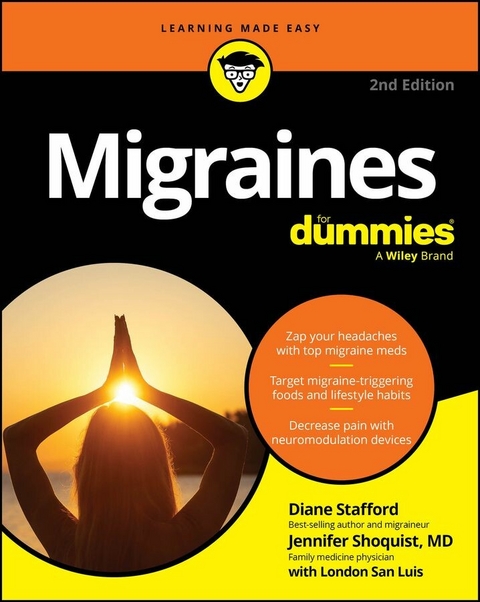
Migraines For Dummies (eBook)
432 Seiten
For Dummies (Verlag)
978-1-394-35784-0 (ISBN)
Listen up and lock down today's best migraine pain solutions
Haven't you spent enough time juggling schedules and cancelling events when headache pain sidelined you? You can put those days behind you with up-to-date information on the when-why-how of migraines and a whole-of-body approach to micromanaging them. Migraines For Dummies supplies the answers you've been looking for in the form of straightforward explanations and reliable advice to help you tackle symptoms, avoid triggers, and find the best medical support. You'll explore new drug therapies, including prescription meds, over-the-counter drugs, nerve stimulators, and alternative remedies. Plus, learn how to reduce migraine frequency by tweaking diet, sleep, and exercise. Updated with the latest research, this Dummies guide shows you how to balance medical care and lifestyle adjustments to fix that aching head of yours and upgrade your quality of life once and for all.
- Resolve migraine pain with new neuromodulation devices that trick your brain
- Identify foods and lifestyle habits that trigger your migraines
- Discover great ways to manage migraines in early, middle, and elder years
- Find out how to avoid the mistake of doubling down on medications
Millions suffer from migraines. That's why it's key to stay on top of developments in diagnosis and treatment. If you or someone you love wrestles with headaches on a regular basis, let Migraines For Dummies deliver topnotch ideas that will change your life forever.
Diane Stafford is a health writer who has written 14 books over more than 20 years. She has extensive personal experience dealing with migraines.
Jennifer Shoquist, MD, is a family medicine physician with 18 years' experience treating patients. She is especially passionate about treating people with migraines.
Chapter 1
Understanding Migraines
IN THIS CHAPTER
Getting a take on migraines
Identifying common types of headaches
Understanding why your head hurts
Personalizing your treatment plan
Juggling family and work issues related to migraine
When you get past the initial shock of having migraines, a symptom becomes a vivid “notification” that it’s time to pull out your cache of weaponry. Whether your go-to answer is a prescription medication, a nerve-stimulating device, or a lifestyle alteration, you’ll know exactly how to smooth your way to a healthier place.
This book supplies the tools you need to banish pain and other symptoms. We share treatments from both medical knowledge and lived experiences. The takeaways apply to children, teens, Millennials, middle-aged people, and older adults, and we’re excited to share insights that will make your life infinitely better.
Granted, migraines are complex. Just when you think you’ve conquered the beast, triggers team up and deliver blockbuster pain that reminds you that migraine attacks are changing targets. Obviously, that variability makes self-care key, and the sooner you are diagnosed and develop a plan, the better. Then, when nature tosses your head a grenade, you can stage a powerful defense.
Migraine enlightenment is magically freeing. People with migraine love days that are headache free, and we’re here to hand you the golden ticket to subduing the dragon for the rest of your life. This chapter gets you started by providing an overview of common types of headaches and how to approach working with them.
Incidentally, you may have noticed our reference to “migraine” in place of “migraines.” Both the singular and plural are acceptable usage today, but you’ll impress your doctor by referring to having “migraine,” which is the version currently endorsed. Either way, the condition hurts — but we’re here with lots of help!
Knowing What Migraines Are — and What They Aren’t
A migraine is an intense, recurring headache, but each occurrence isn’t always debilitating, and it’s usually manageable. The trick to living with migraine is to pinpoint your migraine triggers and find medications and lifestyle changes that get you right back in the game. In short, you don’t have to suffer from FOMO (fear of missing out) if you stay well-informed.
What migraines are
A common myth states that any bad headache that is disabling and excruciating must be a migraine. But the truth is that although some migraine attacks are very severe, others are mild to moderate. Tension headaches, too, can be extremely painful, as can red-flag headaches caused by serious problems such as a hemorrhage (bleeding) in the brain.
Migraine symptoms are different in different people. The uniqueness of the symptoms, in fact, is one reason that some people with migraine end up living for years without effective medication because they don’t even know that their headaches are migraine related. Some experts estimate that many people with migraine would benefit from preventive medications that reduce severity and frequency, but only a small percentage take advantage of these prescription options.
For example, you may assume, based on what you’ve heard, that the headaches you get can’t be migraines because you don’t experience the symptoms you’ve heard from those old wives of “old wives’ tale” fame. The truth, however, is that migraines have a wide variety of symptoms, and not everyone has classic symptoms. Many people experience migraine symptoms for years before going to a doctor to be diagnosed, and that is unfortunate because so many solutions are available.
Although we go into more detail about migraine symptoms in later chapters, the symptoms of migraine include but are not limited to the following:
- Throbbing or pulsating pain that is usually on one side of your head.
- Pain that ranges from moderate to severe.
- An aura that occurs prior to a migraine. An aura is typically a visual disturbance of zigzag lines or flashing lights, and it lasts from a few minutes to less than an hour. You may also experience numbness or tingling of the face and hands. Most people with migraine don’t experience auras, but those who do have a variety of visual symptoms, some of which are alarming, like temporary partial loss of vision in one eye.
- Lethargy and malaise.
- Nausea, vomiting, or both; sensitivity to light, smells, or sounds (or all those); lack of appetite.
The following are features that many people with migraine have in common:
- You come from a family of people with migraine, who may include your parents, grandparents, and siblings.
- Your headaches last from about four hours to three days.
- Sleep usually helps you feel better.
Your headache frequency can be several times a week, once a month, or even less often than that. A day or two before your headache, you may experience any of the following: yawning, frequent urination, drowsiness, irritability, and euphoria. After a headache, you may feel like you have a pain hangover — you’re tired, you don’t feel hungry, and your thinking processes seem slower.
A migraine is essentially a headache and more. Because the normal functioning of your central nervous system is disrupted during a migraine, all body systems are affected. As a result, you may be bothered by sounds, smells, and lights. Your scalp may feel tender. Your feet and hands may be cold.
Symptoms of migraines vary in each individual, so don’t assume that your headaches aren’t migraines just because you lack auras or other classic symptoms. More people with migraine don’t have auras than do. You may have generalized head pain instead of the classic one-sided misery. Further, many people with migraine have never experienced visual disturbances, nausea, or vomiting. Tell your medical experts about your symptoms, and let them identify the kind of headaches you’re having and determine what can be done to wipe out the pain.
About 42 percent of people with migraine inherited a proclivity for it, according to the latest estimates. But you still can take charge of your nervous system by limiting your exposure to triggers. For example, factors that combine to affect your nervous system are certain foods, stress, disordered sleep, and lack of movement. Handle these factors properly, and you may reap the big win of fewer migraines. If migraine runs in your family, a predilection for migraine attacks is part of your genetic material, and you can’t run away from it. In all likelihood, migraine is due to combinations of multiple genes that cause a person to tend to have migraine attacks. (Chapter 3 has more on the genetics/migraine connection.)
What migraines aren’t
The other main types of headaches have symptoms that are different from those of migraine — but sometimes symptoms overlap, making diagnosis difficult. (See Chapter 4 for information on headaches that people often confuse with migraine.)
Some signs that your headache isn’t related to migraine:
- You feel a tight band of discomfort around your head.
- Your shoulder and neck muscles feel knotted.
- You have headaches only after sex or physical exertion.
- Your headaches are getting steadily worse.
Identifying the Common Types of Headaches
Consider the following indicators of these headache types:
- Migraine: The key symptoms are a throbbing head pain that’s typically one-sided, intensity that’s moderate to severe, and a lengthy duration (a migraine attack can last from a few hours up to several days). Activity may make you feel worse. You may have accompanying nausea and vomiting, and/or sensitivity to light and sound. If you suffer from migraines, you usually have headaches on a regular basis.
-
Tension-type headaches: A common headache in people who have migraine, depression, or both, this type of headache presents with a dull ache of mild to moderate pain. The pressure is on both sides of your head, and it comes on slowly.
If you feel pain on both sides of your head, or like a band around the head, including the forehead and back of your head — and if the pain feels more like tightness than it does a throbbing or pounding — you probably have a tension-type headache. You don’t have vomiting or auras with this kind of headache. Tension headaches can occur very frequently (even daily) and are sometimes very painful. Such a headache may last 30 minutes to a week. Triggers are disordered sleep, sunlight exposure, dehydration, alcohol consumption, stress, and long periods of gazing at a computer or cell phone.
-
Cluster headaches: This headache is characterized by sudden and severe piercing pain on one side of the head. These headaches come in clusters — appearing during several consecutive days, weeks, or months, and then disappearing, only to come back months or years later. Cluster headaches can come and go five or six times during a day. They’re usually short-lived, lasting from 15 minutes to two or three hours each time.
With a cluster headache, you may have a droopy-looking eyelid or sweating on the side...
| Erscheint lt. Verlag | 21.8.2025 |
|---|---|
| Sprache | englisch |
| Themenwelt | Medizin / Pharmazie ► Allgemeines / Lexika |
| Schlagworte | Alternative medicine migraine • chronic migraine • London San Luis • migraine • migraine alternative treatment • migraine book • Migraine Headaches • migraine medication • migraine symptoms • Migraine treatment • Vestibular Migraine • visual migraine • what is migraine |
| ISBN-10 | 1-394-35784-2 / 1394357842 |
| ISBN-13 | 978-1-394-35784-0 / 9781394357840 |
| Informationen gemäß Produktsicherheitsverordnung (GPSR) | |
| Haben Sie eine Frage zum Produkt? |
 EPUB (Adobe DRM)
Kopierschutz: Adobe-DRM
Adobe-DRM ist ein Kopierschutz, der das eBook vor Mißbrauch schützen soll. Dabei wird das eBook bereits beim Download auf Ihre persönliche Adobe-ID autorisiert. Lesen können Sie das eBook dann nur auf den Geräten, welche ebenfalls auf Ihre Adobe-ID registriert sind.
Details zum Adobe-DRM
Dateiformat: EPUB (Electronic Publication)
EPUB ist ein offener Standard für eBooks und eignet sich besonders zur Darstellung von Belletristik und Sachbüchern. Der Fließtext wird dynamisch an die Display- und Schriftgröße angepasst. Auch für mobile Lesegeräte ist EPUB daher gut geeignet.
Systemvoraussetzungen:
PC/Mac: Mit einem PC oder Mac können Sie dieses eBook lesen. Sie benötigen eine
eReader: Dieses eBook kann mit (fast) allen eBook-Readern gelesen werden. Mit dem amazon-Kindle ist es aber nicht kompatibel.
Smartphone/Tablet: Egal ob Apple oder Android, dieses eBook können Sie lesen. Sie benötigen eine
Geräteliste und zusätzliche Hinweise
Buying eBooks from abroad
For tax law reasons we can sell eBooks just within Germany and Switzerland. Regrettably we cannot fulfill eBook-orders from other countries.
aus dem Bereich