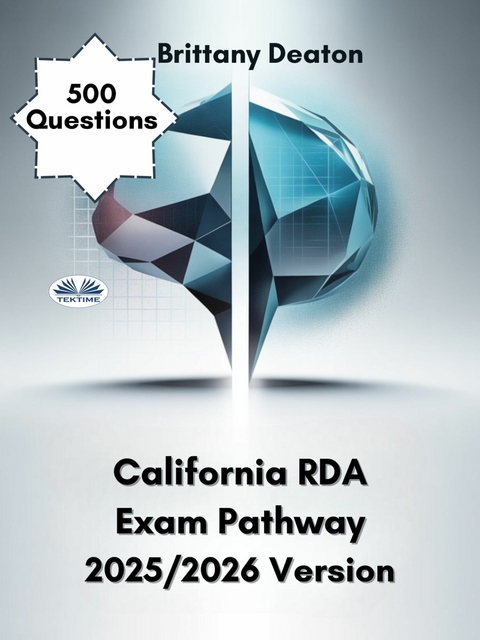
California RDA Exam Pathway 2025/2026 Version (eBook)
154 Seiten
Tektime (Verlag)
978-88-354-8114-0 (ISBN)
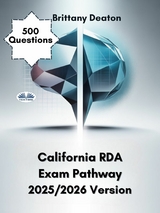
This comprehensive study guide is designed specifically for individuals preparing for the California Registered Dental Assistant (RDA) exam, including both the written and law & ethics components. Updated for the 2025/2026 exam cycle, it offers the tools, strategies, and practice you need to pass with confidence and launch your career in dental assisting.
Key Features:
Aligned with the California Dental Board's current exam blueprint, covering core topics such as dental procedures, infection control, radiology, sterilization, patient care, and California dental law.
500 high-quality practice questions with detailed explanations to reinforce understanding, test application, and identify areas for improvement.
Covers all key areas tested on the written exam and law & ethics test, including patient rights, scope of practice, and dental terminology.
Includes test-taking strategies to manage time, reduce anxiety, and confidently tackle multiple-choice questions.
Structured for focused study with organized content sections, review checklists, and quick-reference material.
Why This Guide Works:
Tailored specifically to California RDA candidates-no generic or out-of-state material.
Written in plain language to make complex concepts easy to understand and retain.
Suitable for both recent dental assisting graduates and experienced candidates needing a refresh.
Developed by professionals with expertise in California dental assisting standards and education.
What You'll Gain:
A thorough understanding of both clinical and legal exam content
Confidence through realistic practice and repetition
Improved test performance and critical thinking under pressure
A direct path to passing the California RDA exam and starting your dental career
This comprehensive study guide is designed specifically for individuals preparing for the California Registered Dental Assistant (RDA) exam, including both the written and law & ethics components. Updated for the 2025/2026 exam cycle, it offers the tools, strategies, and practice you need to pass with confidence and launch your career in dental assisting.Key Features:Aligned with the California Dental Board's current exam blueprint, covering core topics such as dental procedures, infection control, radiology, sterilization, patient care, and California dental law.500 high-quality practice questions with detailed explanations to reinforce understanding, test application, and identify areas for improvement.Covers all key areas tested on the written exam and law & ethics test, including patient rights, scope of practice, and dental terminology.Includes test-taking strategies to manage time, reduce anxiety, and confidently tackle multiple-choice questions.Structured for focused study with organized content sections, review checklists, and quick-reference material.Why This Guide Works:Tailored specifically to California RDA candidates-no generic or out-of-state material.Written in plain language to make complex concepts easy to understand and retain.Suitable for both recent dental assisting graduates and experienced candidates needing a refresh.Developed by professionals with expertise in California dental assisting standards and education.What You'll Gain:A thorough understanding of both clinical and legal exam contentConfidence through realistic practice and repetitionImproved test performance and critical thinking under pressureA direct path to passing the California RDA exam and starting your dental career
Chapter 2 Clinical Procedures & Materials
Chairside Assisting Techniques & Ergonomics
Chairside assisting is one of the most critical responsibilities of a Registered Dental Assistant (RDA) in California. It involves directly supporting the dentist during procedures, ensuring that the patient is comfortable, the equipment is prepared, and the environment is safe and efficient. Proper chairside techniques and ergonomics are vital for maintaining high standards of care and preventing injuries for both patients and dental professionals. This chapter explores these essential elements, breaking down each concept in simple and practical terms to help RDA candidates fully grasp the foundational knowledge necessary to succeed on the job and in the California RDA Exam.
Understanding Chairside Assisting
Chairside assisting refers to all the duties a dental assistant performs while working directly with a dentist during a patient’s treatment. This includes handing instruments, operating suction devices, retracting soft tissues, preparing materials, and ensuring proper infection control. The role of a chairside assistant is not just to assist but to anticipate the needs of the dentist and support the patient throughout the procedure.
A successful dental assistant must develop a good working relationship with the dentist, understand procedures well enough to predict what will be needed next, and communicate effectively. Confidence, organization, and attention to detail are essential traits that improve chairside efficiency.
Key Chairside Assisting Techniques
1. Four-Handed Dentistry
One of the main techniques in modern chairside assisting is four-handed dentistry. This method involves the dentist and the assistant working together in a coordinated and ergonomic way. The assistant passes instruments, manages suction, and helps with materials while the dentist focuses on the procedure. This system reduces fatigue for the dentist and improves procedure speed.
Process of Four-Handed Dentistry:
- The assistant sits across from the dentist, slightly above patient level.
- Instruments are passed using a smooth, efficient motion in the transfer zone.
- Suction and retraction are handled simultaneously with non-dominant hand.
- The assistant ensures a continuous workflow by preparing instruments and materials in advance.
2. Instrument Transfer
Proper instrument transfer is a fundamental skill. The assistant must learn to hand over instruments quickly, quietly, and correctly to maintain rhythm.
Steps for Effective Transfer:
- Hold instruments near the working end.
- Use the left hand for transfer (if the dentist is right-handed).
- Use a modified pen grasp or palm-thumb grasp depending on the tool.
- Be mindful of sharp edges and patient comfort.
3. Moisture Control
Maintaining a dry working field is essential. Assistants use devices like the high-volume evacuator (HVE), saliva ejector, and cotton rolls.
Moisture Control Techniques:
- Position HVE near the working area without obstructing the dentist’s view.
- Use the saliva ejector for less invasive procedures.
- Monitor the patient’s comfort and reposition as necessary.
4. Retraction Techniques
Retracting the cheeks, lips, or tongue allows better access and visibility for the dentist. This must be done gently to avoid discomfort.
Methods:
- Use the mirror or fingers to move soft tissues.
- Ensure good lighting and visibility.
- Communicate with the patient if discomfort arises.
Dental Assistant Ergonomics
Ergonomics is the science of designing the workplace to fit the worker, minimizing fatigue and injury risk. For dental assistants, who often remain in static postures and repeat motions, proper ergonomics are crucial.
1. Proper Seated Position
The correct seated position helps avoid back, neck, and shoulder strain.
Correct Seated Position Includes:
- Sitting on a saddle stool or assistant’s chair with a foot ring.
- Feet flat on the foot ring.
- Knees slightly below hip level.
- Back straight, with lumbar support.
- Shoulders relaxed and even.
2. Zone of Activity
The dental operatory is divided into zones to facilitate four-handed dentistry:
- Operator’s Zone: Where the dentist works (7 to 12 o’clock).
- Assistant’s Zone: Where the assistant operates (2 to 4 o’clock).
- Transfer Zone: Where instrument exchange happens (4 to 7 o’clock).
- Static Zone: Storage area behind the patient’s head (12 to 2 o’clock).
Understanding and staying within these zones allows smoother operations and better teamwork.
3. Lighting and Visibility
Correct lighting minimizes eye strain and improves accuracy. Adjust the overhead light to focus on the oral cavity without casting shadows. Use auxiliary lighting if needed.
4. Stretching and Movement
Dental assisting can lead to repetitive strain injuries. It’s important to stretch periodically and shift positions between procedures.
Tips for Injury Prevention:
- Stretch the neck, shoulders, and wrists.
- Take microbreaks during long procedures.
- Avoid twisting motions when reaching.
Infection Control and Safety in Chairside Assisting
Even though infection control is covered in a separate section, it ties directly into chairside assisting. The assistant is responsible for keeping the operatory clean and safe during patient care.
Key Responsibilities Include:
- Wearing personal protective equipment (PPE).
- Disinfecting surfaces and equipment between patients.
- Ensuring instrument sterilization.
- Following standard precautions.
Patient Communication and Comfort
Part of a dental assistant’s job is to make patients feel calm and informed.
Strategies Include:
- Explaining procedures clearly.
- Maintaining a friendly and calm tone.
- Assisting patients in positioning and comfort.
- Observing signs of anxiety or discomfort.
Chairside Responsibilities Before, During, and After Procedures
Understanding the flow of duties across each stage of treatment ensures efficiency and safety.
Before the Procedure
- Review the patient’s chart and medical history.
- Prepare the tray with correct instruments and materials.
- Disinfect the treatment area.
- Seat and drape the patient.
During the Procedure
- Pass instruments using proper transfer technique.
- Operate HVE and provide retraction.
- Mix and hand materials.
- Monitor patient comfort.
After the Procedure
- Help the patient rinse and sit up slowly.
- Provide post-operative instructions.
- Dispose of or disinfect materials as required.
- Document the procedure.
- Prepare the operatory for the next patient.
Common Chairside Challenges and Solutions
Even experienced assistants face obstacles. Preparing for these challenges helps maintain a professional and calm demeanor.
Examples:
- Missing Instruments: Always double-check tray setups.
- Patient Anxiety: Use positive reassurance and slow explanations.
- Poor Visibility: Adjust light and retraction.
- Fatigue: Use ergonomic posture and take regular breaks.
Conclusion
Chairside assisting techniques and ergonomics are at the heart of successful dental assisting. Mastering four-handed dentistry, instrument transfer, moisture control, and proper posture ensures efficient patient care and supports the dentist effectively. By focusing on ergonomics, communication, and infection control, RDAs can deliver top-quality service while protecting their own health.
Dental Radiography Principles & Safety
Dental radiography is a core component of modern dental practice. For Registered Dental Assistants (RDAs) in California, understanding the principles and safety protocols associated with dental radiography is crucial. It not only ensures accurate diagnostic outcomes but also protects both patients and dental professionals from unnecessary radiation exposure. This section of the California RDA Exam Prep 2025/2026 provides a comprehensive overview of the foundational knowledge required to perform dental radiographic procedures safely and effectively.
Understanding Dental Radiography
Dental radiography involves the use of X-rays to produce images of the teeth, jawbone, and surrounding structures. These images help detect conditions such as cavities, infections, bone loss, and abnormalities that are not visible during a routine visual exam. Radiographs are essential tools in treatment planning and monitoring oral health over time.
There are several types of dental radiographs commonly used in practice:
- Bitewing Radiographs: These show the upper and lower teeth in a single view and are useful for detecting interproximal decay and evaluating bone levels.
- Periapical Radiographs: These provide a detailed view of the entire tooth from crown to root and are used to examine root structure and surrounding bone.
- Panoramic Radiographs: These offer a broad view of the entire mouth and jaw and are helpful for evaluating impacted teeth, jaw disorders, and developmental...
| Erscheint lt. Verlag | 8.8.2025 |
|---|---|
| Sprache | englisch |
| Themenwelt | Medizin / Pharmazie ► Zahnmedizin |
| Schlagworte | California Dental Board RDA Guide • California RDA Exam Prep 2025 • Dental Assistant Certification Study Book • Dental Assisting Exam Book • RDA Law and Ethics Exam Prep • RDA Practice Test California • Registered Dental Assistant Study Guide |
| ISBN-10 | 88-354-8114-7 / 8835481147 |
| ISBN-13 | 978-88-354-8114-0 / 9788835481140 |
| Informationen gemäß Produktsicherheitsverordnung (GPSR) | |
| Haben Sie eine Frage zum Produkt? |
 EPUB (Adobe DRM)
Kopierschutz: Adobe-DRM
Adobe-DRM ist ein Kopierschutz, der das eBook vor Mißbrauch schützen soll. Dabei wird das eBook bereits beim Download auf Ihre persönliche Adobe-ID autorisiert. Lesen können Sie das eBook dann nur auf den Geräten, welche ebenfalls auf Ihre Adobe-ID registriert sind.
Details zum Adobe-DRM
Dateiformat: EPUB (Electronic Publication)
EPUB ist ein offener Standard für eBooks und eignet sich besonders zur Darstellung von Belletristik und Sachbüchern. Der Fließtext wird dynamisch an die Display- und Schriftgröße angepasst. Auch für mobile Lesegeräte ist EPUB daher gut geeignet.
Systemvoraussetzungen:
PC/Mac: Mit einem PC oder Mac können Sie dieses eBook lesen. Sie benötigen eine
eReader: Dieses eBook kann mit (fast) allen eBook-Readern gelesen werden. Mit dem amazon-Kindle ist es aber nicht kompatibel.
Smartphone/Tablet: Egal ob Apple oder Android, dieses eBook können Sie lesen. Sie benötigen eine
Geräteliste und zusätzliche Hinweise
Buying eBooks from abroad
For tax law reasons we can sell eBooks just within Germany and Switzerland. Regrettably we cannot fulfill eBook-orders from other countries.
aus dem Bereich