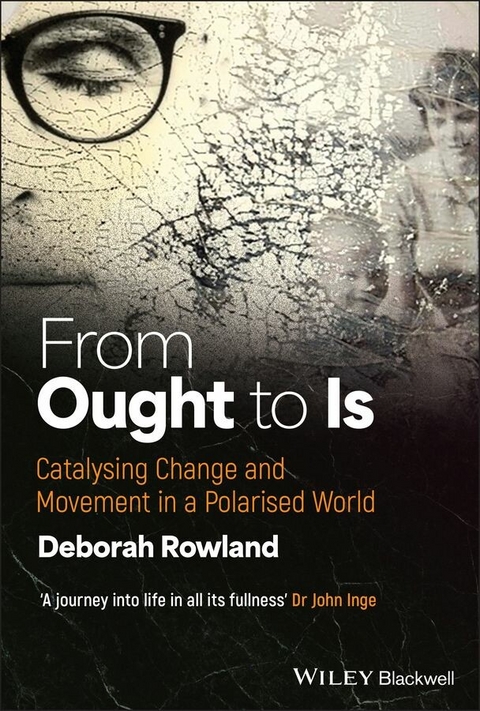
From Ought to Is (eBook)
421 Seiten
Wiley-Blackwell (Verlag)
978-1-394-26512-1 (ISBN)
A groundbreaking guide to achieving sustainable change in today's turbulent and interconnected global landscape
In a world increasingly divided by opposing perspectives, systemic inertia, and rapid societal shifts, From Ought to Is: Catalysing Change and Movement in a Polarised World offers a transformative approach to navigating change. Deborah Rowland challenges conventional change leadership paradigms by urging readers to confront the reality of 'what is' rather than fixating on 'what ought to be.' Through this lens, she demonstrates how true, sustainable change is achieved not by forcing rigid ideals but by fostering courageous honesty and embracing the messy, dynamic truths of the present.
Rooted in decades of research, experience, and interdisciplinary insights from neuroscience, moral philosophy, and spiritual tradition, From Ought to Is provides a compelling guide to navigating complex systems. Rowland illuminates how acknowledging the full truth of a situation can catalyse collaborative action and new possibilities. Through real-life case studies and practical exercises, readers are invited to engage deeply with their own change scenarios, unlocking new possibilities through inclusion, truth, and adaptive leadership.
An experiential roadmap for initiating movement in systems, organisations, and personal lives, From Ought to Is:
- Presents an innovative framework for leading sustainable change which utilises a holistic and interdisciplinary approach
- Offers an adaptive, reality-based alternative for complex environments which challenges traditional command-and-control change models
- Explores the dynamics of polarisation and its impact on leadership, collaboration, and systemic transformation
- Addresses pressing global issues such as political and societal polarisation, technological disruption, and biodiversity collapse
- Expands on the principles introduced in Deborah Rowland's bestselling Still Moving to address today's unique challenges
Ideal for leaders, change practitioners, and anyone seeking to shift entrenched patterns, From Ought to Is supports learning in leadership development programmes and organisational transformation courses. It is an essential text for graduate-level studies in business, organisational behaviour, and leadership, and serves as a vital resource for executives, consultants, and change agents.
DEBORAH ROWLAND is a globally recognised thought-leader, speaker, writer and practitioner in the field of change and its leadership, with over 30 years of experience transforming complex systems. Named an HR Most Influential Thinker and featured on the Thinkers50 Radar, she is the author of Still Moving: How to Lead Mindful Change, and co-author of Sustaining Change: Leadership That Works. Deborah has led change in organisations such as Shell, Gucci Group, BBC Worldwide and PepsiCo, and now acts as change coach to leaders in all walks of life.
A groundbreaking guide to achieving sustainable change in today's turbulent and interconnected global landscape In a world increasingly divided by opposing perspectives, systemic inertia, and rapid societal shifts, From Ought to Is: Catalysing Change and Movement in a Polarised World offers a transformative approach to navigating change. Deborah Rowland challenges conventional change leadership paradigms by urging readers to confront the reality of "e;what is"e; rather than fixating on "e;what ought to be."e; Through this lens, she demonstrates how true, sustainable change is achieved not by forcing rigid ideals but by fostering courageous honesty and embracing the messy, dynamic truths of the present. Rooted in decades of research, experience, and interdisciplinary insights from neuroscience, moral philosophy, and spiritual tradition, From Ought to Is provides a compelling guide to navigating complex systems. Rowland illuminates how acknowledging the full truth of a situation can catalyse collaborative action and new possibilities. Through real-life case studies and practical exercises, readers are invited to engage deeply with their own change scenarios, unlocking new possibilities through inclusion, truth, and adaptive leadership. An experiential roadmap for initiating movement in systems, organisations, and personal lives, From Ought to Is: Presents an innovative framework for leading sustainable change which utilises a holistic and interdisciplinary approach Offers an adaptive, reality-based alternative for complex environments which challenges traditional command-and-control change models Explores the dynamics of polarisation and its impact on leadership, collaboration, and systemic transformation Addresses pressing global issues such as political and societal polarisation, technological disruption, and biodiversity collapse Expands on the principles introduced in Deborah Rowland's bestselling Still Moving to address today's unique challenges Ideal for leaders, change practitioners, and anyone seeking to shift entrenched patterns, From Ought to Is supports learning in leadership development programmes and organisational transformation courses. It is an essential text for graduate-level studies in business, organisational behaviour, and leadership, and serves as a vital resource for executives, consultants, and change agents.
1
Introduction
Everything in Life that we really accept undergoes a change.
Katherine Mansfield
I am so glad you have chosen to read From Ought to Is. I wonder, what has been your motivation? Perhaps your primary reason relates to the sub‐title, Catalysing Change and Movement in a Polarised World – you wish for guidance on how to bring change to stuck places. But what about the title? Have the words, Ought, and Is, also caught your attention? Right now, what resonance do these two words have for you, and do they have a different quality? What associations come to mind? Do the two words elicit different feelings? Or even somatic sensations (ease, or tension)? Are you curious about what this movement means, to go from ought, to is? What is this journey?
Well, I know for sure that getting alongside the meanings of both ought and is, and discerning their distinction in how we bring the world into being, is an essential task if we wish for change: change that is true movement to a different place, change in which you can release yourself from stuck patterns and be more at ease in your life.
And this key skill, of how we navigate between ought and is, ideology and reality, is an attentional one: do we default to our imprinted codes through which to see the world, or can we intentionally summon a perceptual shift in what we experience, to see what is truly there? This fundamental distinction, and the path you choose to walk between ought and is, will shape your entire capacity to bring change to the places where you dearly long for movement.
Our world and the entire cosmos are always in motion. However, for good reasons of stability and continuity, we have become rather skilled as a human species at creating institutions and communities that go against this grain and stay in repeating patterns. Given the waves of disruptive (and increasingly, destructive) change now coming our way, be that in technology, geo‐political power relation shifts, or the wider planetary biosphere, can we up our game in adaptation to match this context?
Whether you are a local community leader seeking greater societal cohesion, a Chief Executive Officer leading business and digital innovation, a team leader implementing workplace change, a family member considering how to bring greater flow and contact among people you love, or a politician wishing to effect change in your constituency, service or nation, this book will speak to you.
Change Starts by Acknowledging What Is1
And here’s the heads up: change that we wish for across any walk of life starts by acknowledging what is, not by striving for what ought to be. When we can bravely and respectfully stand in the full truth of a situation, movement to a new place becomes possible, whatever the challenging costs and consequences of facing what is the case and relinquishing our loyalties to the partial lenses through which we previously viewed reality. Conversely, when we fixate on an obligated, wished‐for state – the ‘oughtyness’ of how we, others, or the situation needs to be – we stay stuck in our story and repeating patterns.
(Ever been in a ‘tiff’ with a neighbour and gone round to them with all kinds of ought to sentences in your head about the upset? Only to find these scripts melted away when, on meeting your neighbour, you allowed the pure relational contact between the two of you about what is here now in the conversation to take over, and then found that the issues got resolved?)
It’s a paradox: we are better able to initiate change when we give up our proclamations of and attachments to how the world needs to be (ought) and fully immerse ourselves in the lived matter of things (is).2
This immersion, being fully with what is, means making an equal, non‐hierarchical, unprejudiced space for everything to exist (yes, including those elements that irritate, even repel us). Contrast this with the experience of ought, which is the pressure that drives us to retain conformity to values (be they from family, our profession, or faith) that interfere with our capacity to allow what is to exist; we bend reality to our loyalties.
What a distinction: do we dare seek out reality, or stick with our wiring? Move towards is, or stay within ought?
From Ought to Is will take you on an educational and experiential journey, and I recommend you have a real‐life change case in mind to work through as you go; a situation from your life or your workplace that seems stuck, over which you have agency, and where you long to spark some movement. Along the way, I will be sharing experiences from my life and my work in the field of change to help illustrate the concepts and encourage your exploration.
Here’s why I believe us all getting on this journey between ought and is is invaluable: I can easily say that it was my realisation of this paradox – that we are best able to initiate change by really accepting what is currently the case (thank you, Katherine Mansfield, for the opening quote) – that has had the most transformative punch for me in my life, both personally and professionally.
Transformative for sure, yet an extremely challenging insight to translate into practice; as I found that giving up my loyalties to how I wished, expected or imagined the world to be – my oughts – very, very hard (I still find that, if I am honest). How so?
While an is predisposition to the world might be better than an ought fixation when initiating change, as meeting reality as it is releases movement far more effortlessly than prodding it towards where we wish it to be, I will show in Chapter 2 how the oughts that underlie this prodding come from an unrelenting source in our neurobiology, and unless we can see and honour their source, we will be forever in their grip.*
Moving From Ought to Is Is Not Easy, But It’s Worth It
So here is the upfront warning: the ought to is journey I will guide you through is no stroll in the park. I didn’t realise quite how hard it was to loosen a loyalty to an ought so that I could fully meet reality as it is, until I had an anaphylactic shock in a pub garden outside Marlborough, England.
What can I attribute this episode to? Well, I was in the middle of telling my adopted mum and dad that I was tracing my birth family – an act that felt like I was threatening the very seat of my belonging to my adopted Rowlands’ family.
The twin feelings of alarm and guilt at transgressing this loyalty to the parents who had so lovingly picked up my six‐month‐old self from the floor of a mother and babies’ home, now felt like evolutionary danger (will I be abandoned by parents, again?), and within an hour, I was being pumped with adrenalin on a bed within Savernake Community Hospital.
Thankfully, my mum and dad’s hearts were large enough to embrace a vast field of loving inclusion, and from that moment I gingerly embarked on my journey to discover and become known to my Irish birth family, my ancestral is, I had never felt more alive and quakingly free. I was starting to experience both the prize (greater ease in my life by discovering the truth, or ‘is‐ness’ of my birth) and the price (fear of becoming outcast from a belonging group) of moving from ought, to is.
Looking back now, I can also see how the breathlessness and burning welts that arose across my body in the pub garden that day were the somatic price I had to pay to feel free of an obligation to always please others (a commonly held ought of an adoptee).
Moving from ought to is is far from being a cognitive, academic exercise. You feel this work in your body.
I did not know that at the time, and after my recovery from the anaphylactic shock (for which no medical, allergic reaction cause could be found), continued to tremble at the thought of how the trace for my birth family, and unconcealment of my full identity, might detrimentally impact my adopted family, to‐be‐met Irish relatives, loving close relationships and the work that had previously defined my life. Challenging my ought‐based loyalty to please felt both liberating and frightening, in equal measure.
Yet moving beyond the safety of my imprinted codes, while bringing feelings of guilt, became utterly worth it.
From my infancy, I had trod a safe path, hard‐wired as an adoptee to please others and be perfect so that I could secure belonging. Casting to one side this fiercely preserved ‘oughtyness’ (a word I am coining to denote a state of being trapped within one’s oughts) – ‘don’t rock the boat’, ‘get on with my given life’, ‘for goodness’ sake Deborah, don’t show your inner vulnerability to the world!’ – I, for one, embarked on the long truth‐uncovering journey to cast aside the instinctual impulses that had kept me safe and integrate the alienated parts of me.
And it turned out that I was able to trace and meet both my birth father and, separately, my birth mother. By openly and respectfully agreeing to the reality of my cast‐out birth – a 1960s child shamefully conceived to un‐wed parents in Catholic...
| Erscheint lt. Verlag | 8.8.2025 |
|---|---|
| Sprache | englisch |
| Themenwelt | Geisteswissenschaften ► Psychologie |
| Medizin / Pharmazie ► Medizinische Fachgebiete ► Psychiatrie / Psychotherapie | |
| Schlagworte | Adaptive Leadership • Change Leadership • change leadership framework • change leadership guide • Change Management • Organisational Change • organisational transformation • sustainable organisational change • Systemic Thinking • transformation leadership |
| ISBN-10 | 1-394-26512-3 / 1394265123 |
| ISBN-13 | 978-1-394-26512-1 / 9781394265121 |
| Informationen gemäß Produktsicherheitsverordnung (GPSR) | |
| Haben Sie eine Frage zum Produkt? |
 EPUB (Adobe DRM)
Kopierschutz: Adobe-DRM
Adobe-DRM ist ein Kopierschutz, der das eBook vor Mißbrauch schützen soll. Dabei wird das eBook bereits beim Download auf Ihre persönliche Adobe-ID autorisiert. Lesen können Sie das eBook dann nur auf den Geräten, welche ebenfalls auf Ihre Adobe-ID registriert sind.
Details zum Adobe-DRM
Dateiformat: EPUB (Electronic Publication)
EPUB ist ein offener Standard für eBooks und eignet sich besonders zur Darstellung von Belletristik und Sachbüchern. Der Fließtext wird dynamisch an die Display- und Schriftgröße angepasst. Auch für mobile Lesegeräte ist EPUB daher gut geeignet.
Systemvoraussetzungen:
PC/Mac: Mit einem PC oder Mac können Sie dieses eBook lesen. Sie benötigen eine
eReader: Dieses eBook kann mit (fast) allen eBook-Readern gelesen werden. Mit dem amazon-Kindle ist es aber nicht kompatibel.
Smartphone/Tablet: Egal ob Apple oder Android, dieses eBook können Sie lesen. Sie benötigen eine
Geräteliste und zusätzliche Hinweise
Buying eBooks from abroad
For tax law reasons we can sell eBooks just within Germany and Switzerland. Regrettably we cannot fulfill eBook-orders from other countries.
aus dem Bereich