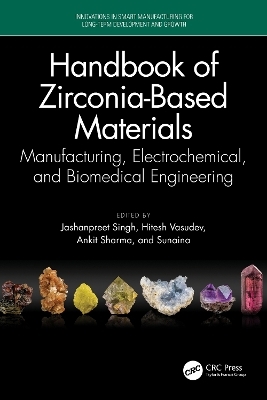
Handbook of Zirconia-Based Materials
CRC Press (Verlag)
978-1-032-85587-5 (ISBN)
- Lieferbar (Termin unbekannt)
- Versandkostenfrei
- Auch auf Rechnung
- Artikel merken
Recent decades have witnessed significant progress in zirconia‑based materials research. This comprehensive handbook explores the latest advancements and applications of these materials, providing insights into cutting‑edge manufacturing and materials science research while covering diverse industrial uses, properties, and synthesis methods. This handbook is structured into five key sections: I. Fundamentals and Materials Science, II. Industrial and Engineering Applications, III. Energy and Catalytic Applications, IV. Medical and Dental Applications, and V. Emerging Technologies.
Handbook of Zirconia‑Based Materials: Manufacturing, Electrochemical, and Biomedical Engineering examines the notable characteristics and wide‑ranging applications of zirconia‑based materials. Zirconia’s distinctive properties like optical transparency, thermal stability, mechanical strength, and electrical conductivity have attracted engineers and researchers across numerous fields, including energy production, biomedical engineering, and environmental remediation. These materials find significant applications in environmental protection, sustainable energy advancement, dental implants, solid oxide fuel cells, and catalytic converters.
This handbook thoroughly investigates zirconia’s crystal structure, phase transitions, and surface chemistry while exploring synthesis methodologies for nanostructured materials, from conventional to cutting‑edge approaches. It also highlights the practical industries utilizing zirconia to demonstrate its importance. This resource provides accessible insights suitable for readers with varying levels of expertise, including industrial researchers, students, professionals, and scholars in manufacturing, materials science, chemistry, and physics.
Dr. Jashanpreet Singh is an assistant professor at the Department of Mechanical Engineering, University Center for Research and Development, Chandigarh University, Mohali. He earned his PhD in Slurry Erosion and Thermal Spray Coatings from Thapar Institute of Engineering and Technology in 2019. With over 3 years of teaching, 3 years of research, and 2 years of industry experience, his research focuses on tribology, thermal spray coatings, CFD simulations, biomedical engineering materials and coatings, additive manufacturing, and materials characterization. He has published over 100 research papers, including more than 50 SCIE/ESCI‑indexed articles and over 92 in SCOPUS. He has authored a book and contributed 25 chapters to different books. He is also a series editor of Advances in Surface Engineering and Tribology from CRC Press/Taylor & Francis. He is listed in Stanford University’s Top 2% Scientists (2022–2024), and he received the "Outstanding Reviewer Award" from IOP in 2021. He is a life member of AICTSD, IAENG, and NITTSD. Prof. (Dr.) Hitesh Vasudev is a professor in the School of Mechanical Engineering at Lovely Professional University, Phagwara, Punjab. He is also the head of the Research and Development Cell. He earned his PhD in 2018 from Guru Nanak Dev Engineering College, Ludhiana. His research interests include surface engineering and thermal spraying techniques, such as HVOF, flame spray, cold and plasma spray, and microwave cladding. He focuses on developing nanostructured, multimodal, and high‑entropy alloy coatings for high‑temperature applications. He has over 190 indexed publications, along with 10 books and 50 book chapters. He is also a series editor of Advances in Surface Engineering and Tribology from CRC Press/Taylor & Francis. A dedicated reviewer, he has received the "Top Cited Paper Award India 2022" by IOP Publishing and LPU’s Research Excellence Awards (2019–2023). He holds a patent and has received research grants from LPU and SERB for biomedical coatings and conference organization. Dr. Ankit Sharma holds the position of Associate Director (Research) of the Center for Research, Impact and Outcome Department, Chitkara University, Punjab, India. He received his doctorate in Mechanical Engineering from the Thapar Institute of Engineering and Technology, India. He has more than 10 years of experience in academics, research, consulting, training, and industry. He has authored numerous national and international publications and has filed/published 30+ international patents. He is also a series editor of Innovations in Smart Manufacturing for Long-Term Development and Growth from CRC Press/Taylor & Francis. He is also the managing and special issue editor of several international journals and has delivered several invited seminars and keynote talks on international (USA, China, India) platforms. Along with that, he is also a reviewer board member of several international journals. Dr. Sunaina is an assistant professor in the Department of Chemistry at Guru Nanak Dev University, Amritsar. She previously worked as a postdoctoral associate at the University of Calgary, focusing on nanobubbles for wastewater treatment. She earned her PhD in 2021 through a joint program between Panjab University and the Institute of Nano Science and Technology, India. Her research spans nanomaterials, including metal oxide–chalcogenide heterostructures for photocatalysis and photodetection, metal ferrites from slime waste for water treatment, and advanced field emission materials. She has published over 31 research articles and 10 book chapters. She has received multiple best paper awards and has hands‑on experience in XRD, SAXS, and UV‑Vis techniques. She was awarded synchrotron beam time at Photon Factory, Japan, highlighting her global research recognition. Her work reflects strong contributions to environmental sustainability and materials innovation.
Section I. Fundamentals and Material Science. 1. Introduction to Zirconia and Zirconia-Based Materials. 2. Zirconia Nanoparticles as the Strengthening Phase. 3. Synthesis of Zirconia-Based Materials. 4. Elaboration and Characterization of Zirconia and Its Comparison with Other Metal-Oxides: Case Study. Section II. Industrial and Engineering Applications. 5. Applications of Zirconia and Zirconia-Based Materials. 6. ZrO2 Used for Thermal Protection Systems of Ultra-High Temperature Automobile and Aerospace Applications. 7. Zirconia-Based Thermal Barrier Coatings: Advancements in Doped, Nanostructured, Multilayered, and Gradient-Structured Systems. 8. Modified Zirconia as an Efficient Thermal Barrier Coating: A Case Study on ZrO2-Based Coatings. 9. Wear Performance of Plasma-Sprayed Nanostructured Zirconia Coatings on Stainless Steel under Distilled Water Conditions. 10. Case Study on the Erosion Wear Performance of ZrO2-Coated SS-410 Using RSM and TOPSIS. Section III. Energy and Catalytic Applications. 11. Catalytic Wonders: The Power of Zirconium in Modern Chemistry. 12. Zirconia-Based Materials for Electrochemical Energy Storage. 13. Zirconia-Based Solid Metal-Organic Framework for Electrochemical Sensors. 14. Zirconium-Based MOFs: Advances in Electrochemical Sensing and Biosensing. Section IV. Medical and Dental Applications. 15. Pharmaceutical and Device Applications of Zirconia. 16. Biological and Biomedical Applications of Zirconia. 17. Influence of Thickness on the Mechanical Strength of Monolithic Zirconia Dental Crowns. 18. Performance of Zirconia Coatings for Dental Applications. Section V. Emerging Technologies. 19. Advancements in Zr and ZrO2 Technologies: Additive Manufacturing and Emerging Fields.
| Erscheinungsdatum | 11.12.2025 |
|---|---|
| Reihe/Serie | Innovations in Smart Manufacturing for Long-Term Development and Growth |
| Zusatzinfo | 27 Tables, black and white; 107 Line drawings, black and white; 40 Halftones, black and white; 147 Illustrations, black and white |
| Verlagsort | London |
| Sprache | englisch |
| Maße | 156 x 234 mm |
| Gewicht | 930 g |
| Themenwelt | Kunst / Musik / Theater ► Design / Innenarchitektur / Mode |
| Medizin / Pharmazie ► Physiotherapie / Ergotherapie ► Orthopädie | |
| Technik ► Bauwesen | |
| Technik ► Maschinenbau | |
| Technik ► Medizintechnik | |
| ISBN-10 | 1-032-85587-8 / 1032855878 |
| ISBN-13 | 978-1-032-85587-5 / 9781032855875 |
| Zustand | Neuware |
| Informationen gemäß Produktsicherheitsverordnung (GPSR) | |
| Haben Sie eine Frage zum Produkt? |
aus dem Bereich