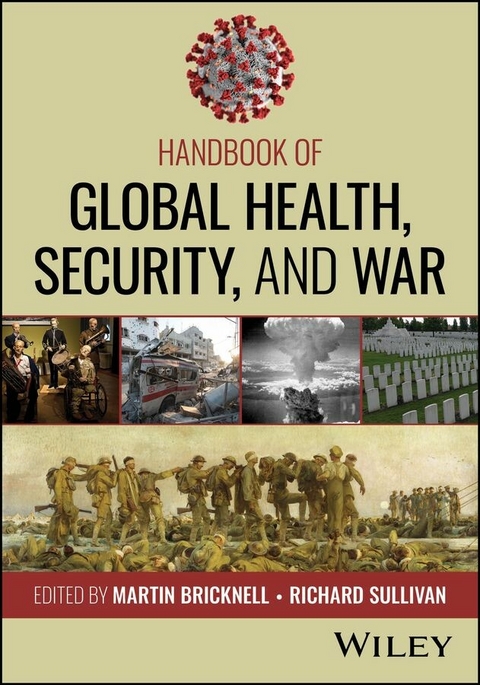
Handbook of Global Health, Security, and War (eBook)
435 Seiten
Wiley (Verlag)
978-1-394-32610-5 (ISBN)
An insightful and contemporary review of current global health threats and their implications for security and stability
In the Handbook of Global Health, Security, and War, Professors Martin Bricknell and Richard Sullivan deliver a fresh, multidisciplinary take on the relationship between health and international affairs. The book explores the most relevant global health threats and their implications for security and stability, providing an up-to-date and authoritative perspective on these international challenges.
This practical guide addresses the unprecedented range of threats to health around the world and their potential to impact the security of populations, states, and the global system. It discusses the academic theories that form the foundations for analysis of global health and international relations. It also examines the impact of insecurity and war on health systems, clinical health services, and the health research and policy agenda.
Readers will also find:
- A thorough introduction to global health and the relationships between determinants of health, health systems, and health services
- Comprehensive explorations of the three dimensions of human security, state security, and global security and their relationships to health
- Practical discussions of the health impacts of war
- A summary of international humanitarian law and ethics as constraints on war and human barbarism
Perfect for undergraduate and postgraduate students with an interest in global health and security, the Handbook of Global Health, Security, and War will also benefit social scientists, researchers in global health, and humanitarian practitioners.
Martin Bricknell, PhD, is Professor of Conflict, Health, and Military Medicine in the Centre for Global Health Security and War at the School of Security Studies in King's College London.
Richard Sullivan, MD, PhD, is Professor of Cancer & Global Health at King's College London.
Author Biographies
Dr Kiran Attridge, MBBS, MSc, MRCGP, FFPH, DMCC
Kiran Attridge is a Public Health Physician and GP. She completed her undergraduate medical studies at the University of Newcastle Upon Tyne and her postgraduate degree at the London School of Hygiene and Tropical Medicine. She saw first‐hand the impact of war on health during her military service with the Royal Air Force, serving in Afghanistan and the broader Middle East before commencing her speciality public health training, where she focused on large‐scale outbreak response in resource‐poor and humanitarian settings, including DRC, Pakistan, and Sierra Leone. She is currently the Course Director for the Conflict and Catastrophe Medicine Course at the Centre for Health Studies at the Worshipful Society of the Apothecaries.
Ana Elisa Barbar
Ana Barbar is an expert on protection of healthcare, with a focus on safe health responses, civil‐military relations and ethical challenges for provision of care in emergency settings. Ana Elisa currently works as a consultant to the World Health Organization and other humanitarian organizations. Previously, she worked for almost a decade in the Red Cross and Red Crescent Movement in different roles, working in Latin America, Middle East, and Africa and spent four years as global advisor to health policy and operations of the International Committee of the Red Cross on issues of protection of healthcare. Ana Elisa is the chair of the board of Insecurity Insight, and holds a Bachelor’s in Psychology, with a clinical license and a full residency in Primary Health Care, as well as an Executive Master’s in Policy Making and International Negotiations. As a guest lecturer, she has taught in different universities in Europe and Africa and served as an expert on protection of healthcare to high‐level panels, including at the Economic and Social Council of the United Nations and to the Human Rights Committee of the National Academies of Sciences, Engineering, and Medicine of the United States. Her most recent publications include an article for Daedalus and a co‐edited book on Medical Neutrality.
Dr Gemma Bowsher, BSc, MA, MBBS, FRSPH, FRGS
Gemma Bowsher is a physician‐social scientist based at King's College London. She completed her medical degree at King's College London and her master's degree at Harvard University. She holds fellowships of the Royal Society of Public Health and the Royal Geographical Society. Her work spans operational and policy domains relating to health security threats in conflict settings such as Ukraine and the Middle East. She leads a range of programmes in these settings focused on responding to biological and chemical emergencies at the clinical, technical, and policy levels.
Jessica Bricknell, MMath, MSc (Associate Editor)
Jessica Bricknell has a master’s in mathematics from the University of Nottingham, a master’s in International Development from the University of Edinburgh and is an ACA chartered accountant. She has been working for the past eight years in the humanitarian and development sector, including the last five years across Uganda and South Sudan working for Save the Children.
Lieutenant General (Rtd) Professor Martin Bricknell, CB, OStJ, PhD, DM, FFPHM, FIHM
Martin Bricknell started as Professor of Conflict, Health, and Military Medicine at King’s College London in 2019. Previously, he served 34 years in the UK Defence Medical Services, culminating his service as the Surgeon General of the UK Armed Forces. He undertook operational tours in Afghanistan, Iraq, and the Balkans with numerous additional overseas assignments. In 2010 and 2006, he held senior Medical Adviser appointments in the NATO ISAF mission. He was awarded the Companion of the Order of Bath, the Order of St John, and the US Bronze Star. He is a specialist in General Practice, Public Health and Occupational Medicine. His multiple academic papers cover: how organisations learn, care pathways in military healthcare, military healthcare ethics, civil‐military relations in health, and the political economy of health in conflict. He convenes an MA module in Global Health, Security and War, and co‐convenes an MA module in Conflict and Health. He is also Co‐Director of the KCL Centre for Conflict and Health Security, the KCL Centre for Military Ethics, Veterans Adviser for the King Edward VII Hospital, Editor‐in‐Chief of the Military Medical Corps Worldwide Almanac, a non‐resident Fellow of the Centre for Global Development, and on the editorial board for the Journal of Military and Veterans Health.
Dr George Bundy, MD (Associate Editor)
George Bundy is a PhD candidate based in the Department of War Studies at King’s College London, where he researches Security Sector Health Systems in NATO Eastern Flank countries. After earning his medical degree from St. Petersburg State Pavlov Medical University, he completed a postdoctoral fellowship at the University of Toledo College of Medicine. His work spans clinical practice, biomedical, and public health research, addressing global health security threats and strengthening health systems across multiple countries.
Dr Eddie Chaloner, BA(Oxon), BM, BCh, FRCS, Gen
Eddie Chaloner is a recently retired vascular surgeon. He served in the British Army and also worked in a variety of conflict/post‐conflict settings with NGOs, including the HALO Trust and Medicins Sans Frontiers. He has published widely on the treatment of blast injury, particularly from anti‐personnel landmines. His current interest encompasses the study of war more generally in its socio‐political context, particularly in relation to the emerging field of cognitive warfare.
Professor Peter von Dadelszen, DPhil (Oxon), FRANZCOG, FRCSC, FRCOG
Peter von Dadelszen is Professor of Global Women’s Health and Honorary Consultant Obstetrician. He is an obstetrician‐scientist at King’s College London and King’s Health Partners. A New Zealander (and now Canadian), Peter trained clinically and academically in New Zealand, UK, and Canada. Currently, his research focus is on pregnancy hypertension, fetal growth, preterm birth, and stillbirth, through a One Health lens.
Colonel (Rtd) Dr Sohrab Dalal, MSc, MSc, MRCGP
Sohrab Dalal trained in medicine at Guy’s Hospital Medical School in the 1980s and completed postgraduate training in primary care in London. Working part‐time in the Faculty of Primary Care at King’s College, London, and as a GP in London, he developed an interest in medical education. Dr Dalal spent three decades working for the UK Ministry of Defence, gaining experience in Aviation Medicine, combat casualty care and Emergency Medicine. Dr Dalal deployed over this period to the broader Middle East Region, including Iraq, Afghanistan, and Syria with UK, coalition and other nation’s forces, for which he was awarded the Meritorious Service Medal. Dr Dalal was appointed a postgraduate trainer and holds master’s degrees in International Primary Care and Defence Leadership. More recently, he held the positions of Regional Clinical Director (North England) and Head, Medical Branch at NATO HQ Supreme Allied Command Transformation (2018–2022), where he was responsible for the creation of the NATO Medical Support Capstone Concept and Allied Joint Publication 4.10c, Medical Support to Operations.
Dr Catherine Davison, MBChB, MA, MRCGP (Associate Editor)
Catherine Davison is a highly experienced senior medical leader with a 21‐year career in the Royal Air Force (RAF). A trained General Practitioner, she has worked extensively in global remote and challenging environments, holding key roles in operational planning, policy development, and medical leadership across diverse international settings. As Commander of the Tactical Medical Wing, she led a 160‐member unit capable of deploying medical capabilities worldwide at high readiness. Her recent experience includes overseeing medical support for NATO and the United Nations, managing a NATO Role 2 facility, and leading United Nations Medical Assistance Teams (MATs) and Aero‐Medical Evacuation Teams (AMETs). Catherine also served as Deputy Force Medical Officer for the United Nations Mission in South Sudan (UNMISS), where she was responsible for healthcare delivery in support of peacekeeping operations. Her career has focused on planning and implementing medical support for international missions, crisis response, and providing care in austere environments.
Dr Abdulkarim Ekzayez, MD, PhD
Abdulkarim Ekzayez is a health system expert with over 13 years’ experience in clinical medicine, humanitarian health, epidemiology, health in conflict settings, and academic research. With in‐depth knowledge of the principles as well as the practicalities of health interventions and dynamics in conflict settings, he has a proven ability in developing strategies, operational plans, research, and evidence‐based policies for health interventions in contested conflict settings. His key achievements include: building one of the first primary health care systems in northwest Syria, which included the development of locally customised electronic medical records; leading the Polio vaccination response in northern Syria between 2013 and 2016; developing an evidence‐based strategy for the Ministry of Health in Afghanistan to introduce new medical interventions in 2018; leading a global research project on reporting attacks on...
| Erscheint lt. Verlag | 29.7.2025 |
|---|---|
| Sprache | englisch |
| Themenwelt | Medizin / Pharmazie |
| Schlagworte | global health and security • global health impact • global health in war • Global health textbook • Global Security • Health and conflict • health in war • health response to war • international health systems • International Humanitarian Law |
| ISBN-10 | 1-394-32610-6 / 1394326106 |
| ISBN-13 | 978-1-394-32610-5 / 9781394326105 |
| Informationen gemäß Produktsicherheitsverordnung (GPSR) | |
| Haben Sie eine Frage zum Produkt? |
 EPUB (Adobe DRM)
Kopierschutz: Adobe-DRM
Adobe-DRM ist ein Kopierschutz, der das eBook vor Mißbrauch schützen soll. Dabei wird das eBook bereits beim Download auf Ihre persönliche Adobe-ID autorisiert. Lesen können Sie das eBook dann nur auf den Geräten, welche ebenfalls auf Ihre Adobe-ID registriert sind.
Details zum Adobe-DRM
Dateiformat: EPUB (Electronic Publication)
EPUB ist ein offener Standard für eBooks und eignet sich besonders zur Darstellung von Belletristik und Sachbüchern. Der Fließtext wird dynamisch an die Display- und Schriftgröße angepasst. Auch für mobile Lesegeräte ist EPUB daher gut geeignet.
Systemvoraussetzungen:
PC/Mac: Mit einem PC oder Mac können Sie dieses eBook lesen. Sie benötigen eine
eReader: Dieses eBook kann mit (fast) allen eBook-Readern gelesen werden. Mit dem amazon-Kindle ist es aber nicht kompatibel.
Smartphone/Tablet: Egal ob Apple oder Android, dieses eBook können Sie lesen. Sie benötigen eine
Geräteliste und zusätzliche Hinweise
Buying eBooks from abroad
For tax law reasons we can sell eBooks just within Germany and Switzerland. Regrettably we cannot fulfill eBook-orders from other countries.
aus dem Bereich