


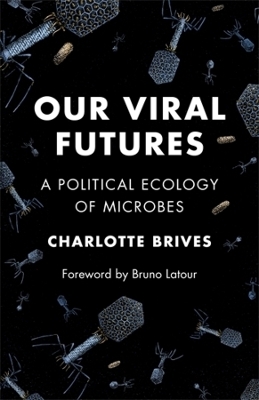
Our Viral Futures
A Political Ecology of Microbes
Seiten
2026
Columbia University Press (Verlag)
978-0-231-22198-6 (ISBN)
Columbia University Press (Verlag)
978-0-231-22198-6 (ISBN)
- Lieferbar (Termin unbekannt)
- Versandkostenfrei
- Auch auf Rechnung
- Artikel merken
In Our Viral Futures, Charlotte Brives examines the development and implications of phage therapy, providing new ways to understand our interconnections with the microbial world.
Increasing bacterial resistance to antibiotics is one of today’s greatest threats to public health. Yet a possible solution has emerged from a surprising source. Phage therapy deploys viruses called bacteriophages, “bacteria eaters,” to treat bacterial infections. What concerns—both biological and social—arise from using viruses in this way? What does phage therapy reveal about the links between humans and microbes?
In Our Viral Futures, Charlotte Brives examines the development and implications of this therapy, providing new ways to understand our interconnections with the microbial world. Considering patients seeking treatment for chronic infections, the establishment of new regulatory frameworks, and the processes of laboratory research and clinical trials, she highlights the complexity and variety of the relationships among humans, phages, and bacteria. Brives places phage therapy in the context of the widespread use of antibiotics under industrial capitalism, which has deployed these treatments in order to enable ecologically devastating forms of mass production and consumption. She argues that the connections between human societies and microbial communities defy the usual categories through which science and medicine understand the world, giving rise to new moral and political questions. Interdisciplinary and nuanced, Our Viral Futures poses a provocative challenge: Instead of continuing to assert that we can control and master microbes, we must learn to coexist with them.
Increasing bacterial resistance to antibiotics is one of today’s greatest threats to public health. Yet a possible solution has emerged from a surprising source. Phage therapy deploys viruses called bacteriophages, “bacteria eaters,” to treat bacterial infections. What concerns—both biological and social—arise from using viruses in this way? What does phage therapy reveal about the links between humans and microbes?
In Our Viral Futures, Charlotte Brives examines the development and implications of this therapy, providing new ways to understand our interconnections with the microbial world. Considering patients seeking treatment for chronic infections, the establishment of new regulatory frameworks, and the processes of laboratory research and clinical trials, she highlights the complexity and variety of the relationships among humans, phages, and bacteria. Brives places phage therapy in the context of the widespread use of antibiotics under industrial capitalism, which has deployed these treatments in order to enable ecologically devastating forms of mass production and consumption. She argues that the connections between human societies and microbial communities defy the usual categories through which science and medicine understand the world, giving rise to new moral and political questions. Interdisciplinary and nuanced, Our Viral Futures poses a provocative challenge: Instead of continuing to assert that we can control and master microbes, we must learn to coexist with them.
Charlotte Brives is an anthropologist of science and biomedicine. She is director of research at the Centre national de la recherche scientifique (CNRS). Bruno Latour (1947–2022) was among the most important figures in science and technology studies.
Foreword by Bruno Latour
Introduction
1. Tensions
2. Alternative Histories
3. Microgeohistories
4. Pluribiosis
5. Pluribiotic Medicine
6. Evidence-Based Medicine
7. Antibiotic Infrastructures
8. Recalcitrance and Ferality
9: Toward a Pluribiotic Model?
Acknowledgments
Notes
Bibliography
Index
| Erscheinungsdatum | 16.12.2025 |
|---|---|
| Reihe/Serie | Science Now |
| Vorwort | Bruno Latour |
| Zusatzinfo | 17 b&w illustrations |
| Verlagsort | New York |
| Sprache | englisch |
| Maße | 140 x 216 mm |
| Themenwelt | Studium ► Querschnittsbereiche ► Infektiologie / Immunologie |
| Naturwissenschaften ► Biologie ► Mikrobiologie / Immunologie | |
| Sozialwissenschaften ► Soziologie | |
| ISBN-10 | 0-231-22198-3 / 0231221983 |
| ISBN-13 | 978-0-231-22198-6 / 9780231221986 |
| Zustand | Neuware |
| Informationen gemäß Produktsicherheitsverordnung (GPSR) | |
| Haben Sie eine Frage zum Produkt? |
Mehr entdecken
aus dem Bereich



aus dem Bereich
Buch | Softcover (2025)
Lehmanns Media (Verlag)
CHF 27,90
Infektionen bei Kindern und Jugendlichen
Buch | Hardcover (2025)
Thieme (Verlag)
CHF 209,95


