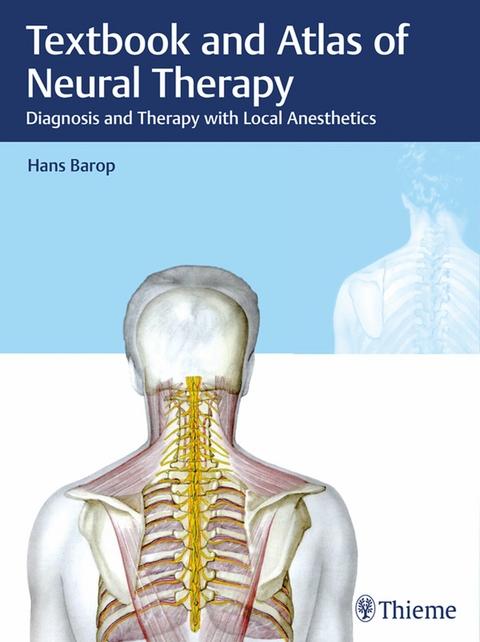
Textbook and Atlas of Neural Therapy (eBook)
737 Seiten
Thieme (Verlag)
978-3-13-258223-1 (ISBN)

1 History of Local Anesthesia and Neural Therapy
1.1
Introduction
The history of anesthesia,274 whether used prophylactically before surgery or therapeutically to treat existing pain, occupies a prominent place in medicine, because pain caused by illness or injury is one of the most common symptoms in everyday medical practice. The methods of targeted pain treatment were highly variable until the end of the 19th century. In addition to medicinal forms, various methods of localized pain reduction for surgical procedures were developed, such as tissue compression, and later nerve compression with truss pad, and the application of cold to specific sites.
A completely new form of localized pain treatment was first described in 1839 by Lundy, Taylor, and Washington. Using precursors of the modern syringe, they tried administering morphine solutions under the skin to achieve a reduction in pain. With the development of the syringe by the French Pravaz (1843), and the hollow cannula by the Scottish Wood in the same year, it was possible for the first time to achieve pain relief through targeted injections of morphine solutions into painful areas and nerves. However, local anesthesia, i.e., the complete alleviation of pain, could not be achieved with morphine solutions.
Koller, an ophthalmologist at the University of Vienna, came into contact with Freud in 1883 during his neurological training.274, 282 Freud had experience with cocaine, which he used to treat heart diseases and nervous exhaustion or depression. In a self-test, Freud determined the analeptic effect of cocaine in addition to its anesthetic effect on the tongue and oral mucosa, and reported this to his colleague. Koller was able to experience this anesthetic effect in his own self-test, especially when suffering from a painful gum inflammation, which he daubed with a cocaine solution on the advice of Freud.
In contrast to Freud, as a surgical ophthalmologist Koller saw the obvious potential for pain-free surgery using cocaine. He applied this property of cocaine therapeutically and, after preliminary trials with animals, performed the first cataract surgery using local anesthesia on September 11, 1884. At a meeting of doctors in Vienna on October 17, 1884, he first reported the successful use of cocaine for local anesthesia of the eye. This was also the starting point for the use of local anesthesia throughout surgery worldwide, which then evolved with breathtaking speed.
Only then was it clear to Freud what a groundbreaking discovery he had been involved in. In a report in Heitler’s Zentralblatt für die gesamte Therapie, he had already reported on the anesthetic effect of cocaine before Koller, and considered the use of cocaine for localized painful infections. Freud was more interested in the therapeutic use than the possibility of a local anesthetic for surgical procedures. He recommended that the ophthalmologist von Königstein use cocaine on iritis and trachoma. He himself had experimentally (and unsuccessfully) attempted to treat trigeminal neuralgia with a cocaine injection targetedto the trigeminal nerve. Worth mentioning is the 1863 report published in Paris by the Peruvian general physician Moreno y Maiz on an animal experiment in which a bullfrog leg was anesthetized by way of cocaine infiltration.
1.2
Anesthesia and the Treatment of Pain
1.2.1 Local Anesthesia
Considering the initial phase of local anesthesia thus far, at this very early stage there were already two different pathways for the newly discovered drug, cocaine:
1. Targeted local anesthesia, i.e., anesthesia for surgical purposes, which was eagerly awaited by the world of surgical treatment.
2. Slightly overshadowed by local anesthesia, the therapeutic use of local anesthesia for existing pain, whether due to neuralgia or tissue inflammation (Freud).
When keeping this two-pronged development in mind and not allowing the concept of pure local anesthesia for surgical purposes to dominate at first sight, local anesthesia and neural therapy can be easily differentiated.
Knowledge about both pathways is still required, since the technique of local anesthesia in the implementation of neural therapy falls into the realm of the technical.
Infiltration, Block, and Spinal Anesthesia
In the rapid development of local anesthesia for surgical purposes, the names Halstedt, Hall, and Hartley are representative of infiltration anesthesia and block anesthesia, which they used in animal experiments and later in human surgery. The first major drawbacks of the drug cocaine came to light: overdoses and dependence with repeated use. Halstedt had become addicted to cocaine through numerous self-tests but was cured after undergoing detoxification; Hall, who had also become addicted, died.
On the one hand, increased experience with the drug cocaine resulted in successful local anesthesia for surgery; on the other hand, an increase in overdose deaths occurred. Thanks to the Parisian surgeon Reclus, the cocaine dosage was corrected after the initial euphoria and a number of iatrogenic deaths, and the use of cocaine for local anesthesia could be continued and developed further. The 20 to 30% cocaine solution first used for topical anesthesia resulted in severe intoxication and even death. Reclus was able to prevent both intoxication and deaths by reducing the concentration initially to 2 to 3% and later to 0.5% solutions.
Block anesthesia, the selective suppression of sensitive peripheral nerves, evolved from infiltration anesthesia, i.e., local numbing through local infiltration of cocaine. With more centrally acting local anesthesia, Bier developed spinal anesthesia, which he first successfully performed on August 15, 1898. His idea was to use the more centrally implemented anesthesia to create a more comprehensive anesthesia with lesser amounts of cocaine than were used in pure block anesthesia. He achieved this by intrathecal injection in the lumbar region with 3 mL of an 0.5% solution of cocaine. Bier was also able to report on the “postspinal headache” after the self-test with this new neuraxial anesthesia.
The American neurologist Corning had successfully performed neuraxial anesthesia before Bier, though not in preparation for surgical treatment, but for treating existing pain. To what extent this involved true spinal anesthesia with intrathecal administration or epidural anesthesia remains unclear.
With regard to the history of local anesthesia, this meant a breakthrough in surgical development in the public eye. With the advancement of local anesthesia, the number of general narcosis procedures previously using chloroform and ether could be reduced and thus many, sometimes fatal, incidents involving general narcosis could be avoided.
Emergence of Segmental Therapy
Less exciting, however, was the development in the therapeutic use of local anesthetics, since it suffered from a lack of attention that still exists even today in the medical landscape of surgery. On closer inspection, however, it turns out that the use of local anesthetics for purely therapeutic use has at least as much potential as local anesthesia for surgery.
In the analysis of the history of neural therapy, it is useful to provide some preliminary guidance for clarifying its fundamental difference from purely local anesthesia. The names representing the beginning of neural therapy are partly the same as those for the development of local anesthesia. These are predominantly the names of surgically qualified doctors who used the injection of local anesthesia in their daily practice. The first observations pointing the way toward neural therapy were made when local anesthetic was not applied to surgical procedures but to preexisting pain.446, 469, 470 Now, it was frequently observed that despite the local anesthesia wearing off, the preexisting pain symptoms were reduced or even completely disappeared.
Reconsider the earliest days of local anesthesia when Freud shared with Koller his first observations on mucosa anesthesia after oral ingestion of cocaine. Freud’s logical, rather intuitive decision to apply a local anesthetic for therapy and not for anesthesia would prove to be correct in the shadow of the rapid development of local anesthesia in surgery. At the same time that the French surgeon Reclus reduced the concentration of cocaine and ultimately prevented its decline in use due to frequent toxic complications, the German Schleich developed “refined local anesthesia” also by reducing the cocaine concentration, by targeted infiltration of nerves, and by additional cooling of the tissue with ethyl chloride.
This combination resulted in a radical reduction of the toxic effects of cocaine, so that the local anesthetic in this “defused form” prevailed.
Schleich also used a 0.5 to 1% strength solution of cocaine for purely therapeutic purposes.446 In 1898, he was the first to observe that not only local infiltration of cocaine alleviated rheumatic symptoms during the anesthetized period, but also the rheumatic symptoms were alleviated for a long time thereafter, or recurred only to a lesser extent. This first documented successful application of local anesthetics for therapeutic purposes can be characterized as the birth of neural...
| Erscheint lt. Verlag | 13.12.2017 |
|---|---|
| Sprache | englisch |
| Themenwelt | Medizin / Pharmazie ► Medizinische Fachgebiete ► Notfallmedizin |
| Medizin / Pharmazie ► Medizinische Fachgebiete ► Orthopädie | |
| Medizin / Pharmazie ► Naturheilkunde | |
| Schlagworte | Anesthetics • autonomic nervous system • Barop • Chronic • Local Anesthetics • Neural • Neural Therapy • neuroanatomical and neurophysiological fundamentals • Pain • therapy |
| ISBN-10 | 3-13-258223-9 / 3132582239 |
| ISBN-13 | 978-3-13-258223-1 / 9783132582231 |
| Informationen gemäß Produktsicherheitsverordnung (GPSR) | |
| Haben Sie eine Frage zum Produkt? |
 EPUB (Wasserzeichen)
DRM: Digitales Wasserzeichen
Dieses eBook enthält ein digitales Wasserzeichen und ist damit für Sie personalisiert. Bei einer missbräuchlichen Weitergabe des eBooks an Dritte ist eine Rückverfolgung an die Quelle möglich.
Dateiformat: EPUB (Electronic Publication)
EPUB ist ein offener Standard für eBooks und eignet sich besonders zur Darstellung von Belletristik und Sachbüchern. Der Fließtext wird dynamisch an die Display- und Schriftgröße angepasst. Auch für mobile Lesegeräte ist EPUB daher gut geeignet.
Systemvoraussetzungen:
PC/Mac: Mit einem PC oder Mac können Sie dieses eBook lesen. Sie benötigen dafür die kostenlose Software Adobe Digital Editions.
eReader: Dieses eBook kann mit (fast) allen eBook-Readern gelesen werden. Mit dem amazon-Kindle ist es aber nicht kompatibel.
Smartphone/Tablet: Egal ob Apple oder Android, dieses eBook können Sie lesen. Sie benötigen dafür eine kostenlose App.
Geräteliste und zusätzliche Hinweise
Buying eBooks from abroad
For tax law reasons we can sell eBooks just within Germany and Switzerland. Regrettably we cannot fulfill eBook-orders from other countries.
aus dem Bereich