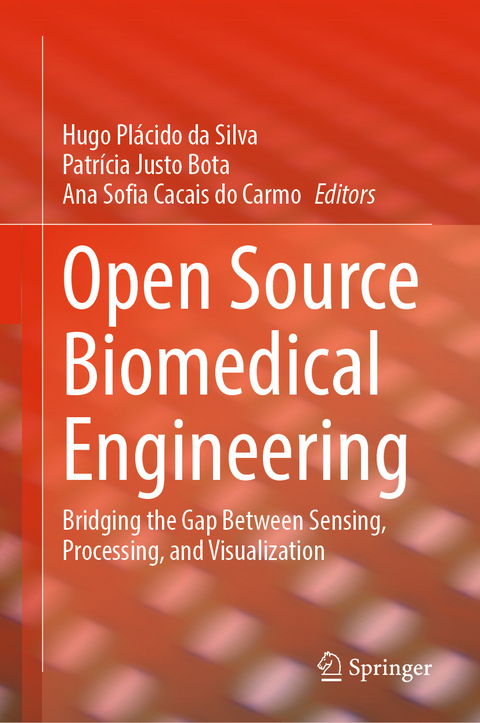
Open Source Biomedical Engineering
Springer International Publishing (Verlag)
978-3-032-03654-4 (ISBN)
- Noch nicht erschienen - erscheint am 23.01.2026
- Versandkostenfrei
- Auch auf Rechnung
- Artikel merken
This book provides a practical end-to-end approach to open source technology in biomedical engineering, covering topics that range from hardware and software design to data acquisition, processing tools, and cloud-based storage. Biomedical device conceptualization, design of experimental evaluation studies, and moving from early-stage prototypes to shelve-worthy products benefiting from open source technologies are also covered. The technical chapters are complemented by working examples and address problems that new entrants and professionals encounter when developing work in biomedical engineering, human-computer interaction, physiological computing, psychophysiology, physiotherapy, and related areas. The book is enriched by case studies where open source technologies have been successfully used to accelerate new developments in biomedical engineering. Contributions are rooted in the state-of-the-art and latest advances in hardware platforms, Python for the signal processing and analysis components, and web-based technologies for the user interface components.
- Provides hardware, software, and product design guidelines;
- Includes source code, case studies, and application examples;
- Accessible to a broad audience interested in moving quickly from a biomedical idea to a solution.
Hugo Plácido da Silva is an award-winning biomedical researcher, inventor, and entrepreneur. He obtained his PhD with Distinction and Honour in Electrical and Computer Engineering and his Habilitation in Biomedical Engineering, both from the Instituto Superior Técnico (IST) University of Lisbon (UL). Dr. Silva is currently a Senior Researcher at the IT - Instituto de Telecomunicações and a Professor at IST-UL. He is co-founder of multiple innovative technology-based companies operating in the fields of biomedical devices and artificial intelligence for healthcare and quality of life. Both at a technical and scientific level, he has actively contributed to and participated in more than 60 national and international projects. Dr. Silva holds 10 granted patents and published 270+ papers in peer reviewed journals, international refereed conferences, and book chapters. His work has been distinguished both internationally and domestically with several awards, including the IEEE Entrepreneurship Impact Award, Career Award alumniIPS , or the Ordem dos Engenheiros Young Engineer Innovation Award, just to name a few. His main research interests include biosignal acquisition and knowledge extraction.
Patrícia Bota holds a PhD with Distinction and Honour from Instituto Superior Técnico (IST) University of Lisbon (UL), where she specialized in the study of human group emotions using physiological data and artificial intelligence. Her research has been published in leading journals, including IEEE Transactions on Affective Computing. Her research journey began at the Fraunhofer Portugal and later continued at the IT - Instituto de Telecomunicações, where she developed innovative algorithms for real-world biomedical applications. Dr. Bota has actively contributed to multiple open-source projects widely used in academia and industry, including ScientISST NOTES (a Jupyter Notebooks repository for biomedical engineering education), BioSPPy (a Python toolbox for biosignal processing), and TSFEL (a feature extraction library for time-series analysis). With over 1,000 citations across more than 10 peer-reviewed publications, Patr&iac
Ch 1: Structured Methodologies for Iterative Concept Design and Biomedical Device Development.- Ch 2: ScientISST CORE: A Novel Hardware Platform for Rapid Prototyping.- Ch 3: Abstracting Low-level Hardware and Firmware Specificities Through Application Programming Interfaces (APIs).- Ch 4: BioSPPy: Opening Physiological Signal Processing to the World.- Ch 5: Interactive Machine Learning: Strategies for Live Performance Using Electromyography.- Ch 6: REPOVIZZ: An Online Platform for Open Access and Visualization of Time-Aligned Multimodal Data Streams.- Ch 7: Creating a Biomedical Dataset: Conceiving a Purpose Statement, Developing an Experimental Protocol, and Addressing Data Management.- Ch 8: Using open-source Hardware for Enhancing Lean Entrepreneurship.- Ch 9: Technology Transfer: From Research to Industrialization.- Ch 10: Case Study: Towards Firefighter Monitoring in the Real-World.- Ch 11: Case Study: Sympathia Sense.- Ch 12: Case Study: COPD Pulmonary Rehabilitation with Biofeedback Physiotherapy.
| Erscheinungsdatum | 29.11.2025 |
|---|---|
| Zusatzinfo | X, 250 p. 123 illus., 108 illus. in color. |
| Verlagsort | Cham |
| Sprache | englisch |
| Maße | 155 x 235 mm |
| Themenwelt | Medizin / Pharmazie ► Physiotherapie / Ergotherapie ► Orthopädie |
| Technik | |
| Schlagworte | Biomedical Applications • biomedical datasets • biomedical devices • Biomedical Software • BITalino • Human-Computer interaction • Java for biomedical engineering • Medical technology • Open Source biomedical technology • physiological computing • Psychophysiology, • Python for biomedical engineering • Rapid Prototyping |
| ISBN-10 | 3-032-03654-2 / 3032036542 |
| ISBN-13 | 978-3-032-03654-4 / 9783032036544 |
| Zustand | Neuware |
| Informationen gemäß Produktsicherheitsverordnung (GPSR) | |
| Haben Sie eine Frage zum Produkt? |
aus dem Bereich