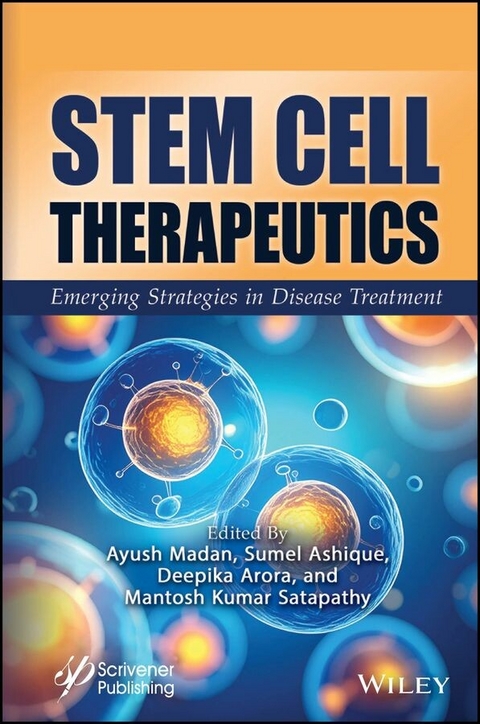
Stem Cell Therapeutics (eBook)
1129 Seiten
Wiley-Scrivener (Verlag)
978-1-394-31376-1 (ISBN)
Discover the revolutionary potential of stem cell therapy and gain a comprehensive understanding of its applications, challenges, and ethical considerations across various medical fields with Stem Cell Therapeutics, a must-read for anyone interested in the future of medicine.
Stem Cell Therapeutics delves into the forefront of medical research, exploring the revolutionary potential of stem cell therapy in combating a wide array of diseases. This comprehensive volume provides a thorough examination of the subject matter, offering insights into the latest advancements, methodologies, and applications of stem cell therapeutics.
The book adopts a multidisciplinary approach, drawing upon expertise from fields such as biology, medicine, biotechnology, and bioengineering. Readers can expect to encounter in-depth discussions on the use of stem cells in treating various medical conditions, including neurodegenerative disorders, cardiovascular diseases, autoimmune conditions, and cancer. Each chapter provides a comprehensive overview of the current state of research for each disease, highlighting the challenges, successes, and prospects of stem cell-based therapies. Additionally, the book explores ethical considerations, regulatory frameworks, and commercialization strategies surrounding the field, ensuring a well-rounded understanding of the subject matter for readers at all levels of expertise.
Ayush Madan is an assistant professor in the Department of Biotechnology at the People's University, Bhopal, and a research assistant at the Institute of Tropical Aquaculture and Fisheries. He has published over 45 book chapters and articles in international journals. His research interests include animal biotechnology, bioprocess engineering, and downstream processing.
Sumel Ashique is a researcher in the School of Pharmaceutical Sciences at Lovely Professional University. He has over 200 publications, including eight books and numerous book chapters and journal articles. His research focuses on nanoformulations, targeted drug delivery, probiotics, and postbiotics.
Deepika Arora, PhD is the Lab Director at the Regenerative Cell Research Institute. She has published over 19 book chapters and articles in international journals. Her research focuses on cell therapy, regenerative medicine, and tissue engineering.
Mantosh Kumar Satapathy, PhD is a postdoctoral researcher in the College of Biomedical Engineering at Taipei Medical University with over a decade of experience. He has published over 20 articles in international journals and conferences. He specializes in cell culture, tissure engineering, nanocomposites, and nanobiotechnology.
Discover the revolutionary potential of stem cell therapy and gain a comprehensive understanding of its applications, challenges, and ethical considerations across various medical fields with Stem Cell Therapeutics, a must-read for anyone interested in the future of medicine. Stem Cell Therapeutics delves into the forefront of medical research, exploring the revolutionary potential of stem cell therapy in combating a wide array of diseases. This comprehensive volume provides a thorough examination of the subject matter, offering insights into the latest advancements, methodologies, and applications of stem cell therapeutics. The book adopts a multidisciplinary approach, drawing upon expertise from fields such as biology, medicine, biotechnology, and bioengineering. Readers can expect to encounter in-depth discussions on the use of stem cells in treating various medical conditions, including neurodegenerative disorders, cardiovascular diseases, autoimmune conditions, and cancer. Each chapter provides a comprehensive overview of the current state of research for each disease, highlighting the challenges, successes, and prospects of stem cell-based therapies. Additionally, the book explores ethical considerations, regulatory frameworks, and commercialization strategies surrounding the field, ensuring a well-rounded understanding of the subject matter for readers at all levels of expertise.
1
Unraveling the Mechanisms: Insights Into Stem Cell Behavior in Disease Microenvironments
Pranshul Sethi1,2, Aniruddha Sen3, Sonima4, Ayush Madan5,6, Syed Mohsin Waheed7 and Bibhas Kumar Bhunia8*
1Chitkara College of Pharmacy, Chitkara University, Punjab, India
2College of Pharmacy, Shri Venkateshwara University, Gajraula, Uttar-Pradesh, India
3Department of Biochemistry, All India Institute of Medical Sciences, Gorakhpur, Uttar Pradesh, India
4Department of Pharmacology, University Institute of Pharma Science and Research, Chandigarh University Gharuan, Punjab, India
5Department of Biotechnology, School of Research and Technology, People’s University, Bhanpur, Bhopal, Madhya Pradesh, India
6Institute of Tropical Aquaculture and Fisheries, Universiti Malaysia Terengganu, Kuala Nerus, Terengganu, Malaysia
7Divacc Research Laboratories Pvt. Ltd. AIC-JNUFI, Jawaharlal Nehru University, New Delhi, India
8Department of Life Sciences, Parul Institute of Applied Sciences & Research and Development Cell, Parul University, Vadodara, Gujarat, India
Abstract
Stem cell research holds great promise for the development of regenerative medicine, with potential cures and treatments for a wide range of diseases. This is still a subject area of stem cells interacting with the pathological microenvironments and their behavior that remains a core point of investigation.
This chapter offers general insight into the mechanisms by which stem cell behavior is governed within these complex settings, many of which tend to be hostile. This chapter will begin focusing on the basic features of stem cell biology and how a stem cell niche is typically organized under physiological conditions. This is accompanied by changes in the microenvironment within these niches, driven by diseases, including modifications to the extracellular matrix, oxygen levels, and the presence of inflammatory signals. These are relevant since they will largely influence the fates of stem cells vis-à-vis the processes of differentiation, migration, and self-renewal. This goes deep into the critical signaling pathways and molecular interactions pivotal in determining stem cell behavior in disease contexts, such as Wnt, Notch, Hedgehog, and so on. This chapter also discusses how stem cells respond to the mechanical and biochemical cues of their altered microenvironments and the implication of such responses for disease progression and therapy.
Moreover, the chapter discusses some of the most recent methodological developments in studying stem cell–disease interactions. Advanced imaging techniques, single-cell RNA sequencing, and innovative in vitro and in vivo models are discussed in this context, the ways those are being applied to shed new light upon disease-induced dynamics of stem cells. The chapter finishes with an outlook on potential therapeutic strategies built based on understanding derived from stem cell behavior within a diseased microenvironment. Pursuing targeted molecular pathways and microenvironmental factors allows the potential for optimal stem-cell-based therapies, leading to better clinical outcomes. This chapter will not only improve our understanding of the biology of stem cells in disease but it is also set to pave the way toward targeted regenerative therapeutics.
Keywords: Stem cells, disease microenvironments, regenerative medicine, stem cell niche, therapeutic strategies, molecular signaling pathways
1.1 Introduction
Human stem cell research has substantially developed over the past few decades and is beginning to emerge as a critical pillar for regenerative medicine. Stem cells are relevant because of their self-renewal and differentiation ability into different cells; therefore, they can help study the development and mechanisms of diseases with potential therapeutic applications. This continued in full swing after the 1981 discovery of embryonic stem cells from mice. Martin Evans and Matthew Kaufman went on to show that those cells could differentiate into any cell type [1]. The process was carried even further by James Thomson, who derived human embryonic stem cells in 1998, thus making a breakthrough in biomedical research [2].
Early research primarily focused on the fundamental properties of stem cells, such as pluripotency and multipotency. Pluripotent stem cells comprise embryonic and induced pluripotent stem (iPSC) cells. Since they can differentiate to all body cell types, this is more generalized for fundamental research as well as for clinical use [3]. Notably, this field was revolutionized by the discovery of iPS cells in 2006 (which can be derived from adult somatic cells and reprogrammed to an embryonic-like state) that avoid the ethical issues associated with embryonic stem (ES) cell lines [4]. Our knowledge of adult stem cells, i.e., hematopoietic stem cells (HSCs) and mesenchymal stem cells (MSCs), has also blossomed. Symporemonic cells are so named because they are quasistepwise-insoluble virtually in whole tissues, and they abode an moment character to network retrial and helium/popper. This led to our understanding of HSCs, the cells responsible for lifelong renewal of all blood cell types and successful bone marrow transplantation (now utilized worldwide for leukemia and other blood diseases) [5]. Conversely, because of their immunomodulating and regenerative properties [6], MSCs have also become promising tools for the treatment of various diseases including inflammatory diseases or tissue injuries.
However, how stem cells function for a long term in disease microenvironments will be a key factor in developing successful stem cell therapies. When in a pathogenic setting, the way stem cells act is very different and usually more negatively impacted than under normal conditions. For example, in cancer, the unique tumor microenvironment with hypoxic conditions, inflammation, and differences in the extracellular matrix components generally may precondition stem cell fate, leading to tumorigenesis and metastasis in a more interactive way [7]. In neurodegenerative diseases such as Alzheimer’s and Parkinson’s, the inhibitory effects are due to the inflammatory milieu and neurotoxic factors acting on neural stem cells’ regenerative capacity, which precludes them from developing their regenerative potential for repair purposes [8].
Several reasons argue for studying these interactions. It may be helpful for understanding how certain disease factors modify the function of stem cells in terms of differentiation, migration, and self-renewal. Such a knowledge would point exactly toward the optimization of the stem cell therapy procedure in a way that enhances its effectiveness and safety. For example, a comprehension of the precise signaling pathways and molecular cues (e.g., Wnt, Notch, and Hedgehog) might permit to develop measures that would alter the signals, leading to less bountiful therapeutic manifestations [9]. Understanding these mechanisms in a disease context, e.g., within endothelial stem cells, is the key to designing new targeted therapies aimed at addressing the root cause of a diseases rather than merely masking symptoms. For instance, in heart diseases, stem cell therapy is adopted to repair and regenerate the damaged heart muscle cells. How hypoxia influences the properties of stem cells has been largely elucidated, and this information can further us in developing improved approaches to enhance their therapeutic potential [10].
The aim of this chapter is to provide an insight into the possible ways that alterations in the stem cell niche within disease microenvironments can regulate the behavior of a stem cell. This chapter discusses ways in which stem cells are influenced by altered biochemical and biophysical components of the niche (e.g., ECM, oxygen, inflammatory signals) with a focus on how changes to these factors affect fate selections of stem cells. This chapter provides a synopsis of the key signaling pathways and molecular crosstalk that condition stem cell function, within the context of different diseases including Wnt, Notch, and Hedgehog signaling. In addition, the chapter reviews recent methodological advances—advanced imaging, single-cell RNA sequencing, and new in vitro and in vivo models—that are transforming research into stem cell–disease interactions. While this review is not aimed at documenting the development and utility of each, these tools have been extremely valuable in advancing our knowledge regarding stem cell biology on disease states and only deserve mention here. Lastly, we will discuss potential therapeutic interventions arising from our increasing understanding of how stem cells may behave in diseased microenvironments. We seek to provide the strategy’s details concerning molecular targets and the microenvironment on how to realize enhanced effectiveness of stem cell-based therapies toward ensuring better clinical outcomes overall.
1.2 Stem Cell Biology and the Stem Cell Niche
1.2.1 Characteristics of Stem Cells
Stem cells are unique cells with two defining characteristics: self-renewal and differentiation potential. These properties are essential for their role in development, tissue repair, and regenerative medicine.
1.2.1.1 Self-Renewal
A stem cell can also replicate itself without differentiation for many divisions. This phenomenon is known as self-renewal. Self-renewal is a mechanism to ensure stem cell numbers...
| Erscheint lt. Verlag | 8.7.2025 |
|---|---|
| Sprache | englisch |
| Themenwelt | Medizin / Pharmazie ► Medizinische Fachgebiete |
| Technik | |
| Schlagworte | Biomedical Applications • Biotechnology • Cancer Treatment • Cardiovascular Diseases • cellular therapy • Clinical translation • Disease treatment • ethical considerations • neurodegenerative disorders • Regenerative medicine • Regulatory frameworks • Stem cell applications • stem cell research • Stem Cell Therapy • Tissue engineering |
| ISBN-10 | 1-394-31376-4 / 1394313764 |
| ISBN-13 | 978-1-394-31376-1 / 9781394313761 |
| Informationen gemäß Produktsicherheitsverordnung (GPSR) | |
| Haben Sie eine Frage zum Produkt? |
 EPUB (Adobe DRM)
Kopierschutz: Adobe-DRM
Adobe-DRM ist ein Kopierschutz, der das eBook vor Mißbrauch schützen soll. Dabei wird das eBook bereits beim Download auf Ihre persönliche Adobe-ID autorisiert. Lesen können Sie das eBook dann nur auf den Geräten, welche ebenfalls auf Ihre Adobe-ID registriert sind.
Details zum Adobe-DRM
Dateiformat: EPUB (Electronic Publication)
EPUB ist ein offener Standard für eBooks und eignet sich besonders zur Darstellung von Belletristik und Sachbüchern. Der Fließtext wird dynamisch an die Display- und Schriftgröße angepasst. Auch für mobile Lesegeräte ist EPUB daher gut geeignet.
Systemvoraussetzungen:
PC/Mac: Mit einem PC oder Mac können Sie dieses eBook lesen. Sie benötigen eine
eReader: Dieses eBook kann mit (fast) allen eBook-Readern gelesen werden. Mit dem amazon-Kindle ist es aber nicht kompatibel.
Smartphone/Tablet: Egal ob Apple oder Android, dieses eBook können Sie lesen. Sie benötigen eine
Geräteliste und zusätzliche Hinweise
Buying eBooks from abroad
For tax law reasons we can sell eBooks just within Germany and Switzerland. Regrettably we cannot fulfill eBook-orders from other countries.
aus dem Bereich