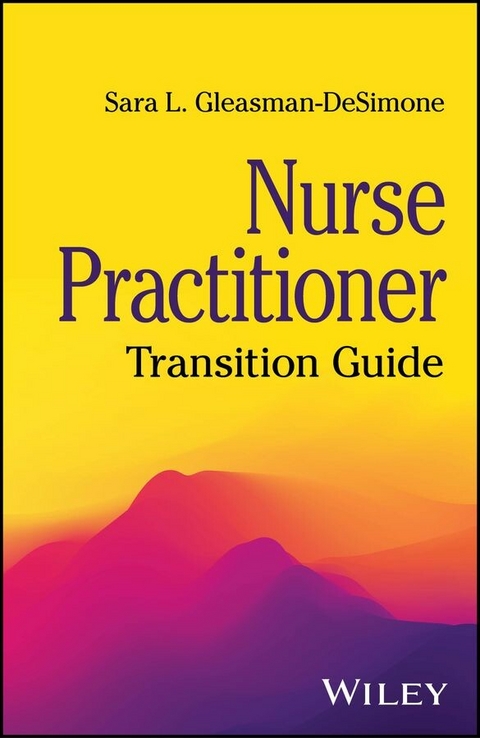
Nurse Practitioner (eBook)
397 Seiten
Wiley (Verlag)
978-1-394-30369-4 (ISBN)

A comprehensive guide to the transition to clinical practice
Nurse Practitioners (NP) have become one of the most important parts of the medical profession. They provide direct patient care, bring a wealth of expertise, and in many clinical settings they are the primary guarantor of good patient outcomes. Nurse Practitioner: Transition Guide is a crucial resource designed to help guide a nurse practitioner through the challenging transition from academia to clinical practice. Covering all essential topics and enriched with real clinical experiences shared by practicing NPs, it's unlike any other work in addressing the needs of this growing group of indispensable medical professionals.
Readers of Nurse Practitioner: Transition Guide will also find:
- Case studies, reflective exercises, and worksheets for goal setting
- Detailed discussion of topics from board certification, job searching, and interview preparation to ethics, self-care, and communication
- Essential information for the changing post-COVID landscape
Nurse Practitioner: Transition Guide is ideal for graduate students in their final semester of a Nurse Practitioner program who are taking a transition or capstone course. Additionally, preceptors preparing the next generation of Nurse Practitioners for the realities of clinical practice will find valuable insights and practical guidance throughout.
Sara L. Gleasman-DeSimone, PhD, NP-C, holds a PhD in education with a focus on post-secondary adult education. She maintains an active clinical practice as a nurse practitioner in both inpatient and outpatient settings and is an active contributor to the advancement of the nursing profession. She is also Graduate Nursing Director and Assistant Professor for an NP/DNP program. Working at the intersection of education and healthcare, Sara consistently strives for excellence in both and is committed to lifelong learning.
A comprehensive guide to the transition to clinical practice Nurse Practitioners (NP) have become one of the most important parts of the medical profession. They provide direct patient care, bring a wealth of expertise, and in many clinical settings they are the primary guarantor of good patient outcomes. Nurse Practitioner: Transition Guide is a crucial resource designed to help guide a nurse practitioner through the challenging transition from academia to clinical practice. Covering all essential topics and enriched with real clinical experiences shared by practicing NPs, it s unlike any other work in addressing the needs of this growing group of indispensable medical professionals. Readers of Nurse Practitioner: Transition Guide will also find: Case studies, reflective exercises, and worksheets for goal settingDetailed discussion of topics from board certification, job searching, and interview preparation to ethics, self-care, and communication Essential information for the changing post-COVID landscape Nurse Practitioner: Transition Guide is ideal for graduate students in their final semester of a Nurse Practitioner program who are taking a transition or capstone course. Additionally, preceptors preparing the next generation of Nurse Practitioners for the realities of clinical practice will find valuable insights and practical guidance throughout.
Chapter 1
Introduction
Sara L. Gleasman‐DeSimone PhD, ANP‐C
Le Moyne College, Graduate Nursing Department, Syracuse, NY, USA
1.1 Introduction
1.1.1 Transitions
Stepping out of the structured school environment and into independent clinical practice can feel overwhelming at first, especially without the guidance of a preceptor. For the new nurse practitioner (NP), understanding what to expect and how to navigate this shift can make a world of difference. During this time, one will begin forming a new professional identity and adopting a mindset aligned with the advanced nursing role.
1.1.2 Purpose
This book was created to support new NPs as they shift from their final semester of school to the challenges of their first year in practice. It aims to bridge the gap between classroom learning and the realities of professional work. It provides practical advice and strategies to make this period less overwhelming and more fulfilling. By blending actionable tips with academic insight, this guide equips new NPs with the tools and confidence they need to establish a strong foundation for a successful career.
1.2 Intended Audience
This book is developed for NP students in the final semester of their program and in the first year of practice. It also provides valuable insights for preceptors and faculty who play a crucial role in guiding new NPs, offering mentorship, support, and practical advice to help them integrate successfully into their roles.
1.3 Importance of Book
1.3.1 Growth of the Profession
The NP profession continues to experience significant growth. As of November 2023, there are approximately 385,000 licensed NPs in the United States, marking an 8.5% increase from 355,000 in 2022 [1]. This steady growth reflects the rising demand for high‐quality, patient‐centered care, which NPs deliver across diverse settings. A key driver of this expansion is the NPs' ability to address healthcare shortages and improve access to care, particularly in underserved areas. Legislative advancements in many states have granted full practice authority (FPA) to NPs, enabling them to practice independently. These changes highlight the recognition of NPs as providers of high‐quality, cost‐effective care. Furthermore, the expansion of Doctor of Nursing Practice (DNP) programs equips NPs to apply evidence‐based practices in clinical settings to improve patient outcomes.
On a global scale, the role of NPs is also expanding. For example, the American Association of Nurse Practitioners (AANP) launched an international membership category in 2024, reflecting the global growth of advanced practice nursing. The AANP supports the international NP community through initiatives like the International Advanced Practice Nurse Ambassador Program, which funds international participants' attendance at AANP conferences to foster collaboration and learning. Additionally, the organization collaborates with global partners to advance NP roles and improve patient access to care worldwide [2]. These efforts demonstrate the profession's adaptability and growing influence on healthcare systems across various regions.
Looking ahead, the US Bureau of Labor Statistics projects a 45% increase in NP employment from 2022 to 2032, a growth rate significantly higher than the average for all occupations [3]. This rapid expansion is driven by escalating healthcare demands, an aging population, and provider shortages.
However, NPs have earned top recognition in US News & World Report's 2024 rankings, securing the titles of Best Job, Best Healthcare Job, and Best STEM Job [4]. This acclaim highlights the profession's ability to deliver cost‐effective, high‐quality primary care. Efforts by organizations like the AANP to expand and diversify the workforce will help sustain this growth and ensure that NPs continue to meet the needs in the healthcare environment [1].
1.4 Historical Background of Nurse Practitioner Practice
1.4.1 The Beginning
The NP profession began with a vision to train nurses to provide advanced care. This idea came to fruition in 1965 when Dr. Loretta Ford and Dr. Henry Silver established the first NP program at the University of Colorado. Their goal was to expand the role of nurses by integrating advanced clinical skills with a focus on disease prevention and health promotion. This innovative program enabled nurses to assume advanced roles in providing primary care, particularly to underserved populations, laying the foundation for the NP profession [5]. Shortly thereafter, Boston College introduced a graduate‐level NP program, and by 1973, more than 65 NP programs were operational across the United States. That same year, the National Association of Pediatric Nurse Practitioners (NAPNAP) was founded, playing a critical role in advancing pediatric healthcare.
1.4.2 Definition and Growth of the Profession
As the years went on, there was continued growth for NP programs as the profession gained broader recognition. By 1989, 90% of NP programs were offering master's degrees or higher, reflecting the profession's commitment to advanced education and professionalization [6]. The AANP, established in 1983 with just 100 members, became a cornerstone of professional advocacy. By launching its journal in 1989, the AANP provided NPs with a dedicated platform to share research and best practices that further formalized the profession. By the end of the 2000s, the number of practicing NPs in the United States had surpassed 130,000, underscoring the growing role of NPs as essential healthcare providers.
1.4.3 Evolving Policy and Practice
Around this time, many states passed laws to formally define the NP role and give them greater independence in practice [7]. These legal milestones created a foundation for the profession's growth, opening the door to expanded responsibilities and authority. For example, the Balanced Budget Act of 1997 increased reimbursement for NP services under Medicare and Medicaid, solidifying the NP role as providers in the healthcare system [6]. This ensured reimbursement equity at 85% of the physician rate for equivalent services. Additionally, the Affordable Care Act (ACA) emphasized team‐based, patient‐centered care models, such as patient‐centered medical homes and accountable care organizations, where NPs play a pivotal role in delivering primary care.
One of the most significant advancements for NPs is FPA. With FPA, NPs can independently practice without the need for physician oversight. This change is important for addressing healthcare challenges like improving access to care in underserved areas. This also meets the growing demand created by an aging population and the rise in chronic diseases [6]. By 2023, 27 states and the District of Columbia had adopted FPA, with more states working toward similar legislation. However, NPs deliver care that matches and sometimes exceeds that of physicians in areas like patient outcomes, satisfaction, and cost‐effectiveness [8]. The COVID‐19 pandemic underscored the autonomy and flexibility of NPs, as many states temporarily relaxed physician supervision requirements, strengthening the case for making FPA a permanent policy. Policy advancements have not only expanded NP autonomy but also highlighted the importance of supporting novice NPs during their transition to independent practice [8, 9].
1.5 What Do You Call a Nurse Practitioner?
The terminology used to describe NPs can significantly impact their professional identity and perception within healthcare. Terms like “midlevel provider” and “physician extender” are often viewed as demeaning and have been associated with discomfort and professional conflict [10]. Despite their use in some settings to differentiate NPs from physicians, these labels fail to reflect the expertise and autonomy of NPs. It is recommended to use appropriate professional titles that recognize their qualifications, particularly for those holding a doctoral degree [11]. Using respectful and accurate terminology not only validates the NP role but also fosters greater collaboration within healthcare teams.
1.6 Elevator Speech
An elevator speech is a concise summary that communicates an NP's role and value. This helps NPs confidently highlight their expertise, build connections, and advocate for their profession in various settings. However, NPs are advanced practice registered nurses with graduate or doctoral‐level education who assess, diagnose, treat, and prescribe medications. They provide primary, acute, and specialty healthcare, focusing on health promotion and disease prevention. This focus on disease prevention helps improve overall health outcomes and reduces the burden of preventable illnesses [12]. Furthermore, NPs work closely with interdisciplinary teams, contributing their expertise to improve communication and coordination, ultimately enhancing patient outcomes [13].
The AANP defines NPs as “licensed, autonomous clinicians who blend clinical expertise in diagnosing and treating health conditions with a focus on disease prevention and health promotion” [14]. This...
| Erscheint lt. Verlag | 8.7.2025 |
|---|---|
| Sprache | englisch |
| Themenwelt | Medizin / Pharmazie ► Pflege |
| Schlagworte | AI • Burnout • contract negotiation skill • credentialing • DEA • interprofessional education • interviewing for nursing • launching a practice • Medicaid • medicare • Nursing job essential • opportunity for advancement • Patient-centered Care |
| ISBN-10 | 1-394-30369-6 / 1394303696 |
| ISBN-13 | 978-1-394-30369-4 / 9781394303694 |
| Informationen gemäß Produktsicherheitsverordnung (GPSR) | |
| Haben Sie eine Frage zum Produkt? |
 EPUB (Adobe DRM)
Kopierschutz: Adobe-DRM
Adobe-DRM ist ein Kopierschutz, der das eBook vor Mißbrauch schützen soll. Dabei wird das eBook bereits beim Download auf Ihre persönliche Adobe-ID autorisiert. Lesen können Sie das eBook dann nur auf den Geräten, welche ebenfalls auf Ihre Adobe-ID registriert sind.
Details zum Adobe-DRM
Dateiformat: EPUB (Electronic Publication)
EPUB ist ein offener Standard für eBooks und eignet sich besonders zur Darstellung von Belletristik und Sachbüchern. Der Fließtext wird dynamisch an die Display- und Schriftgröße angepasst. Auch für mobile Lesegeräte ist EPUB daher gut geeignet.
Systemvoraussetzungen:
PC/Mac: Mit einem PC oder Mac können Sie dieses eBook lesen. Sie benötigen eine
eReader: Dieses eBook kann mit (fast) allen eBook-Readern gelesen werden. Mit dem amazon-Kindle ist es aber nicht kompatibel.
Smartphone/Tablet: Egal ob Apple oder Android, dieses eBook können Sie lesen. Sie benötigen eine
Geräteliste und zusätzliche Hinweise
Buying eBooks from abroad
For tax law reasons we can sell eBooks just within Germany and Switzerland. Regrettably we cannot fulfill eBook-orders from other countries.
aus dem Bereich