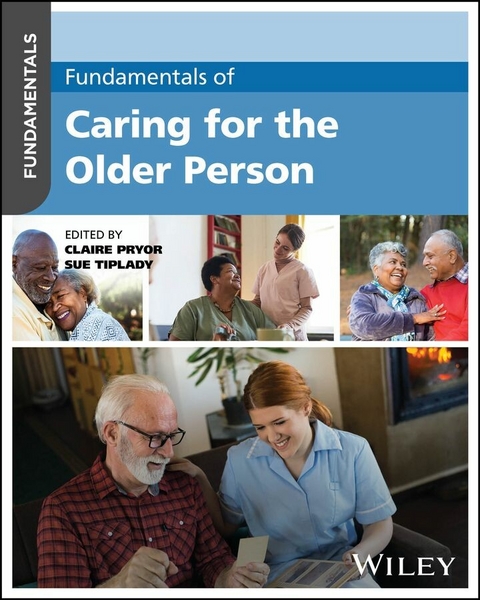
Fundamentals of Caring for the Older Person (eBook)
781 Seiten
Wiley (Verlag)
978-1-394-27112-2 (ISBN)
A comprehensive guide to delivering high-quality care for older adults
As older adults increasingly become the primary users of health and social care services, the need for health and social care professionals with specific knowledge in this area has never been greater. Fundamentals of Caring for the Older Person equips nursing students and healthcare professionals with the essential skills, knowledge, and attitudes needed to provide compassionate, evidence-based care for older individuals with complex needs.
With real-world narratives, this practical guide offers a holistic approach, recognising that older people are not a homogenous group but individuals with unique experiences, strengths, and requirements. Written by experienced clinicians and academics, the book integrates key considerations across physical, psychological, and social dimensions of care, offering a clear and engaging foundation for anyone committed to enhancing the quality of care for older adults in diverse settings.
- Presents a person-centred approach to caring for older adults, featuring episodes of care, examples, and narratives to amplify the voice of older individuals in their own care and ensure practical application of theory
- Utilises a three-unit structure for ease of learning: key aspects of ageing, altered pathology and disease management, and care practices
- Addresses key policies and professional literature recommendations to improve care for older people
- Includes pedagogical tools such as key points, clinical investigations, pharmacology insights, and red/orange/green flags for pathological, psychological, and social considerations
Designed for flexibility, with chapters functioning as standalone units, Fundamentals of Caring for the Older Person supports students and newly qualified practitioners alike. It is ideal for undergraduate and postgraduate programmes in nursing, allied health, and social care, particularly for courses in adult nursing and gerontology.
Claire Pryor is a Professor of Adult Social Care Nursing at the University of Salford. A registered nurse and independent and supplementary prescriber, she holds a PhD, an MSc in Advancing Healthcare Practice, and a BSc in Nursing Science. With extensive experience in both clinical practice and education, she supports both student nurses and nurses in their professional development, and works to enhance care for older adults through research and teaching.
Sue Tiplady has had an extensive nursing career leading and managing the care of older people. Within her senior management roles in the NHS, she commissioned and designed services to improve care delivery for older people and their carers. As an Assistant Professor at Northumbria University, she contributed to a range of research focussed on Gerontology and Dementia Care, embedding the care of older people into the pre-registration nursing curriculum and designing specialist programmes for post-registration education delivery.
A comprehensive guide to delivering high-quality care for older adults As older adults increasingly become the primary users of health and social care services, the need for health and social care professionals with specific knowledge in this area has never been greater. Fundamentals of Caring for the Older Person equips nursing students and healthcare professionals with the essential skills, knowledge, and attitudes needed to provide compassionate, evidence-based care for older individuals with complex needs. With real-world narratives, this practical guide offers a holistic approach, recognising that older people are not a homogenous group but individuals with unique experiences, strengths, and requirements. Written by experienced clinicians and academics, the book integrates key considerations across physical, psychological, and social dimensions of care, offering a clear and engaging foundation for anyone committed to enhancing the quality of care for older adults in diverse settings. Presents a person-centred approach to caring for older adults, featuring episodes of care, examples, and narratives to amplify the voice of older individuals in their own care and ensure practical application of theoryUtilises a three-unit structure for ease of learning: key aspects of ageing, altered pathology and disease management, and care practicesAddresses key policies and professional literature recommendations to improve care for older peopleIncludes pedagogical tools such as key points, clinical investigations, pharmacology insights, and red/orange/green flags for pathological, psychological, and social considerations Designed for flexibility, with chapters functioning as standalone units, Fundamentals of Caring for the Older Person supports students and newly qualified practitioners alike. It is ideal for undergraduate and postgraduate programmes in nursing, allied health, and social care, particularly for courses in adult nursing and gerontology.
CHAPTER 1
Ageing and Ageing Populations
Elaine Francis
Northumbria Healthcare NHS Foundation Trust, Northumberland and North Tyneside, UK
LEARNING OUTCOMES
After reading this chapter, the reader will be able to:
- Outline international and national population change
- Discuss the concepts of ageing and ageing well
- Appreciate the impact of ageism and assumptions within care for older people
- Understand the need for a comprehensive, person‐centred approach to care for older people
- Consider and examine their own values, assumptions and perspectives of ageing
Introduction
Chapter 1 explores ageing populations as a foundation for understanding and exploring the specialism of caring for the older person. This chapter outlines significant worldwide and national demographic change and invites you to explore the concept of ageing, representations of ageing and older people and realities of health inequality.
There is an urgency to act now to improve the lives of older people. Reading the chapter, you are encouraged to reflect on your own beliefs, viewpoints and experience and consider the experience of your own ageing population.
A chapter within a book, it is always the case that there will be omissions, and many more words could be spent exploring ageing in hard‐to‐reach populations. Key considerations around caregivers and frailty are detailed elsewhere. Consideration has been taken to add reference to widely available comprehensive data and reports, so you are able to question these with your own local populations in mind.
While the chapter may raise more concerns than offer solutions, these solutions are abundant within the chapters that follow. Consent has been received for case studies; however, details have been changed to protect anonymity.
What Is Ageing?
Ageing is a multifaceted phenomenon. Biologically, it is ‘the time‐related deterioration of the physiological functions necessary for survival and fertility’ [1]. The World Health Organization [2], when applying ageing to people, broadens this definition to ‘the process of growing older, characterised by a progressive decline in functional capacity and increased vulnerability to disease and disability’.
Physically, the ageing process has a deleterious effect on the functioning of bodily systems, from urinary and gastrointestinal systems to declining sensory systems. These, in turn, impact psychological performance.
Ageing encompasses not only physical, cognitive, functional and psychological changes but also social and environmental dimensions. During the 1980s, there was a shift from a biomedical focus on ageing towards considering more holistic ‘successful ageing’. While there are numerous definitions for what ‘successful’ means, they typically focus on how to increase healthy, functional or fulfilling years for both an individual and a population [3].
This new direction had widespread implications for clinical research and policy across the world. Within the United Kingdom, this concept formed the basis of the ‘Ageing Well’ discourse, as seen in the NHS Long Term Plan [4].
What Age Is ‘Old Age’?
An adult is defined as an ‘older person’ when they reach a certain chronological ‘threshold’ age. These are the ages at which physical and psychological changes tend to occur. The World Health Organization typically uses a threshold age of 60 or 65 years. Within the NHS, typically, anyone over the age of 65 years may be considered an older person [5].
However, if measurements of ageing considered faster increases in life expectancy, it would show slower rates of population ‘ageing’. An age marker such as 65 years could be replaced by a measure of prospective age, for example, a future life expectancy of 15 years. Applied in practice, for the US population as of 2018, this threshold age would be 71.5 years. In Japan, it is 74 years; in Nigeria, it is 58 years. Take the example of a 60‐year‐old man living in Western Europe and ask – is he old? In today’s society, 93% of men survive until their 60th year, whereas 150 years ago, less than 25% would [6].
Functional age is an alternative or adjunct to chronological age, which considers the ability to carry out a task and participate in activities essential to independent living. The benefits of integrating functional ageing include links with healthy ageing and developing and maintaining functional ability to enable well‐being in older age [7].
Neither chronological nor functional age considers how a person may feel. Psychological theories of ageing discuss developmental stage theories and changes in cognition, emotion and behaviour [8]. In psychosocial theory, Erikson’s model of development can be used to understand the older person’s health and care needs. This model portrays a conflict between ‘integrity’ vs ‘despair’, highlighting the ability to reflect on one's life with satisfaction, and for it to continue to feel meaningful. Reflecting the ageing well narrative, we are social beings, and to thrive, we need a sense of self‐worth and belonging [9].
Trends in Population Ageing
Population ageing, where older people become a larger demographic share of the total population, is poised to become one of the most significant social transformations of the twenty‐first century.
For the first time in human history, there are more people living in the world who are aged 65 years and over than under 5 years. The United Nations project that by 2050, the number of people aged 65 years and over will be double that of children under the age of 5 years and almost the same as those under 12 years. Between 2015 and 2050, the proportion of the world's population over 60 years will nearly double from 12% to 22% [10].
In addition, for a large majority of countries in the world, their populations are irreversibly ageing. ‘Super age’ populations, where 20% of a population are over the age of 65 years, are a global phenomenon that requires attention and action on an international scale. Europe is the world’s oldest continent, with 21.1% of its adult population aged over 65 years in 2022 and predicted to reach half a million centenarians by 2050 [11].
FIGURE 1.1 The countries with the oldest population in the world.
Source: Countries With the Oldest Populations in the World /PRB / CC BY 3.0.
Today’s pace of population ageing is much faster than in the past. While it took France 150 years to become a super‐population, an increase from 10% to 20% of the population aged over 65 years, this same demographic change is predicted to take only 20 years in China, India and Brazil. Figure 1.1 shows countries with the oldest populations in the world.
The UK population is ageing. This is due to rapid improvements in survival and decline in mortality rates, in particular, cardiovascular disease and IHD and fertility trends [12]. Over the 15 years between 2021 and 2036, the size of the UK population aged 85 years and over is projected to increase from 1.6 million (2.5% of the total population) to 2.6 million (3.5%). By 2039, the number of people aged 75 years and over is expected to double from 5 million to nearly 10 million [13].
Across the UK regions, Wales has the largest proportion of people aged over 70 years (15.4%), followed by England (13.5%) and Scotland (13.8%), with Northern Ireland having the smallest at 12.1% [14].
The 2021 Census for England and Wales recorded more people than ever before in older age groups. Over 11 million people, 18.6% of the total population were aged 65 years or older, compared with 16.4% in 2011. In England, almost 40% of people are over 50 years with almost 20% over 65 years, and the number of people aged 80 years and older is predicted to double in the next 40 years. Older people are more likely to live in rural and coastal areas, while younger people live in cities, with the most ageing local authorities on the south and east coast [15].
Population ageing, however, can vary significantly across small geographic areas and local authorities, often where there is a densely urban university city next to a much more rural local authority. To recognise this, the Office of National Statistics [16] created a subnational ageing tool to compare different local authorities and regions in the United Kingdom.
While increasing longevity is to be celebrated, for some, the average time living in good health has not improved. Social determinants of health are the main driver of health inequalities. Social isolation and loneliness are important but often neglected social determinants of health, with health effects exceeding those of smoking 15 cigarettes per day or obesity [17]. Two million older people in the United Kingdom are living in poverty, and more than half experience deep poverty, unable to meet the most basic needs for a decent quality of life [18]. Power imbalances within inequality and the benefits of technology may be limited to those who have the means to pay for them [19].
Reflection Point
New technologies and robotic assistance.
What is the future of ageing? There is growing interest...
| Erscheint lt. Verlag | 8.7.2025 |
|---|---|
| Reihe/Serie | Fundamentals |
| Mitarbeit |
Herausgeber (Serie): Ian Peate |
| Sprache | englisch |
| Themenwelt | Medizin / Pharmazie ► Pflege |
| Schlagworte | geriatric nursing education • geriatric nursing guide • geriatric nursing reference • geriatric nursing textbook • geriatric person-centred care • healthcare for older people • older adult care guide • older adult care reference • older adult care textbook |
| ISBN-10 | 1-394-27112-3 / 1394271123 |
| ISBN-13 | 978-1-394-27112-2 / 9781394271122 |
| Informationen gemäß Produktsicherheitsverordnung (GPSR) | |
| Haben Sie eine Frage zum Produkt? |
 EPUB (Adobe DRM)
Kopierschutz: Adobe-DRM
Adobe-DRM ist ein Kopierschutz, der das eBook vor Mißbrauch schützen soll. Dabei wird das eBook bereits beim Download auf Ihre persönliche Adobe-ID autorisiert. Lesen können Sie das eBook dann nur auf den Geräten, welche ebenfalls auf Ihre Adobe-ID registriert sind.
Details zum Adobe-DRM
Dateiformat: EPUB (Electronic Publication)
EPUB ist ein offener Standard für eBooks und eignet sich besonders zur Darstellung von Belletristik und Sachbüchern. Der Fließtext wird dynamisch an die Display- und Schriftgröße angepasst. Auch für mobile Lesegeräte ist EPUB daher gut geeignet.
Systemvoraussetzungen:
PC/Mac: Mit einem PC oder Mac können Sie dieses eBook lesen. Sie benötigen eine
eReader: Dieses eBook kann mit (fast) allen eBook-Readern gelesen werden. Mit dem amazon-Kindle ist es aber nicht kompatibel.
Smartphone/Tablet: Egal ob Apple oder Android, dieses eBook können Sie lesen. Sie benötigen eine
Geräteliste und zusätzliche Hinweise
Buying eBooks from abroad
For tax law reasons we can sell eBooks just within Germany and Switzerland. Regrettably we cannot fulfill eBook-orders from other countries.
aus dem Bereich