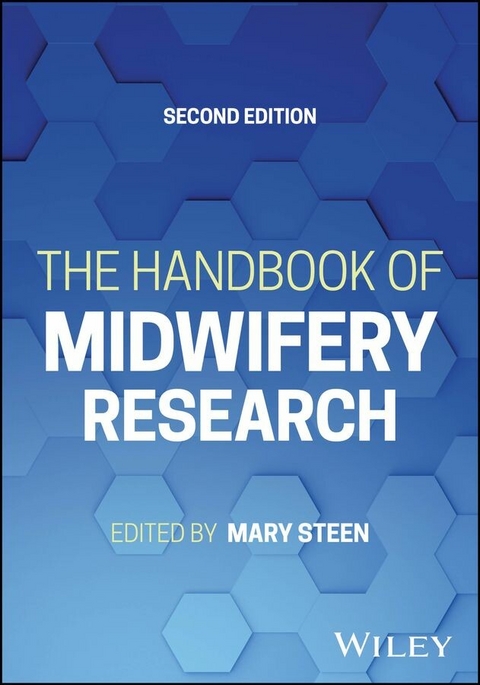
The Handbook of Midwifery Research (eBook)
535 Seiten
Wiley (Verlag)
978-1-119-57318-0 (ISBN)
An accessible introduction to the spectrum of research in maternity care
The Handbook of Midwifery Research, Second Edition, enables midwives and student midwives to search and make sense of research evidence, write research proposals, and undertake and disseminate research studies. Written in a concise and accessible style, this book includes useful tools and techniques to keep readers up to date with the best available evidence to apply to their own clinical practice. This second edition has been extensively revised to reflect current midwifery research and involves a range of study designs. The book is divided into three parts: understanding research, undertaking research, and publishing research.
The Handbook of Midwifery Research includes information on:
- Different types of reviews and steps to assess them when little information is published on a topic
- How to use a search strategy and search terms, including the PRISMA guidelines and flowcharts to show search stages systematically
- Critical analysis of reported research, and integrating results and findings
- Quantitative and qualitative data collection methodologies, and mixed methods with specifics on convergent, sequential explanatory, exploratory, and hybrid study designs
- The history and role of ethics in healthcare, midwifery, and research governance
- The importance of the links between research, education, policies, and clinical practice
With case studies, learning objectives, and clear examples throughout, The Handbook of Midwifery Research is an essential learning resource for any midwife or student wanting to approach research with confidence.
Mary Steen, OBE, Professor of Midwifery and Discipline Lead at Curtin University and King Edward Memorial Hospital, Perth, Western Australia, has been conducting research since 1992 across Europe, the UK, Australia, Nigeria, Brazil, Iran, the Emirates, and Thailand, with the aim of improving care and services for women, babies, and their families. Her exceptional contributions to midwifery, and to maternal and familial health research, were formally recognised in 2025 when she was awarded an OBE in the King's Birthday Honours List.
1
Introduction to midwifery research
Introducing research
The focus of this chapter is to introduce midwifery research, types of knowledge, audit and research, the differences between qualitative and quantitative research and the importance of evidence‐based practice. This chapter will assist midwives and students to initially gain basic knowledge and understanding of what research is and why it is important. This new knowledge will enable midwives and students to understand and appreciate the need for evidence‐based practice when caring for childbearing women, their babies and their families. The importance of evidence‐based practice will be stressed to promote good standards of care.
Aim
To introduce midwives and students to different research approaches that will help them develop an understanding of types of knowledge, the differences between audit and research and the importance of evidence‐based practice.
Learning outcomes
- To be able to recognise different types of knowledge
- To be able to distinguish between qualitative and quantitative approaches
- To be introduced to multi‐methods and mixed methods
- To know the difference between audit and research
- To be introduced to implementation research and knowledge mobilisation
- To gain an understanding the importance of evidence‐based practice
Research questions – what, where, when, why, who and how?
When undertaking research, you must first ask yourself the questions what, where, when, why, who and how? This will help you decide the research approach you need to apply, either quantitative (measures/numbers/counts/frequencies) or qualitative (measures words/phrases/language). This approach will help you to develop a research question or hypothesis (theory) that needs asking and is relevant to something you are curious or concerned about in midwifery education, policy, management or practice. The first task you will need to do when you have an idea of the research question you would like to ask is to find out about any existing evidence there is currently available on the subject matter.
Ideally, when planning to do a research study, you should choose something you are passionate about or some burning issue you would like to address. Once you have made a decision about what you would like to investigate or explore and have a preliminary research question, you will need to undertake a literature search to see if the research question has already been asked or not. Using a search strategy and structuring the review in some way (which is covered in the next chapter) can be helpful in organising the evidence or identifying a lack of evidence you may find. The search strategy and literature review can be influenced by the research approach adopted and this chapter introduces the different approaches to research.
Midwifery and research
Midwifery‐led research has not had a long history; in fact, as late as the 1980s there was a paucity of research in this area. Early midwifery research studies such as the routine shaving of women in labour (Romney, 1980), the routine use of enemas during labour (Romney & Gordon, 1981), the use of episiotomies (Sleep et al., 1984) and the routine admission of women in labour (Garforth & Garcia, 1987) are examples of traditional midwifery practices that were found to be of little benefit to women.
The publication of ‘Effective Care in Pregnancy and Childbirth’, which provided details of several systematic reviews, initially assisted in the dissemination of research evidence to the midwifery profession (Chalmers et al., 1989). The Midwifery Research Database (MIRIAD) had 393 studies recorded in 1995, whereas during its inception period 1976–1980, only 21 studies were recorded (McCormick & Renfrew, 1997).
Presently, it is difficult to determine exactly how many midwifery studies are in the public domain, but an internet search (February 2024) using the terms ‘Midwifery research studies’ on Google Scholar resulted in 1,140,000 hits, clearly demonstrating that the body of knowledge has increased significantly and is continuing to do so. More midwives are now in possession of a Master's or PhD qualification and based in academic and/or clinical settings; this means that midwives have undertaken a significant research review/study and contributed to the growing body of evidence. However, a recent scoping review identified that there was a need to increase the focus and number of midwifery‐led trials in Australia and New Zealand (Homer et al., 2023) and this may be the case for other countries. A search of the Australian and New Zealand clinical trials register identified 26,467 randomised controlled trials, of which 50 were midwife‐led. There appears to have been a dominance of non‐experimental research undertaken by midwives and this review highlights a lack of high‐quality randomised trials directing midwifery practice and maternity services which indicates that there is a need to support midwives to design and conduct trials and publish findings. These findings may not be too surprising as the concept of research was not included in the midwifery curriculum until the late 1980s (Macdonald, 2004) but then became an integral element for student midwives' studies with assignments being based on research critiques or formulation of research proposals.
Postgraduate students who are studying at Master's level conduct and write up a research study as part of their dissertation. Midwives studying at PhD level must usually submit a more in‐depth piece of writing to meet the requirements to obtain this qualification. It may be that due to time and resources available, qualitative studies are more feasible to undertake, and midwifery research is still evolving. Opportunities for midwives to be chief investigator are still limited.
The terms ‘dissertation’ and ‘thesis’ are commonly used interchangeably, and may be used differently depending on the country. In Europe and Australia, for example, a student will write a dissertation to complete the requirements of a Master's degree (sometimes for a Bachelor's degree) and a thesis for a PhD. In the USA, the definitions are usually reversed, i.e. a thesis at the end of a Bachelor's or Master's degree and a dissertation for a PhD.
When embarking on a research study, it is vitally important that midwives and student midwives gain a clear understanding of the research process. This process will be clearly explained in this introductory chapter and will be referred to in other chapters. However, initially, it is important to discuss how research informs education, and education then informs clinical practice. This triad model promotes the implementation of evidence‐based practice. For example, in the UK, the NMC Code (NMC, 2018) and new Standards give guidance as to what is expected from nurses and midwives regarding their professional behaviour and practice. The NMC states:
BOX 1.1 NMC STRATEGY 2020–2025.
‘Promote and uphold the highest professional standards in nursing and midwifery to protect the public and inspire confidence in the professions.’
Thus working towards the NMC Vision:
‘Safe, effective and kind nursing and midwifery practice, improving everyone's health and wellbeing.’
‘All registrants must ensure that all the advice and information they share with service users is evidence based.’
And:
‘All student assessments must be supported by a diverse and reliable evidence base.’
These statements support the NMC's Strategy 2020–2025 Purpose and Vision (Box 1.1).
Regulatory bodies such as the NMC also have a duty to conduct research to inform how they undertake their roles and responsibilities to regulate and investigate the nursing and midwifery professions. In 2019, the NMC published ‘Ambitious for Change’, a programme of research that reviewed the impact of its regulatory processes and people's diversity characteristics. This research was undertaken in two phases. Phase one investigated the impact the regulatory processes had on nursing and midwifery professionals with different diversity characteristics (April 2016–2019). Phase two explored revalidation experiences to gain understanding of why certain groups are less likely to revalidate and what can be done to address this issue (NMC, 2022). Findings reported that sometimes people receive different outcomes based on who they are when ‘Oversea Registration’, ‘Revalidation’ and ‘Fitness to Practise’ regulatory processes were examined. This research has prompted the NMC to introduce changes to the processes examined and is a useful baseline to measure progress and improvement.
Types of research knowledge
As mentioned previously, a process needs to be followed and this starts with trying to determine ‘what you want to know’. This sounds easy, but the reality is that this starting point does take time. It's your thinking time, time to put your thoughts into reality. What burning issues do you want to address? What subject or topic are you passionate about? What have...
| Erscheint lt. Verlag | 8.7.2025 |
|---|---|
| Sprache | englisch |
| Themenwelt | Medizin / Pharmazie ► Pflege |
| Schlagworte | midwifery analysis • midwifery clinical practice • midwifery data collection midwifery research interview • midwifery evidence • midwifery guide • midwifery research • midwifery research findings • midwifery research proposal • midwifery reviews |
| ISBN-10 | 1-119-57318-1 / 1119573181 |
| ISBN-13 | 978-1-119-57318-0 / 9781119573180 |
| Informationen gemäß Produktsicherheitsverordnung (GPSR) | |
| Haben Sie eine Frage zum Produkt? |
 EPUB (Adobe DRM)
Kopierschutz: Adobe-DRM
Adobe-DRM ist ein Kopierschutz, der das eBook vor Mißbrauch schützen soll. Dabei wird das eBook bereits beim Download auf Ihre persönliche Adobe-ID autorisiert. Lesen können Sie das eBook dann nur auf den Geräten, welche ebenfalls auf Ihre Adobe-ID registriert sind.
Details zum Adobe-DRM
Dateiformat: EPUB (Electronic Publication)
EPUB ist ein offener Standard für eBooks und eignet sich besonders zur Darstellung von Belletristik und Sachbüchern. Der Fließtext wird dynamisch an die Display- und Schriftgröße angepasst. Auch für mobile Lesegeräte ist EPUB daher gut geeignet.
Systemvoraussetzungen:
PC/Mac: Mit einem PC oder Mac können Sie dieses eBook lesen. Sie benötigen eine
eReader: Dieses eBook kann mit (fast) allen eBook-Readern gelesen werden. Mit dem amazon-Kindle ist es aber nicht kompatibel.
Smartphone/Tablet: Egal ob Apple oder Android, dieses eBook können Sie lesen. Sie benötigen eine
Geräteliste und zusätzliche Hinweise
Buying eBooks from abroad
For tax law reasons we can sell eBooks just within Germany and Switzerland. Regrettably we cannot fulfill eBook-orders from other countries.
aus dem Bereich