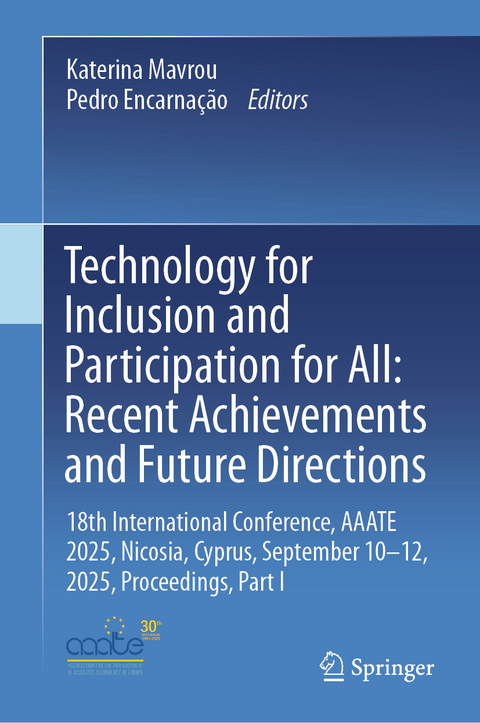
Technology for Inclusion and Participation for All: Recent Achievements and Future Directions
Springer International Publishing (Verlag)
978-3-032-01627-0 (ISBN)
This two-volume set constitutes the proceedings of the 18th biennial AAATE Conference on Technology for Inclusion and Participation for All: Recent Achievements and Future Directions, AAATE 2025, which took place in Nicosia, Cyprus, during September 10-12, 2025. The 107 full papers included in the proceedings were carefully reviewed and selected from a total of 224 submissions.
This collection of papers explores the intersection of advanced technologies, accessibility, and inclusion across education, healthcare, and the workplace. It emphasizes the development and implementation of assistive technologies to support individuals with diverse needs, particularly those with cognitive, sensory, and mobility impairments, and older adults.
The key topics explored are as follows:
· Inclusive education and workplace participation: How to exploit digital tools, Universal Design for Learning, and AI to foster inclusive learning environments and equitable access to employment.
· Digital accessibility: How to plan and design accessible digital spaces to enhance digital inclusion.
· Assistive technology for mobility and navigation: Exploring advances in wheelchairs technologies, mobility and indoor navigation systems to enhance autonomy and participation for all users.
· Assistive technology in healthcare and rehabilitation: Understanding how to integrate interactive technologies such as virtual reality, eye-tracking, and serious games for diagnosing and rehabilitation of neurodevelopmental disorders, and integrating assistive technologies in healthcare settings.
· Artificial Intel
Advanced technologies for inclusion and participation in education and labour.- Evaluating The Role Of An Assistive Online Toolkit To Support Autistic Students During The Transition Into University.- Digital Skills, Reasonable Accommodation and Technological Assistance for Employment in Cyprus..- Artificial Intelligence And Disability: Using ChatGPT To Improve The Well-Being And Understand The Needs Of Students With Autism Spectrum Disorders.- Participatory Development of AI-enabled Applications. Insights from a German Research Project with People with Learning Disabilities.- Online Conversion Service of PDF/PowerPoint into Accessible Forms for Dyslexic Students.- UniNotesXR - Accessible Collaboration in Extended Reality: A Spatial Whiteboard with 3D Audio User Guidance for the Visually Impaired.- Immersive Learning for Inclusive Workplaces: Evaluating Mixed Reality in Vocational Training for People with Neurodevelopmental Disorders.- Augmented Reality-Based Training for Gardening: Enhancing Skills for Individuals with Special Needs at Il Seme Social Cooperative.- Bridging the Digital Media Divide - Enhancing Internet Accessibility for Students with Special Needs via [App s Name].- Impact of Interactive Sensory Ball on Children with Autism Spectrum Disorder: Enhancing Engagement, Self-Regulation, and Teacher Support.- Accessibility in digital spaces.- Flex Picture eBook: Software for the Creation of Accessible Interactive Images.- Uses of Email applications by People who are Blind and Low vision.- Accessibility Guidelines for 360-Degree Platforms: Derivation and Implementation.- Accessible indoor navigation systems.- A Systematic Review of Smartphone-based Indoor Navigation Assistance for Blind and Visually Impaired People.- Analysis of Indoor Wayfinding Accessible-Assistive Technologies for Mobility, and Blind and Visually Impaired Individuals.- Creating User-Centered Guidelines For Digital Guidance Systems.- Advancing diagnosis and rehabilitation of neurodevelopmental disorders: The role of virtual reality, eye-tracking, and serious games.- Sensors in Inclusive Virtual Reality Games for People with Intellectual Disability.- Usability of Smart Wearable for Adult and Paediatric Neurological Upper Limb Re/Habilitation: Perspectives of Users and Allied Health Professionals.- Creating a Virtual Environment For The Development Of Social And Communication Skills Of Children With Autism.- A New Path to Recovery: Virtual Reality-Driven Treadmill Exercises.- Recommendation System of Virtual Reality (VR) Application for Rehabilitation Purposes.- User-center Game Development For Older Adults.- Artificial intelligence in care and support ecosystems.- Lessons Learnt And Hands-On Experience In Developing Personalized AI-Powered Assistive Technology Companions For Use In Patient Care Settings.- A Novel AI-powered Approach for Improving Inclusion and Participation of Unpaid Caregivers in a Digital Carer Support Community.- About Assistive Technology Stack Supporting Active and Healthy Aging Based on Personalization and Application of Sensor Measurements.- Artificial intelligence in higher education: Advancing inclusive environments, pedagogical approaches, and assistive technologies.- AI Research: Where are the Disabled Researchers and the Voices of Disabled People.- Comparative Study on Gen-AI Models to Write Alt Text.- Evaluating Large Multimodal Models for Inclusive Mathematics Education: Addressing Dyslexia and Dyscalculia in Higher Education.- Assistive technologies outcomes and impact measurement.- Satisfaction With And Perceived E
| Erscheinungsdatum | 03.09.2025 |
|---|---|
| Zusatzinfo | XXI, 483 p. 98 illus., 82 illus. in color. |
| Verlagsort | Cham |
| Sprache | englisch |
| Maße | 155 x 235 mm |
| Themenwelt | Medizin / Pharmazie ► Physiotherapie / Ergotherapie ► Orthopädie |
| Technik | |
| Schlagworte | Accessibility • AI powered AT • ambient assisted living • assistive robotics • Assistive Technology • Augmented Reality based AT • Internet of Things Applications • Smart Environments applications • Universal Design • Virtual Reality based AT |
| ISBN-10 | 3-032-01627-4 / 3032016274 |
| ISBN-13 | 978-3-032-01627-0 / 9783032016270 |
| Zustand | Neuware |
| Informationen gemäß Produktsicherheitsverordnung (GPSR) | |
| Haben Sie eine Frage zum Produkt? |
aus dem Bereich