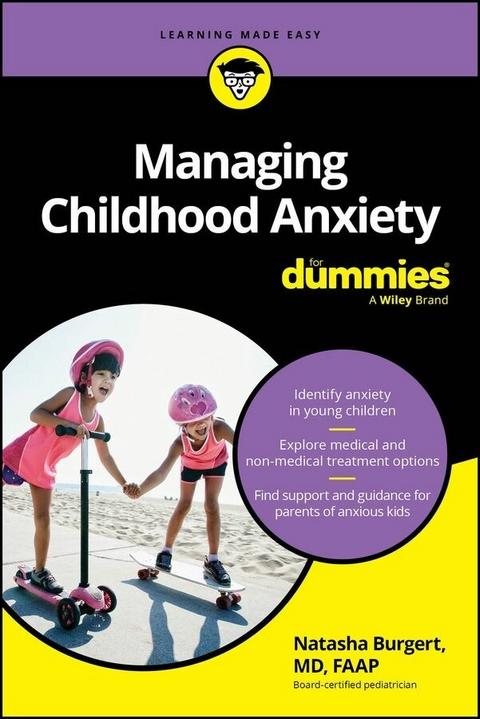
Managing Childhood Anxiety For Dummies (eBook)
388 Seiten
For Dummies (Verlag)
9781394329564 (ISBN)
Understand what child anxiety is, how to treat it, and how to support and encourage anxious children
Anxiety is the most common mental health condition in young children. Managing Childhood Anxiety For Dummies is the go-to resource for parents of young children who suspect their child may be experiencing anxiety but aren't sure where to start. Learn to recognize the symptoms of anxiety in kids who may be too young to explain how they're feeling and get expert advice on supporting them with proper treatment and guidance. Find answers to questions like: When is worry normal, and when it is a sign of anxiety? Which interventions are most effective for anxious kids? How can I make my home or classroom less stress inducing? Written by an experienced pediatrician, this compassionate book challenges harmful taboos about mental health and equips you with the tools you need to be a resource to any young child with anxiety.
- Learn the basics of childhood anxiety and how it's diagnosed
- Explore ways to diagnosis anxiety, treat it with proven methods, and manage the physical symptoms that often come with childhood anxiety
- Find helpful tips to create a supportive environment at home and school to foster your young child's growth and development
- Discover effective and positive strategies to help your anxious child with sleep, screen time, and sports performance
Managing Childhood Anxiety For Dummies provides essential information to assist you in supporting the children in your care. It's also invaluable for all parents and caregivers of children aged 4-11 years who have concerns about a child's persistent worrying.
Natasha Burgert, MD, FAAP, is a board-certified pediatrician, national spokesperson for the American Academy of Pediatrics, and child health advocate. Dr. Burgert is a prolific writer and media contributor. She held a regular column, 'Dear Pediatrician,' for two years in Forbes Health, and is a sought-after speaker and educator.
Understand what child anxiety is, how to treat it, and how to support and encourage anxious children Anxiety is the most common mental health condition in young children. Managing Childhood Anxiety For Dummies is the go-to resource for parents of young children who suspect their child may be experiencing anxiety but aren't sure where to start. Learn to recognize the symptoms of anxiety in kids who may be too young to explain how they're feeling and get expert advice on supporting them with proper treatment and guidance. Find answers to questions like: When is worry normal, and when it is a sign of anxiety? Which interventions are most effective for anxious kids? How can I make my home or classroom less stress inducing? Written by an experienced pediatrician, this compassionate book challenges harmful taboos about mental health and equips you with the tools you need to be a resource to any young child with anxiety. Learn the basics of childhood anxiety and how it's diagnosed Explore ways to diagnosis anxiety, treat it with proven methods, and manage the physical symptoms that often come with childhood anxiety Find helpful tips to create a supportive environment at home and school to foster your young child's growth and development Discover effective and positive strategies to help your anxious child with sleep, screen time, and sports performance Managing Childhood Anxiety For Dummies provides essential information to assist you in supporting the children in your care. It's also invaluable for all parents and caregivers of children aged 4-11 years who have concerns about a child's persistent worrying.
Chapter 1
Worrying About Your Child’s Worries
IN THIS CHAPTER
Examining how anxiety presents in young children
Making a diagnosis of anxiety
Developing a comprehensive treatment plan
Anxiety is a protector and defender. Without it, we wouldn’t be able to survive or properly care for the ones we love. But when feelings of worry and fear become irrational, all-consuming, or cause us to change our behavior, that’s when anxiety becomes unhealthy and no longer performs its desired function.
In this chapter, you discover some anxiety basics, including why childhood anxiety is particularly unique. You start to think about anxiety as a medical diagnosis. Finally, you see that childhood anxiety is exceptionally treatable, and treatment starts with you.
Defining Anxiety
Childhood anxiety represents a spectrum of emotional, behavioral, and physical responses characterized by persistent worry, fear, and apprehension that exceeds developmental norms and interferes with daily functioning.
As a pediatrician, I regularly see how anxiety uniquely manifests in children through physical complaints like stomachaches or headaches, behavioral changes such as school avoidance or tantrums, and cognitive patterns involving excessive worry. When these symptoms get big enough to pull kids away from the things they need or love to do, I become concerned that a child may be suffering from an anxiety disorder.
The importance of addressing childhood anxiety cannot be overstated. Longitudinal studies show that children with untreated anxiety are more likely to develop depression, substance use disorders, and even more severe anxiety conditions later in life. Beyond these long-term concerns, childhood anxiety immediately impacts academic performance, social development, family functioning, and overall quality of life.
There are ways to reduce the impact of anxiety’s long-term effects. This book walks you through these evidence-supported interventions, including many things you can do at home. See Parts 3 and 4.
Analyzing Anxiety
Childhood anxiety is on the rise. In fact, doctor visits for anxiety have increased from 1.4 percent in 2006 to 4.2 percent in 2018. In my private practice, I see one or two children per day for anxiety management. Multiply that by the 67,000 pediatricians in the United States alone, and you can appreciate how common anxiety disorders are in today’s youth.
Seeing rising rates of anxiety
Researchers are devoting countless hours of expertise to determine why rates of child anxiety are on the rise. Theories include increased public awareness, pandemic fallout, and social media use. See Chapter 3.
Regardless of the cause of anxiety’s rise, the message is clear: Kids are more anxious than ever before. Every child, including yours, deserves to be heard, seen, and supported if they show signs of worry and stress. Being aware of anxiety and its symptoms is the first step.
Finding the roots of anxiety
Childhood anxiety results from a blend of biological and environmental factors. Biological factors are determined by your child’s genetics, temperament, and brain development. Environmental factors refer to elements or conditions in a child’s surroundings that influence their health. You find these factors discussed in various ways throughout this book. Also, you find ways to modify or impact factors you think are triggering your child’s anxiety symptoms.
Although you cannot take anxiety away from your child, you can change the intensity and duration of their anxiety experience.
Looking for Anxiety in Children
One of the biggest challenges — and joys — of working with kids is that they are physiologically and developmentally different than adults. These inherent differences make identifying, evaluating, and diagnosing anxiety in young kids difficult.
Appreciating child development
When working with kids, it’s important to take a child’s developmental phase into account. As children grow, they pass through expected phases while acquiring increasingly complex skills, called developmental milestones. Milestone progress from infancy through young adulthood is predictable in sequence, with one skill building upon another.
If you’re looking for a comprehensive list of childhood developmental milestones, the CDC has a free, interactive app called “CDC’s Milestone Tracker.” Find additional online resources in the Appendix.
At every well-child visit, pediatricians assess social-emotional milestones. These key developmental achievements (found in Chapter 2) involve a child’s ability to understand emotions, form relationships, express feelings, and navigate social interactions in age-appropriate ways. Social-emotional milestones are especially important to assess for kids struggling with fear and worry.
If you are unsure whether your child’s behavior is normal, call your child’s pediatrician. We get questions from worried parents every day and can let you know if additional evaluation is needed.
Showing, not telling
When you’re frightened, your body surges with stress hormones, all aimed at one goal — to protect. This hormone cascade prepares your body to fight, run away, or hide from a threat. This happens in kids too, but they lack the language to express what their brain and body are feeling. Instead of using words, kids show anxiety though behaviors.
Anxiety’s uncomfortable symptoms lead to avoidance behaviors — a key characteristic in all types of childhood anxiety. Avoidance behaviors are actions kids take to escape or prevent anxiety-provoking situations. If avoidance behaviors are allowed to continue, the connection is reinforced in their brain as an effective way to avoid danger and fear, becoming a learned behavior over time.
Kids don’t tell you they are feeling anxious, they show you through changes in their behavior.
Checking out various anxiety types
If a child’s anxiety behaviors are not age-appropriate, or if they are interfering with the things the child loves to play and do, that’s when professionals consider the possibility of an anxiety disorder. In young children, some anxiety disorder types are more common than others. For details of the most common anxiety disorders in young children, including separation anxiety disorder, social anxiety disorder, generalized anxiety disorder, and specific phobias see Chapter 4.
Getting the Diagnosis
Diagnosing a childhood anxiety disorder requires specialized assessments that consider development, cognition, and family involvement. The good news is that decades of research have focused on child anxiety identification and treatment. Today, there are evidence-supported interventions to help identify kids more quickly and guide treatment in age-appropriate ways.
Starting with your child’s doctor
An anxiety diagnosis starts with a trip to your child’s healthcare provider. During the appointment, you can share your child’s story and why you’re worried about anxiety. In turn, your child’s doctor will evaluate them for any medical conditions that may be contributing to their symptoms. The doctor can also find ways to support the physical symptoms of anxiety your child may be experiencing. For more on doctors’ visits see Chapter 7.
Not all child health providers evaluate children for anxiety. Talk with your child’s doctor to find out whether they handle mental health concerns or suggest going elsewhere for an assessment.
Considering alternative diagnoses
If an anxiety disorder is suspected, or if your child’s behaviors are unclear, tapping into the expertise of a child psychologist can be helpful. During a comprehensive psychological evaluation, your observations of your child’s behaviors will be considered, in addition to information directly gathered from your child.
Some different diagnoses that psychologists consider when evaluating a child with anxiety behaviors include the following (see Chapter 8):
- Attention-deficit/hyperactivity disorder (ADHD)
- Oppositional defiant disorder (ODD)
- Learning challenges
- Sensory processing disorder (SPD)
- Autism spectrum disorder (ASD)
Up to half of children with an anxiety disorder have an additional health condition or disorder, referred to as a co-morbidity. Having more than one diagnosis can create interactions that may complicate diagnosis, treatment, and management.
Accepting your child’s anxiety
When a child is diagnosed with an anxiety disorder, families often feel overwhelmed. It’s tough to see your child struggle, and guilt or shame may arise. I encourage you to let go of these feelings — they’re not yours to hold. The sooner you release them, the sooner you can confidently support your child and work toward symptom remission.
Your child with anxiety is not broken, and there’s nothing to “fix.” Anxiety is a part of who they are and always will be. It’s another aspect of your child you’re learning about as they grow, offering you more ways to show love, support, and...
| Erscheint lt. Verlag | 2.7.2025 |
|---|---|
| Sprache | englisch |
| Themenwelt | Sachbuch/Ratgeber ► Gesundheit / Leben / Psychologie |
| Medizin / Pharmazie ► Medizinische Fachgebiete | |
| Schlagworte | Anxiety kids • anxiety parenting • anxious children • child anxiety • Childhood anxiety • child mental health, pediatrician • kids anxiety intervention • kids anxiety relief • kids anxiety supplement • Kids Meditation • parenting anxious kids • school psychologist book |
| ISBN-13 | 9781394329564 / 9781394329564 |
| Informationen gemäß Produktsicherheitsverordnung (GPSR) | |
| Haben Sie eine Frage zum Produkt? |
 EPUB (Adobe DRM)
Kopierschutz: Adobe-DRM
Adobe-DRM ist ein Kopierschutz, der das eBook vor Mißbrauch schützen soll. Dabei wird das eBook bereits beim Download auf Ihre persönliche Adobe-ID autorisiert. Lesen können Sie das eBook dann nur auf den Geräten, welche ebenfalls auf Ihre Adobe-ID registriert sind.
Details zum Adobe-DRM
Dateiformat: EPUB (Electronic Publication)
EPUB ist ein offener Standard für eBooks und eignet sich besonders zur Darstellung von Belletristik und Sachbüchern. Der Fließtext wird dynamisch an die Display- und Schriftgröße angepasst. Auch für mobile Lesegeräte ist EPUB daher gut geeignet.
Systemvoraussetzungen:
PC/Mac: Mit einem PC oder Mac können Sie dieses eBook lesen. Sie benötigen eine
eReader: Dieses eBook kann mit (fast) allen eBook-Readern gelesen werden. Mit dem amazon-Kindle ist es aber nicht kompatibel.
Smartphone/Tablet: Egal ob Apple oder Android, dieses eBook können Sie lesen. Sie benötigen eine
Geräteliste und zusätzliche Hinweise
Buying eBooks from abroad
For tax law reasons we can sell eBooks just within Germany and Switzerland. Regrettably we cannot fulfill eBook-orders from other countries.
aus dem Bereich