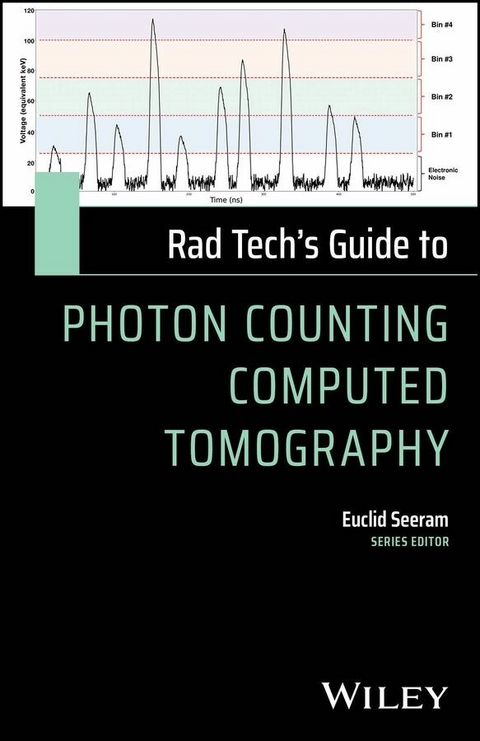
Rad Tech's Guide to Photon Counting Computed Tomography (eBook)
159 Seiten
Wiley (Verlag)
978-1-394-30723-4 (ISBN)
Concise guide offering a thorough exploration of the transformative technology of photon counting
Rad Tech's Guide to Photon Counting Computed Tomography is a comprehensive resource that enables readers to stay at the forefront of medical imaging with the first FDA-cleared Photon Counting Computed Tomography (PCCT) scanner. Ensuring compliance and cutting-edge practice, readers can prepare for the future with a guide that addresses upcoming educational requirements in medical imaging technology. This book is designed for quick reference, with precise, bulleted guidance, and material that aligns with international standards.
Rad Tech's Guide to Photon Counting Computed Tomography includes information on:
- Essential physics of radiation attenuation in CT and the physical principles of MSCT imaging, with a review of CT image quality
- Fundamental physical principles of PCCT, including the technical design characteristics of their semiconductor sensors and associated electronics
- Advantages of PCCT systems compared to CT systems using EIDs, with each advantage illustrated with selected anatomical areas
- Elements of the ACR manual for quality control of CT systems and quality assurance programs for a PCD CT imaging system
Suitable for an international audience, Rad Tech's Guide to Photon Counting Computed Tomography is an excellent reference for professionals and practitioners in the fields of computed tomography, nuclear medicine, diagnostic medical sonography, magnetic resonance imaging, and biomedical engineering technology.
Euclid Seeram, PhD., MSc., BSc., FCAMRT is Former Program Head of Medical Imaging Degree and Magnetic Resonance Imaging Programs, British Columbia Institute of Technology, British Columbia, Canada.
He is Adjunct Associate Professor, Medical Imaging and Radiation Sciences, Monash University, Australia; Adjunct Professor, Medical Radiation Sciences, Faculty of Health, University of Canberra, Australia.
1
The Invention of the Computed Tomography Scanner and the Nobel Prize
Chapter at a Glance
- Introduction
- What Is Computed Tomography?
- Invention of the Computed Tomography Scanner: Contributions of the Pioneers
- Physical Principles and Technology of ComputedTomography: A Brief Overview
- The Evolution of Computed Tomography Detectors
- Photon‐Counting Detectors: Current State of Computed Tomography Imaging
- References
Introduction
Computed tomography (CT) is a sectional imaging modality that has been used for several decades as a diagnostic tool in medicine. CT is based on tomographic principles to collect attenuation data from the patient and subjecting these data to complex computer software referred to as image reconstruction algorithms to create sectional anatomical slices of the patient through computer processing.
The purpose of this chapter is to outline in a comprehensive manner a brief description of CT as presented by the pioneers of this imaging modality, identify three major processes involved in CT imaging, and identify the fundamental elements of the evolution of CT detectors leading to the introduction of photon‐counting detectors used in current state‐of‐the‐art CT scanners.
What Is Computed Tomography?
The 1979 Nobel Prize in Physiology or Medicine was awarded to Godfrey N. Hounsfield and Allan M. Cormack “for the development of computer assisted tomography” [1]. In his Nobel Prize lecture, Hounsfield stated that “Computed Tomography … measures the attenuation of X‐ray beams passing through sections of the body from hundreds of different angles, and then, from the evidence of these measurements, a computer is able to reconstruct pictures of the body’s interior … based on the separate examination of a series of contiguous cross sections, as though we looked at the body separated into a series of thin “slices” [2].
Invention of the Computed Tomography Scanner: Contribution of the Pioneers
CT was invented in the 1970s as a diagnostic tool for the noninvasive clinical examination of the human brain [3–5]. This development was championed by two notable individuals, namely, Godfrey Newbold Hounsfield and Allan Cormack [6].
Godfrey Newbold Hounsfield
The literature includes numerous articles on Hounsfield and Cormack. This section will summarize the major contributions of each of them. Hounsfield was born in 1919 in Nottinghamshire, England. After his studies in electronics and electrical and mechanical engineering, he joined the staff at Electronic and Musical Industry (EMI Limited) in 1951 and began working on radar systems and later on computer technology.
In 1967, Hounsfield was investigating pattern recognition and reconstruction techniques by using the computer. During his research, he subsequently deduced that, passing an X‐ray beam through an object at different angles, recording X‐ray transmission readings, and processing these measurements would provide information about the internal structures of that object. His initial experiments used radiation from an americium gamma source coupled with a sodium iodide crystal detector, and it took about 9 days to scan the object. The computer needed 2.5 hours to process the 28,000 measurements collected by the detector. Since this procedure was too long, the gamma radiation source was replaced by a diagnostic X‐ray tube. The results of these experiments were more accurate and took 1 day to produce a picture [5].
In 1971, the first clinical prototype CT brain scanner (EMI Mark 1) was installed at Atkinson‐Morley’s Hospital and clinical studies were conducted under the direction of Dr. Ambrose. The processing time for the picture was reduced to about 20 minutes. Later, with the introduction of minicomputers, the processing time was reduced further to 4.5 minutes [5]. In 1972, Hounsfield received the McRobert Award and subsequently earned several prestigious awards such as a Fellowship of the Royal Society and the Lasker Prize in the United States. In 1977, Hounsfield was appointed Commander of the British Empire, and in 1979, he shared the Nobel Prize in physiology or medicine with Allan MacLeod Cormack, a physics professor at Tufts University in Medford, Massachusetts, for their contributions to the development of CT. After receiving this prestigious prize, he was knighted by her majesty Queen Elizabeth II and became an Honorary Fellow of the Royal Academy of Engineering. Sir Godfrey Hounsfield died on August 12, 2004, at age 84 [6]. Additional details of Hounsfield’s pioneering work can be found in a book titled Godfrey Hounsfield: Intuitive Genius of CT by Bates et al. [7], who were friends of Hounsfield and worked with him at EMI.
Allan MacLeod Cormack
Allan MacLeod Cormack was born in Johannesburg, South Africa, in 1924. He attended the University of Cape Town, where he obtained a bachelor of science in physics in 1944 and earned a master of science in crystallography in 1945. In 1958, he joined the physics department at Tufts University in the United States.
Professor Cormack developed solutions to the mathematical problems in CT. It was not until Hounsfield began work on the development of the first clinically useful CT scanner that Cormack’s work addressed the solution to the mathematical problem in CT [8]. Cormack died at age 74 in Massachusetts on May 7, 1998. Furthermore, Professor Cormacposthumously received the Order of Mapungubwe, South Africa’s highest honor, in December 2002, for his contribution to the invention of the CT scanner. On October 1, 2021, CT imaging completed 50 years of being a diagnostic tool in medicine [9].
Physical Principles and Technology of Computed Tomography: A Brief Overview
From the description of CT imaging by Hounsfield in the previous section, and noting that Cormack worked out the solutions to the mathematical problem in CT, it is useful to describe the fundamental elements in the CT imaging process, as a means of laying the foundation for Chapter 2.
Major Processes of Computed Tomography Imaging
The fundamental principles of CT imaging have been described in several textbooks on CT [10–12], and each has identified three major processes: data acquisition, image reconstruction, and image display, storage, and communications, as illustrated in Figure 1.1. The data acquisition system components are shown in Figure 1.2 and include the X‐ray tube, detectors, and detector electronics. The purpose of the data acquisition system is not only to produce an X‐ray beam from the X‐ray tube, but also to measure the initial intensity of the beam from the X‐ray tube and the intensity of the X‐ray beam passing through the patient. The detector electronics convert the attenuated X‐ray photons falling upon the detectors into electrical signals that are subsequently converted into digital data for processing by a mid‐range computer system.
Figure 1.1 Three major processes used by a conventional computed tomography scanner to produce diagnostic‐quality images.
Source: Reproduced from Seeram [13]/American Society of Radiologic Technologists.
Figure 1.2 The major system components of the data acquisition system, illustrating the X‐ray tube, the detectors, and the detector electronics.
Source: Reproduced from Seeram [13]/American Society of Radiologic Technologists.
The next major process is image reconstruction. In this step, complex computer algorithms are used to create images using the attenuation data collected from the patient during the scanning process. The algorithms provide the solution to the mathematical problem in CT and have evolved through the years, from the filtered back projection and iterative reconstruction algorithms to reconstruction algorithms based on artificial intelligence (AI) [14]. While the older algorithms resulted in both poor image quality in low‐dose CT imaging and long reconstruction times, AI‐based algorithms have demonstrated improved image quality, especially in low‐dose CT imaging [15–17].
A more detailed description of these algorithms will be reviewed in Chapter 2.
The final process deals with image display, storage, and communications. In this step, images are viewed on a monitor for interpretation, stored using appropriate storage devices, and subsequently distributed using a Medical Image Management and Processing System (MIMPS), formerly referred to as Picture Archiving and Communication System (PACS) [18].
The Evolution of Computed Tomography Detectors
Since this book deals with a new detector system referred to as a photon‐counting detector, a brief review of the evolution of detectors used in CT is warranted. The detector used by Hounsfield when he invented the CT scanner (EMI Mark‐4)...
| Erscheint lt. Verlag | 30.6.2025 |
|---|---|
| Reihe/Serie | Rad Tech's Guides' |
| Sprache | englisch |
| Themenwelt | Medizin / Pharmazie ► Allgemeines / Lexika |
| Schlagworte | ACR manual • CT image quality • CT Systems • CT systems EIDs • PCCT systems • PCD CT imaging system • Photon Counting Computed Tomography • physical principles MSCT imaging • radiation attenuation CT • semiconductor sensors pcct |
| ISBN-10 | 1-394-30723-3 / 1394307233 |
| ISBN-13 | 978-1-394-30723-4 / 9781394307234 |
| Informationen gemäß Produktsicherheitsverordnung (GPSR) | |
| Haben Sie eine Frage zum Produkt? |
 EPUB (Adobe DRM)
Kopierschutz: Adobe-DRM
Adobe-DRM ist ein Kopierschutz, der das eBook vor Mißbrauch schützen soll. Dabei wird das eBook bereits beim Download auf Ihre persönliche Adobe-ID autorisiert. Lesen können Sie das eBook dann nur auf den Geräten, welche ebenfalls auf Ihre Adobe-ID registriert sind.
Details zum Adobe-DRM
Dateiformat: EPUB (Electronic Publication)
EPUB ist ein offener Standard für eBooks und eignet sich besonders zur Darstellung von Belletristik und Sachbüchern. Der Fließtext wird dynamisch an die Display- und Schriftgröße angepasst. Auch für mobile Lesegeräte ist EPUB daher gut geeignet.
Systemvoraussetzungen:
PC/Mac: Mit einem PC oder Mac können Sie dieses eBook lesen. Sie benötigen eine
eReader: Dieses eBook kann mit (fast) allen eBook-Readern gelesen werden. Mit dem amazon-Kindle ist es aber nicht kompatibel.
Smartphone/Tablet: Egal ob Apple oder Android, dieses eBook können Sie lesen. Sie benötigen eine
Geräteliste und zusätzliche Hinweise
Buying eBooks from abroad
For tax law reasons we can sell eBooks just within Germany and Switzerland. Regrettably we cannot fulfill eBook-orders from other countries.
aus dem Bereich