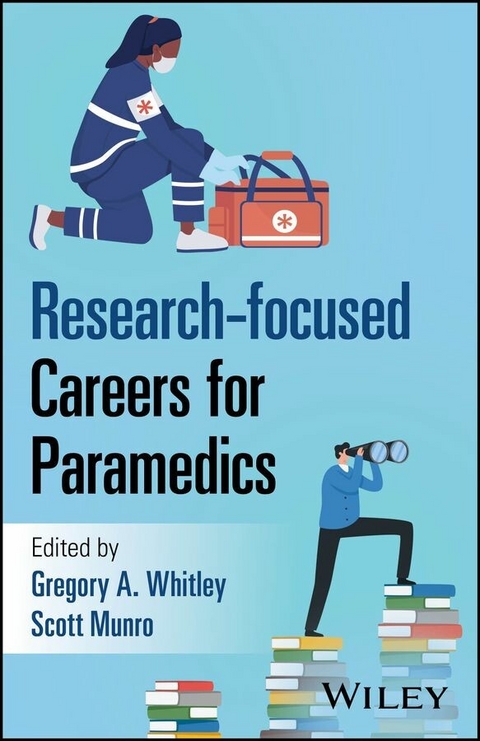
Research-focused Careers for Paramedics (eBook)
251 Seiten
Wiley (Verlag)
978-1-394-24125-5 (ISBN)
Practical guidance for aspiring and established clinical academic paramedics
In Research-focused Careers for Paramedics, a team of distinguished paramedic researchers provide practical guidance to support clinical academic career development. Written to support paramedics across the globe who have an interest in research, this book offers a guide through the stages of a research-focused career, from novice to expert. Supported by international case studies from 15 paramedics at various stages of their own research-focused career, this book provides real-world guidance for aspiring and established clinical academic paramedics.
Readers will find:
- Expert advice on career development, mentorship, networking and funding applications for research grants and fellowships
- Comprehensive explorations of the paramedic education systems across multiple countries
- Practical discussions of the authors' four-stage career model of paramedic research: novice, competent, proficient, expert
- Real-world case studies shedding light on the opportunities and challenges posed by each stage of the paramedic research career model
Perfect for practicing paramedics with an interest in research, Research-focused Careers for Paramedics will also benefit students of paramedicine and researchers with a background in paramedicine.
Gregory A. Whitley is a Paramedic Research Fellow for the East Midlands Ambulance Service NHS Trust, and an Associate Professor in Paramedic Science at the University of Lincoln, UK.
Scott Munro is a Critical Care Paramedic for the South East Coast Ambulance Service NHS Foundation Trust, and a Lecturer in Paramedic Practice at the University of Surrey, UK.
About the Contributors
Alan Michael Batt, PhD
Alan is an Associate Professor (adjunct) at Monash University, the Paramedicine Programme Lead and an Assistant Professor (adjunct) at Queen’s University, and an Assistant Professor (status) at the University of Toronto. He originally qualified as a paramedic in Ireland and has since gained experience in nine countries across four continents. He is a Co‐Chair of the McNally Project for Paramedicine Research in Canada, a Fellow of the Higher Education Academy (United Kingdom), and a Member of the Academy of Medical Educators (United Kingdom). Alan’s programme of research uses mixed methods approaches to explore health professions education, with a focus on professional competencies, the evolving role of paramedicine, care of marginalised populations, and social and structural determinants of health. He is a Deputy Editor of Paramedicine and serves as a Senior Appraiser with the Prehospital Evidence‐Based Practice Project at Dalhousie University. He has published over 190 articles, reports, and chapters and has presented at international and national conferences on more than 200 occasions. His research has attracted over $3.7m CAD in research funding, and he has received multiple awards for his scholarly and professional contributions to paramedicine.
Malcolm Boyle, PhD
Malcolm is an Associate Professor and an Academic Lead in Paramedic Education and a Programme Director for Paramedicine Programmes at Griffith University. He was a paramedic for over 35 years, with the last 28 years as a Mobile Intensive Care Ambulance (MICA) Paramedic in Victoria, primarily working in rural areas. He has been working in academia since 1999 and moved to Griffith University in July 2016, prior to that he was at Monash University in Melbourne, Australia. Malcolm’s PhD research focused on triage and error detection in pre‐hospital trauma management. Malcolm is a Fellow of the Australasian College of Paramedicine, and he has published over 200 academic outputs and secured over $2.5m AUD in research funding as a chief investigator or co‐applicant.
Georgette Eaton, DPhil (Oxon)
Georgette is the Consultant Paramedic in Urgent Care at London Ambulance Service NHS Trust and an Honorary Researcher at the Nuffield Department of Primary Care Health Sciences at the University of Oxford. Georgette completed her DPhil (PhD) in Evidence‐Based Health Care at the University of Oxford in 2024, where her research —funded by a Doctoral Research Fellowship from the National Institute for Health and Care Research—explored the impact of paramedics in NHS primary care, using realist approaches to improve understanding, support intelligent policy, and make recommendations for future workforce planning. Georgette is a facilitator and co‐chair within the Oxfordshire Community for Allied Health Professions Research, as well as a Scientist International Collaborator in the McNally Project and a Deputy Editor for Paramedicine.
Ben Meadley, PhD
Ben Meadley is an Intensive Care Paramedic and the Director of Paramedicine at Ambulance Victoria. He is a registered paramedic who commenced his career with Ambulance Victoria in 1998, followed by a period with New South Wales Ambulance from 1999 to 2003. Returning to Ambulance Victoria, Ben trained as an intensive care (MICA) paramedic in 2004 and an intensive care (MICA) flight paramedic in 2009. He joined the staff of Monash University in 2003, and he has held the positions of Teaching Associate, Lecturer, and Unit Coordinator in the undergraduate and postgraduate programmes. Ben completed his PhD at Monash Paramedicine, investigating the physiological and metabolic health of paramedics, as well as human performance in specialist teams. Ben has developed expertise in pre‐hospital critical care, paramedic education, human performance, and paramedic health and well‐being. His research interests include respiratory and cardiovascular physiology, point‐of‐care ultrasound, human performance optimisation, and selection to specialist paramedicine teams. Ben divides his time between clinical, teaching, and research roles. He is also a Fellow of the Australasian College of Paramedicine and was awarded the Ambulance Service Medal in 2023.
Elisha Miller, MSc
Elisha's career in the ambulance service began as an urgent call taker in the Yorkshire Ambulance Service NHS Trust (YAS) control room. With a desire to advance clinically, she applied for the paramedic science programme at Coventry University, graduating as a paramedic in 2013. She then served as an operational paramedic for West Midlands Ambulance Service University NHS Foundation Trust until March 2016, when she relocated back to Yorkshire to work as a frontline paramedic. In October 2019, she joined the YAS Research and Development team as a Research Paramedic, where she assisted in leading the delivery of the YAS research portfolio, including successfully applying for College of Paramedics small grants to fund her own research study.
In 2020, Elisha presented the findings from her Advanced Clinical Practice MSc dissertation at the College of Paramedics’ Fourth Annual National Research Conference, where her abstract was published in the British Paramedic Journal, and her full paper is currently awaiting publication. In December 2023, she obtained an 18‐month secondment to the National Institute for Health and Care Research Academy as a Senior Programme Manager, overseeing funding programmes that support health and social care professionals in their clinical and academic careers. Alongside this role, she is due to complete her MSc in Clinical Research Delivery at the University of Sheffield in 2025 and serves as a reviewer for the British Paramedic Journal.
Brendan Shannon, PhD
Brendan is an Associate Professor and the Deputy Head of the Department of Paramedicine at Monash University and a member of the Australasian College of Paramedicine Community Paramedicine working group. A registered paramedic with more than a decade of clinical experience, Brendan is passionate about refining healthcare models to ensure underserved communities receive the requisite care and support. He is known for innovating new education programmes and paramedicine models of care and career pathways that facilitate this, including as the Education Lead for the Victorian Paramedic Practitioner programme. Brendan's doctoral research focused on the impact of health services implementing alternative care pathways in community settings. As a health services researcher, he has published extensively, demonstrating his commitment to translating complex data into actionable insights to enhance healthcare delivery and patient outcomes. Brendan's collaborative, data‐driven approach has earned him domestic and international recognition, which he applies to his own research and teaching, as well as the research he supervises.
Peter O’Meara, PhD
Peter is an internationally recognised expert on paramedicine models of care and education. He is an Adjunct Professor of Paramedicine at Monash and Charles Sturt Universities in Australia, a Board Member of the Paramedic Network and the American Paramedic Association in the United States, a Fellow of the Australasian College of Paramedicine, and a member of several national and international advisory committees. His academic studies have been diverse and encompass health administration, public policy, and agricultural health and medicine.
Peter is a well‐published and cited paramedic author of more than 100 peer‐reviewed papers as well as several book chapters, and innumerable commentaries and editorials. He has examined doctoral theses, been a peer reviewer for a wide range of journals and several competitive research schemes in Australia and elsewhere, as well as assessing paramedicine education programmes locally and internationally. A highlight of his research has been the opportunity to work collaboratively with doctoral candidates and a wide range of researchers across the globe. The main foci of his recent research have been the evolution of paramedicine as a health discipline, community paramedicine, and the challenge of better understanding the rise in violence perpetrated against paramedics and other health workers.
Walter Tavares, PhD
Walter is a distinguished university professor based in Canada, with a strong focus on advancing health professions education and professional practice, specifically within paramedicine.
He is an Assistant Professor in the Department of Health and Society, Director of the Paramedicine Collaborative in the Department of Family and Community Medicine, and Education Scientist in the Wilson Centre for Health Professions Education Research at the University of Toronto. He is also a Co‐Chair of the McNally Project for Paramedicine Research and leads a Research and Development programme with York Region Paramedic Services in Ontario, Canada. He is also a Deputy Editor of the journal Paramedicine. He completed his PhD in Health Services Research and a five‐year education fellowship at the Wilson Centre. As an experienced academic, Walter’s research contributes to educational advances, refinements to clinical and professional practice, and policy development locally, nationally, and internationally. Walter’s contributions extend beyond academia into policy advocacy, ensuring advances to evolving challenges.
Julia Williams, PhD
Julia is a registered paramedic who...
| Erscheint lt. Verlag | 1.7.2025 |
|---|---|
| Sprache | englisch |
| Themenwelt | Medizin / Pharmazie |
| Schlagworte | academia • academic • ambulance • Career • Case Studies • clinical academia • Development • doctorate • Education • Fellowship • Funding • Guide • lecturer • Model • paramedic • Paramedicine • PhD • practitioner and academic • prehospital • Professor • Research |
| ISBN-10 | 1-394-24125-9 / 1394241259 |
| ISBN-13 | 978-1-394-24125-5 / 9781394241255 |
| Informationen gemäß Produktsicherheitsverordnung (GPSR) | |
| Haben Sie eine Frage zum Produkt? |
 EPUB (Adobe DRM)
Kopierschutz: Adobe-DRM
Adobe-DRM ist ein Kopierschutz, der das eBook vor Mißbrauch schützen soll. Dabei wird das eBook bereits beim Download auf Ihre persönliche Adobe-ID autorisiert. Lesen können Sie das eBook dann nur auf den Geräten, welche ebenfalls auf Ihre Adobe-ID registriert sind.
Details zum Adobe-DRM
Dateiformat: EPUB (Electronic Publication)
EPUB ist ein offener Standard für eBooks und eignet sich besonders zur Darstellung von Belletristik und Sachbüchern. Der Fließtext wird dynamisch an die Display- und Schriftgröße angepasst. Auch für mobile Lesegeräte ist EPUB daher gut geeignet.
Systemvoraussetzungen:
PC/Mac: Mit einem PC oder Mac können Sie dieses eBook lesen. Sie benötigen eine
eReader: Dieses eBook kann mit (fast) allen eBook-Readern gelesen werden. Mit dem amazon-Kindle ist es aber nicht kompatibel.
Smartphone/Tablet: Egal ob Apple oder Android, dieses eBook können Sie lesen. Sie benötigen eine
Geräteliste und zusätzliche Hinweise
Buying eBooks from abroad
For tax law reasons we can sell eBooks just within Germany and Switzerland. Regrettably we cannot fulfill eBook-orders from other countries.
aus dem Bereich