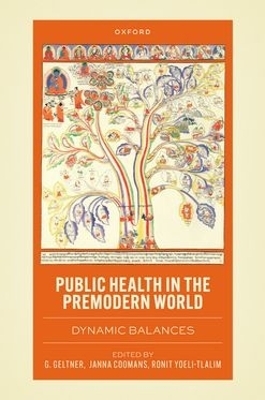
Public Health in the Premodern World
Oxford University Press (Verlag)
978-0-19-896946-4 (ISBN)
- Noch nicht erschienen (ca. Februar 2026)
- Versandkostenfrei
- Auch auf Rechnung
- Artikel merken
Chapters [6, 12, and 14] of this work are available under the terms of a [CC BY-NC-ND 4.0 International] open access licence. This part/these parts of the work is/are free to read on [the Oxford Academic platform] and offered as a free PDF download from OUP and selected open access locations.
The public health movement is commonly (and incorrectly) characterized as a response to the ills of industrialization and modernization. Setting out to correct this misconception, this volume gathers sixteen studies on the deeper history and archaeology of public health from across the premodern globe.
Each chapter vividly reconstructs preventative ideas and practices in a different region, critically engaging with the paradigm of 'healthscaping', or designing environments where health can bloom. Studies range from programs to fight fire in later medieval England and restrict the movements of poor migrants in the Low Countries, to invoking gendered spirits in central America, maintaining water infrastructures in Cairo, and creating visual prophylactics in Tibet. All of these programs had shortcomings and limitations, but tracing them collectively stresses two main points. First, there is a transregional justification for rejecting the concept of public health as a modern, industrial phenomenon embedded in Western biomedicine and beholden to centralised states and bureaucracies. Secondly, preventative biopolitics predate and transcend urban centers in Europe and can be documented for numerous civilizations in other world regions, as well as in the countryside, for both sedentary and mobile groups.
The volume accordingly illustrates that public health has a far richer history than a recent set of ideas and practices developed in response to the Industrial Revolution of the eighteenth century, and that communities across the globe defined and pursued health in different ways, using the social, intellectual, legal, and physical tools at their disposal. This has important implications for all those interested in histories of health, medicine, and science in the medieval world, as well as for understandings of modern public health programs.
G. Geltner is a social, cultural, and environmental historian with a focus on Europe, 1100-1550 and a broad comparative approach. He has published extensively on the history of crime and punishment, the mendicant orders, community health, and mining, increasingly in collaboration with archaeology and the paleo-sciences. Janna Coomans is Assistant Professor at the department of Medieval History, Utrecht University. Her research focuses on social history, public health, and environment in premodern cities. Her dissertation was published in 2021 as Community, Urban Health and Environment in the Late Medieval Low Countries (Cambridge University Press). Between 2018-2021, she was a post-doctoral researcher in the ERC-project 'Healthscaping Urban Europe'. Ronit Yoeli-Tlalim is a medical historian who has worked on various aspects of Eurasian transmissions of knowledge. Within this general scope, she has published extensively on the multi-cultural aspects of Tibetan medicine, the transmissions of medical knowledge along the Silk Roads, as well as on the links between early Jewish medicine and other medical traditions.
Contributor List
List of maps
List of figures and tables
Introduction: Premodern Bodies, Changing Environments, New Approaches. G. Geltner, Janna Coomans and Ronit Yoeli-Tlalim
Part 1: Urban Risks and Resources
1: Asaf Goldschmidt and Marta Hanson: Healthscaping Public-Health History in Premodern China
2: Abigail Agresta: Plague Prevention, Care, and Infrastructure in Valencia, 1450-1520
3: Carmen Caballero-Navas: Agents of Communal Health in Iberian Jewish Communities, 1200-1500
4: Lola Digard: Governmentality, Biopolitics and Medical Institutions in Flemish Cities, 1200-1550
5: Carole Rawcliffe: Fire Prevention in Late Medieval British Towns and Cities
6: Maaike van Berkel and Edmund Hayes: Governing Water and Public Health in a Muslim City: Cairo in the Thirteenth and Fourteenth Century CE
Part 2: Healthscaping the Countryside
7: Léa Hermenault: Dynamic Landscapes: The Archaeology of Prevention in Northwestern Europe (Seventh to Fourteenth Century)
8: G. Geltner: Preventative Healthcare among Miners in Europe, 1200-1550
9: Janna Coomans: Dangerous Flows: Public Health and the Itinerant Poor in the Urban and Rural Low Countries, 1400-1600
10: Francesco Bianchini: Better Safe than Sorry: 'Houses of Health' and Ideologies of Care across the Bay of Bengal
Part 3: Religious and Intellectual Traditions of Preventative Healthcare
11: Edward Anthony Polanco: They Who Have Stood as Women: The Nahua-Cihuateteoh Reciprocal Preventative Relationship in the Postclassic and Early Colonial Valley of Mexico
12: Justin Stearns: The Promises and Limitations of Islamicate Plague Treatises from the Eighth/Fourteenth-Fourteenth/Nineteenth Centuries
13: Claire Weeda: Pestilential Insects and Public Health in Europe, c. 1100-1600
14: Shireen Hamza: Ulema, Medicine, and Community in Yemen's Long Fifteenth Century
15: Ronit Yoeli-Tlalim: Buddhist Prophylactics in Visual Form: Bio-Politics and Public Health in Seventeenth Century Tibet
Afterword: Where Next? Peregrine Horden
| Erscheint lt. Verlag | 26.2.2026 |
|---|---|
| Verlagsort | Oxford |
| Sprache | englisch |
| Maße | 156 x 234 mm |
| Themenwelt | Geschichte ► Teilgebiete der Geschichte ► Kulturgeschichte |
| Medizin / Pharmazie | |
| ISBN-10 | 0-19-896946-5 / 0198969465 |
| ISBN-13 | 978-0-19-896946-4 / 9780198969464 |
| Zustand | Neuware |
| Informationen gemäß Produktsicherheitsverordnung (GPSR) | |
| Haben Sie eine Frage zum Produkt? |
aus dem Bereich