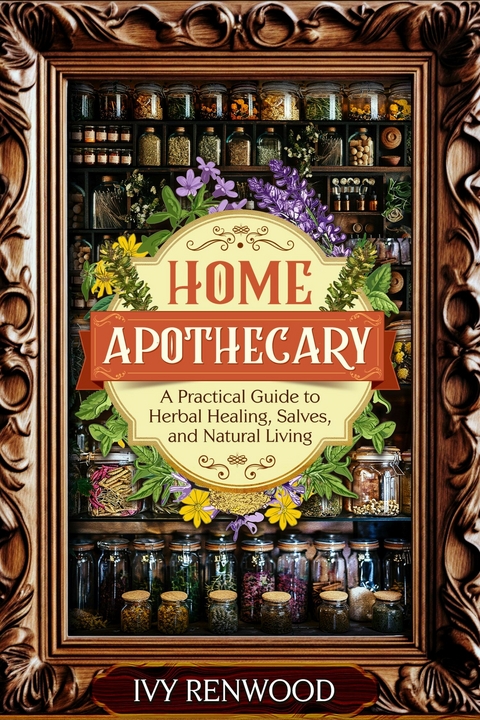
Home Apothecary (eBook)
108 Seiten
Publishdrive (Verlag)
979-8-9992725-1-5 (ISBN)
You deserve good health, and that is what nature has to offer!
For far too long, people have been discouraged from herbal remedies, and the truth has been distorted or purposefully hidden, but that ends today.
Herbal remedies are real, and they work.
How and why will be explained in fine detail in this book, but you'll also discover:
Easy-to-follow instructions for growing medicinal herbs.
Recipes for creating potent tinctures, herbal teas, and other customizable herbal remedies.
Surprising scientific proof of how herbs work in the human body.
Guidance on integrating herbs into your self-care routine.
How to live in alignment with the Earth.
Useful advice on building a successful herb garden despite limited space or experience.
Ethical sourcing and waste-free herbalism
Stop settling for the lies and limitations.
Plants are a gift that nature has given freely, and they are nothing like the quick fixes that temporarily mask your symptoms or give you a problem in exchange for a cure.
Click on the 'Add to Cart' button now, and realign with the natural order!
1
Understanding Herbal Medicine
Most of the population had their first introduction to herbalism with grandma or grandpa. Grandparents had remedies for just about everything. Your tummy hurts? Grandma knows what to do. You skinned your knee or caught the flu? They have just the thing. They were literally magicians brewing potions with plants that only they understood. You may not have known it when you were much younger, but they were herbalists.
Figure 1: Herbalists know how to utilize the magic of nature. Source: https://www.pexels.com/photo/purple-petaled-flowers-in-mortar-and-pestle-105028/
Movies have made people believe that there can be only one herbalist per community, and they HAVE to be a mysterious figure with a pouch full of equally mysterious plants. Thank you, Hollywood, for that misconception.
Herbalism is a practice that anyone can learn. It is not limited to people who wear long robes or live in enchanted forests. A herbalist is anyone who loves nature and uses plants for healing—a herbalist is anyone who practices herbalism.
Herbalism is a science that involves turning plants into medicine—simple, short, and straight to the point. It is the oldest form of medicine in human history, dating back 60,000 years, although nobody documented anything back then, at least until ancient Sumerians felt it was a good idea to write things down, you know, for later.
The History of Herbalism
Herbalism’s recorded history began in ancient Sumer, around 3000 BCE, in what is now southern Iraq. Ancient Sumer is one of the oldest known civilizations in history, and they take credit for many major advancements/inventions, including some of the first records of herbal medicine.
The Sumerians truly respected nature and believed that plants held special powers that healed many diseases. The bulk of them were farmers, probably because they didn’t have the internet, but they spent their days growing plants on farms between the Tigris and Euphrates rivers.
They were a smart people, and it didn’t take long for them to notice that certain plants could relieve pain or heal wounds, so they took it upon themselves to experiment with different herbs for medicinal purposes. Their keen observations and experiences formed the foundation for herbal medicine, and that foundation went on to influence many cultures in the future.
Sumerians loved to write things down, and honestly, we’re grateful they were obsessed with keeping records. They documented their knowledge on clay tablets, which were inscribed with cuneiform writing— symbols that represented sounds and ideas. These tablets contained records of their medical practices and included very detailed descriptions of multiple herbs and their uses.
Among the herbs mentioned in these records, willow and poppy stand out. Willow trees were everywhere in the region, and the Sumerians somehow discovered their pain-relieving properties. They wrote about how they used the bark of the willow to make teas or poultices because it helped with pain and inflammation. This is particularly interesting because modern medicine has confirmed that willow bark contains salicin, a compound similar to aspirin.
Poppy, another important plant in Sumer, was known for its calming effects. The Sumerians used poppy seeds and extracts to brew medicines for anxiety and sleep issues. They believed that poppies could help people relax and escape from their worries. You may not believe it but this foreshadowed poppy’s later role in medicine as morphine and as a few familiar recreational drugs, including heroin, codeine, and opium. They’re all derivatives of the poppy plant.
Thankfully, Sumerians also understood the importance of preparation and dosage. They knew that different herbs had different effects depending on how they were processed and how much was used. They had quite a sophisticated approach to herbalism, and this legacy did not end with their civilization.
Moving forward in time, you’ll find ancient Egypt around 1500 BCE. The Egyptians took herbalism to another level. One of their most important contributions to medicine is the Ebers Papyrus, an extremely detailed ancient document that lists over 700 different remedies and medical practices that the Egyptians used. This shows you just how much they valued plant-based treatments in their healthcare system.
Ancient Egyptians were obsessed with garlic. They believed it had protective qualities, not only for the body but also for the spirit. Garlic was THE herb for strength and immunity back then. Warriors would eat it before going into battle, believing it would keep them safe and strong.
Another important plant for ancient Egyptian medicine was myrrh. Myrrh is a resin derived from the Commiphora tree. Egyptians used it to treat wounds and infections. It was also a major ingredient for mummification to preserve dead bodies for the afterlife. The Egyptians believed that myrrh helped protect the body, and they were right. Myrrh is both antibacterial and antifungal, two properties that slow down the decomposition process.
Egyptian merchants exchanged garlic, myrrh, and other herbs with people from the Mediterranean and beyond. This trade not only lined their pockets but also gave other cultures a bit of their herbal wisdom.
On the other side of the world, the Chinese were busy with their own version of herbalism. Chinese herbal medicine has roots going back thousands of years, with evidence showing that the Chinese were using plants as medicine as early as 2700 BCE. One of the oldest and most important texts on the topic is called the “Huangdi Neijing” or the “Yellow Emperor’s Inner Canon.” This document, written around the 2nd century BCE, carefully explains the critical importance of balance when it comes to health and how herbs could be used to help restore that balance.
Chinese herbal medicine is different from most forms of herbalism in that it doesn’t believe in treating the sickness per se. It believes in healing the whole person. Their healthcare system was more holistic than most.
The Indians also had a holistic approach to health and herbalism called Ayurveda. Ayurveda is incredibly old, more than 3,000 years old. Like Chinese medicine, it believes in balance—balance in the body, the mind, and the connection between the two.
Ancient Rome and Greece also made a few contributions to herbalism as far as the story goes. Hippocrates, who lived in Greece around 460 to 370 BCE, was crowned the Father of Medicine. He changed how people thought about health and illness. People in those days believed that diseases were caused by bad spirits or curses, but Hippocrates presented an alternative: observation and understanding the body. Who would have thought?
Figure 2: Hippocrates. Source: https://commons.wikimedia.org/wiki/File:Portrait_of_Hippocrates_from_Linden,_Magni_Hippocratis...1665_Wellcome_L0014825.jpg
He encouraged physicians to observe their patients closely and to use what they saw to guide their treatments. He firmly believed that many illnesses could be cured with natural remedies, especially herbs. Dioscorides, another Greek physician, believed the same thing. He even wrote a book about it, De Materia Medica, detailing more than 600 plants and their healing effects. Doctors relied on his book well into the Middle Ages and the Renaissance, that’s how famous and important it was.
Speaking of the Renaissance, it was when herbalism finally found its place in the scientific community. Botanists and herbalists started to classify plants systematically. Herbal texts from ancient times were translated and studied. The work of herbalists like Nicholas Culpeper, who published “The English Physician,” made herbal knowledge more accessible to the public. It was a monumental time for herbalism, and it lasted until the 19th century, when pharmaceuticals took over with fast-acting synthetic drugs and impressive advertising. Herbalism disappeared into the shadows and remained a hush topic until the 20th century when people realized the potential side effects of pharmaceuticals and started looking for natural alternatives. And here we are.
Herbalism in the Modern Era
The side effects of pharmaceutical drugs aren’t a secret anymore. Yes, these medications can help, but they also carry unwanted issues, it’s sort of a package deal. Pain relievers can potentially upset your stomach, and antibiotics are not particularly good for your gut health and pH balance. Do they work? Absolutely, but are they risky? Yes.
For this reason alone, more people are looking to herbal remedies as a safer choice. Herbs like ginger, turmeric, and chamomile have always been the solution to everyday problems like inflammation, digestive issues, and anxiety, and that hasn’t changed even after a few thousand years. Herbs are nothing if not consistent, and people appreciate consistency.
Herbalism also takes a holistic approach to health, meaning it looks at the person in their entirety, not only their symptoms. This is appealing to the many people who want to improve not only their physical health but also their mental and emotional states. Herbalists tend to suggest lifestyle changes, like eating better and resting more, while using herbal remedies. Modern doctors also recommend lifestyle changes alongside synthetic drugs, but the point of synthetic drugs is to keep you dependent on them. Lifestyle changes won’t save you from the side effects or collateral damage. After all, it’s a business, and if you’re not sick, how will these companies make money? Herbalism does not need your reliance. The remedies might not be as fast-acting as pharmaceuticals, but they work...
| Erscheint lt. Verlag | 20.6.2025 |
|---|---|
| Sprache | englisch |
| Themenwelt | Sachbuch/Ratgeber ► Gesundheit / Leben / Psychologie ► Alternative Heilverfahren |
| Medizin / Pharmazie ► Naturheilkunde ► Homöopathie | |
| Medizin / Pharmazie ► Naturheilkunde ► Phytotherapie | |
| Schlagworte | diy herbal medicine • herbal healing • herbal salves • home apothecary • Natural Living • natural remedies • salve recipes |
| ISBN-13 | 979-8-9992725-1-5 / 9798999272515 |
| Informationen gemäß Produktsicherheitsverordnung (GPSR) | |
| Haben Sie eine Frage zum Produkt? |
 EPUB (Adobe DRM)
Größe: 6,5 MB
Kopierschutz: Adobe-DRM
Adobe-DRM ist ein Kopierschutz, der das eBook vor Mißbrauch schützen soll. Dabei wird das eBook bereits beim Download auf Ihre persönliche Adobe-ID autorisiert. Lesen können Sie das eBook dann nur auf den Geräten, welche ebenfalls auf Ihre Adobe-ID registriert sind.
Details zum Adobe-DRM
Dateiformat: EPUB (Electronic Publication)
EPUB ist ein offener Standard für eBooks und eignet sich besonders zur Darstellung von Belletristik und Sachbüchern. Der Fließtext wird dynamisch an die Display- und Schriftgröße angepasst. Auch für mobile Lesegeräte ist EPUB daher gut geeignet.
Systemvoraussetzungen:
PC/Mac: Mit einem PC oder Mac können Sie dieses eBook lesen. Sie benötigen eine
eReader: Dieses eBook kann mit (fast) allen eBook-Readern gelesen werden. Mit dem amazon-Kindle ist es aber nicht kompatibel.
Smartphone/Tablet: Egal ob Apple oder Android, dieses eBook können Sie lesen. Sie benötigen eine
Geräteliste und zusätzliche Hinweise
Buying eBooks from abroad
For tax law reasons we can sell eBooks just within Germany and Switzerland. Regrettably we cannot fulfill eBook-orders from other countries.
EPUB (Ohne DRM)Digital Rights Management: ohne DRM
Dieses eBook enthält kein DRM oder Kopierschutz. Eine Weitergabe an Dritte ist jedoch rechtlich nicht zulässig, weil Sie beim Kauf nur die Rechte an der persönlichen Nutzung erwerben.
Dateiformat: EPUB (Electronic Publication)
EPUB ist ein offener Standard für eBooks und eignet sich besonders zur Darstellung von Belletristik und Sachbüchern. Der Fließtext wird dynamisch an die Display- und Schriftgröße angepasst. Auch für mobile Lesegeräte ist EPUB daher gut geeignet.
Systemvoraussetzungen:
PC/Mac: Mit einem PC oder Mac können Sie dieses eBook lesen. Sie benötigen dafür die kostenlose Software Adobe Digital Editions.
eReader: Dieses eBook kann mit (fast) allen eBook-Readern gelesen werden. Mit dem amazon-Kindle ist es aber nicht kompatibel.
Smartphone/Tablet: Egal ob Apple oder Android, dieses eBook können Sie lesen. Sie benötigen dafür eine kostenlose App.
Geräteliste und zusätzliche Hinweise
Buying eBooks from abroad
For tax law reasons we can sell eBooks just within Germany and Switzerland. Regrettably we cannot fulfill eBook-orders from other countries.
aus dem Bereich