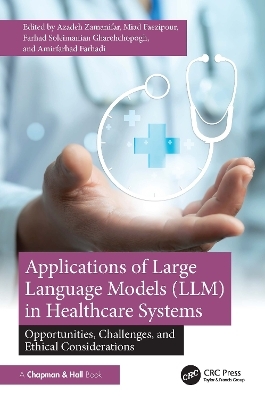
Applications of Large Language Models (LLM) in Healthcare Systems
CRC Press (Verlag)
978-1-041-12491-7 (ISBN)
By bridging the gap between technical artificial intelligence (AI) development and clinical application, this book highlights the critical collaboration between clinicians and data scientists to create representative datasets and fine-tune models for clinical accuracy and interpretability. Real-world challenges such as mitigating bias, managing AI hallucinations, and safeguarding patient confidentiality are explored, alongside strategies for continuous improvement and long-term impact assessment.
Key features include:
Case studies illustrating LLM applications in clinical decision support, medical imaging, patient communication, and administrative automation
In-depth discussion of data privacy, regulatory compliance, and ethical considerations in AI healthcare applications
Insights into overcoming challenges like bias, hallucinations, and interoperability with existing health information systems
How LLMs could revolutionize patient care in future, including operational efficiency and personalized medicine
This book is an essential resource for clinicians, healthcare executives, technologists, data scientists, and students seeking to harness the power of LLMs to improve patient outcomes and streamline healthcare delivery.
Azadeh Zamanifar is currently head of computer engineering department at Islamic Azad university, science and research branch. She received her B.Sc. degree in Computer Engineering (Hardware) from Tehran University in 2002. She went on to complete her M.Sc. degree in Computer Engineering (Software) at the University of Science and Technology in 2008, before obtaining her Ph.D. in Software Engineering from Shahid Beheshti University in Tehran, Iran. Currently, she serves as the Head of the Software and AI Department at Islamic Azad University Science and Research Branch. Her research interests include health care systems, Machine Learning and distributed systems. Miad Faezipour is an associate professor of electrical and computer engineering technology at the School of Engineering Technology, Purdue University. She is also a full member of the Regenstrief Center for Healthcare Engineering (RCHE) and a core faculty member of the Applied AI Research Center (AARC) at Purdue University. She is the founder and director of the Digital/Biomedical Embedded Systems and Technology (D-BEST) research laboratory. She received the M.Sc. and Ph.D. degrees in electrical engineering from the University of Texas at Dallas. Prior to joining Purdue University in August 2021, she has served the Computer Science & Engineering and Biomedical Engineering programs of the University of Bridgeport, CT as a faculty member for ten years. Her research interests primarily include healthcare technology, digital/biomedical embedded hardware/software co-designs, biomedical signal/image processing, computer vision, healthcare/biomedical informatics, artificial intelligence and AI-based bio-data augmentation. She is a Senior Member of IEEE, EMBS and the IEEE Women in Engineering. Farhad Soleimanian Gharehchopogh: Department of computer engineering, Urmia branch, Islamic Azad university, Urmia, Iran, Farhad Soleimanian Gharehchopogh an Associate Professor in the Department of Computer Engineering at Urmia Branch, Islamic Azad University, since 2015, brings a wealth of experience to his role. He received a B.S. from the Shabestar Branch, Islamic Azad University in 2002, and an M.S. from Cukurova University in Adana, Turkey. He earned his Ph.D. in Computer Engineering from Hacettepe University in 2015. Dr Farhad has published over 200 journal articles, many in high-impact journals, with over 9000 citations. His research interests span Data Mining and Machine Learning. Much of his work has been on improving the understanding, design, and performance of algorithms, mainly through the application of engineering. Amirfarhad Farhadi holds a Ph.D. in Artificial Intelligence and is currently a Postdoctoral Fellow at Iran University of Science and Technology. He also serves as an Adjunct Professor in the Department of Computer Engineering at the Science and Research Branch of Islamic Azad University. His research expertise spans Artificial Intelligence (AI), machine learning, deep learning, transfer learning, reinforcement learning, natural language processing (NLP), and healthcare systems. Dr. Farhadi serves as a reviewer for esteemed journals, including IEEE Transactions on Pattern Analysis and Machine Intelligence (TPAMI) and IEEE Transactions on Neural Networks and Learning Systems, among others. In addition to his academic contributions, he holds patents in robotics and actively participates in the AI industry, focusing on innovative applications and technological advancements.
Preface
List of Contributors
Editor Bios
Chapter 01 Large Language Models in Clinical Application
Homayoun Safarpour, Amirfarhad Farhadi, Martin Cunneen, György Molnár, Enikő Nagy
Chapter 02 Administrative Efficiency: Providing Healthcare Operations
Alireza Taheri, Amirfarhad Farhadi, Azadeh Zamanifar, Amirmohammad Mataji
Chapter 03 LLMs in drug discovery, clinical trial analysis, and medical literature review
Sina Abbaskhani, Deniz NoorMohammadzadehMaleki, Amirfarhad Farhadi, and Azadeh Zamanifar
Chapter 04 LLMs For Personalaized Medicine and Treatment planning
Amirfarhad Farhadi, and Nasser Mozayeni
Chapter 05 The Large Language Models for Public Health Surveillance and Outbreak Arezou Naghib, Farhad Soleimanian Gharehchopogh, and Parisa Tavana
Chapter 06 The Role of Large Language Models in Delivering Artificial Intelligence-Based Psychological Interventions and Therapies
Arezou Naghib, Farhad Soleimanian Gharehchopogh, and Azadeh Zamanifar
Chapter 07 Explainable AI (XAI): Making LLM Decisions Transparent and Trustworthy
Amirfarhad Farhadi, Azadeh Zamanifar, Fouad Bahrpeyma
Chapter 08 Ethical Implications for LLMs
Mohammad Saleh, and Azadeh Tabatabaei
Chapter 09 Limitations of Large Language Models in Healthcare Systems
Farshid Babapour Mofrad , and Midya Yousefzamani
Chapter 10 Future Trends and Innovations in Healthcare Systems Using LLMs
Kiana Pilevar Abrisham, and Khalil Alipour
| Erscheinungsdatum | 18.10.2025 |
|---|---|
| Zusatzinfo | 22 Tables, black and white; 31 Line drawings, black and white; 1 Halftones, black and white; 32 Illustrations, black and white |
| Verlagsort | London |
| Sprache | englisch |
| Maße | 156 x 234 mm |
| Gewicht | 720 g |
| Themenwelt | Informatik ► Theorie / Studium ► Künstliche Intelligenz / Robotik |
| Medizin / Pharmazie ► Gesundheitswesen | |
| Studium ► Querschnittsbereiche ► Epidemiologie / Med. Biometrie | |
| ISBN-10 | 1-041-12491-0 / 1041124910 |
| ISBN-13 | 978-1-041-12491-7 / 9781041124917 |
| Zustand | Neuware |
| Informationen gemäß Produktsicherheitsverordnung (GPSR) | |
| Haben Sie eine Frage zum Produkt? |
aus dem Bereich