Zum Hauptinhalt springen
Nicht aus der Schweiz? Besuchen Sie lehmanns.de
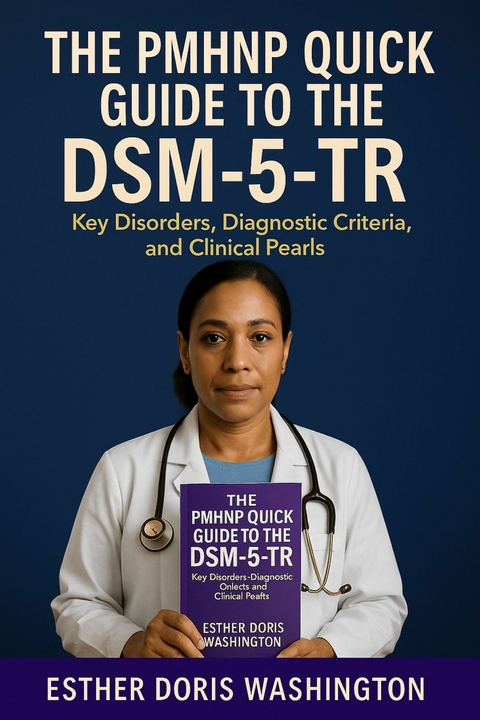
The PMHNP Quick Guide to the DSM-5-TR -  Esther Doris Washington

The PMHNP Quick Guide to the DSM-5-TR (eBook)

Key Disorders, Diagnostic Criteria, and Clinical Pearls
eBook Download: EPUB
2025 | 1. Auflage
124 Seiten
Isohan Publishing (Verlag)
9780000909688 (ISBN)
Systemvoraussetzungen
8,70 inkl. MwSt
(CHF 8,50)
Der eBook-Verkauf erfolgt durch die Lehmanns Media GmbH (Berlin) zum Preis in Euro inkl. MwSt.
  • Download sofort lieferbar
  • Zahlungsarten anzeigen

                    The PMHNP Quick Guide to the DSM-5-TR


                Key Disorders, Diagnostic Criteria, and Clinical Pearls


Understanding the complexities of psychiatric diagnosis is a core skill for every aspiring Psychiatric Mental Health Nurse Practitioner. This quick-reference guide distills the essential knowledge from the DSM-5-TR, making it accessible and actionable for PMHNP students, board exam candidates, and new clinicians.


Stop sifting through a massive manual. This book offers a focused, high-yield approach to the most frequently encountered mental health conditions. You'll find:


Concise Diagnostic Criteria: Get straight to the point with easy-to-scan, bulleted lists for key disorders.


PMHNP Clinical Pearls: Discover practical insights on patient presentation, interviewing techniques, crucial differential diagnoses, and essential considerations for medication and therapy management.


Real-World Application: Learn from detailed case examples that bring diagnostic concepts to life, showing you how to apply criteria in clinical settings.


Foundational Skills: Strengthen your understanding of the psychiatric interview, therapeutic alliance, gathering collateral information, and the vital role of cultural context in diagnosis.


Portable and Practical: Designed for on-the-go use, fitting perfectly into your coat pocket or clipboard for rapid access during clinical rotations.


This is not a reproduction of the full manual. It's a strategically condensed tool, purpose-built for the PMHNP's unique scope of practice. Gain confidence in formulating initial differential diagnoses, preparing for the ANCC PMHNP-BC™ exam, and providing effective patient care. Empower your practice with accurate, clinically relevant diagnostic knowledge. Your path to confident psychiatric practice starts here.

Chapter 1: The PMHNP's Place in Diagnosis
Before you even touch a diagnostic manual, you must ground yourself in the fundamental human work of diagnosis. It is not just ticking boxes or playing a game of matching symptoms to criteria. It is a profoundly human process that begins the instant a person enters your space. Their story, their struggles, and their desire for relief become your central focus. This opening section helps you understand the bedrock upon which all good diagnostic practice stands—the bond between you and the person asking for help. Without this bond, any manual is just a collection of lists; with it, the manual becomes a way to truly understand and help.
The Interview: Both Science and Art
Your main instrument for helping people is the psychiatric interview. It serves as both a scientific way to gather facts and an artistic expression requiring a gentle touch, understanding, and awareness of yourself. Science provides the structure—the need to ask about mood, rest, appetite, and thoughts of self-harm. Art gives you the right moment—knowing when to ask for more details and when to simply sit quietly, letting a person organize their thoughts.
The scientific part asks you to follow a logical path to confirm or rule out specific conditions. You are, in effect, a detective looking for clues. But unlike a detective at a crime scene, your clues arrive filtered through human feelings—shame, fright, confusion, and sometimes, a desperate wish to be seen as "normal." The artistic part involves seeing past that filter without judging.
Let's consider a situation. Imagine David, a 45-year-old man, who arrives at your office because his wife insisted. He sits stiffly on the edge of the chair, arms crossed, giving only single-word responses.
You: "What brings you here today?"
David: "My wife."
You: "What were her worries?"
David: "I do not know."
A purely scientific approach—running down a checklist of symptoms—would fall short here. He would deny everything. The artistic part requires a change in strategy. You might notice the rough patches on his hands or the tiredness in his eyes.
You: "Those appear to be the hands of someone who works hard. What do you do for a job?"
This is not a question from a diagnostic checklist. It is a human question. It creates an opening. David might uncross his arms and tell you he is a carpenter who lost his job three months ago. He has not told his wife. He feels like he has failed. Suddenly, his quietness is not just resistance; it is the sound of deep shame. The science of diagnosis can then begin because the art of making a connection came first. The interview is like a graceful dance between structured questions and genuine human interaction (1).
Making a Strong Connection
The bond you build with a person, often called a therapeutic alliance, predicts good results in mental health care more than anything else. It is the trust and understanding you build, the feeling that you are both on the same team, working toward a shared goal. You cannot demand this; you earn it, session by session, interaction by interaction.
This connection rests on a few core ideas:
  • Unconditional Positive Regard: You must truly see the goodness in the person before you, separate from their struggles or behaviors. They are not their diagnosis.
  • Empathy: This is not feeling sorry for them ("I feel sorry for you") but a true attempt to understand the world from their viewpoint ("I am trying to feel what you feel").
  • Genuineness: Be yourself. Being real helps people relax and open up. Patients can sense when a provider is just playing a part.
Consider Maya, a 16-year-old girl with a history of hurting herself, brought in by her parents. She slouches in her chair, refusing to make eye contact. Her file says she has been "non-compliant" with previous therapists.
You: "I have read your chart, and it says a lot about what other people think is happening. I am more interested in hearing it from you. School, parents, friends... it all sounds pretty hard. I am guessing you feel like no one understands it."
This statement accomplishes a few things. It validates her experience, separates you from the past "non-compliant" label, and uses true honesty. You are not starting with a safety check, although that is certainly necessary. You are starting by joining her team.
Maya: (Looks up for the first time) "They just do not listen."
You: "Alright. I will. I cannot promise I will always have the right answers, but I can promise I will always listen."
That is how a connection begins. It is like a contract of trust. Without it, your diagnostic questions are just an intense questioning, and your treatment plan is just a sheet of paper (2).
Bringing in More Information
A patient's story is your main source of facts, but it is rarely the only source. Collateral information—from family, partners, school records, or other medical providers—can provide a more complete picture. It can help confirm symptoms, set a timeline, and show parts of a person's life that they may not see themselves.
However, gathering this information is a careful process. It must always happen with the patient's clear, permission after they understand. You are not secretly investigating them; you are inviting other trusted people to help with their care.
The key is combining sources. You take the patient's own words, the additional information, and your own observations, then see where they agree and where they differ. A difference is not a lie; it is simply more information to consider.
Let's look at Mark, 52, who comes to you for help with "stress." He says he feels down but insists he sleeps well, has a good appetite, and is doing fine at his job as an accountant. He signs a form giving you permission to speak with his wife, Sarah.
Sarah tells a different story. She says Mark has lost 20 pounds, barely sleeps, and often just stares at the television for hours. Last week, he missed a big work deadline, something that has never happened before.
  • Patient's Report: Slight stress, doing well.
  • Additional Report: Significant weight loss, severe inability to sleep, problems at work.
  • Your Observation: Mark looks tired and speaks slowly.
The information from Sarah does not mean Mark was lying. He may not fully grasp how serious his depression is, or he might be downplaying his symptoms because he wants to appear strong. The additional information changes the whole diagnostic picture, pointing much more clearly toward a Major Depressive Episode. When you bring this information back to Mark—gently and without blame—it can become a strong way to help him become more aware.
You: "Mark, I spoke with Sarah, and she is worried. She mentioned your sleep has been very poor and that you have lost some weight. Sometimes when we are going through something, we do not see how much it is affecting us. Does that seem possible?"
Culture and Community: How They Shape Understanding
The DSM-5-TR comes from a particular background—mostly Western and medical. But sadness, struggle, and healing show up differently across different communities. A diagnosis made without thinking about a person's cultural, community, and spiritual background is incomplete—and likely not correct.
Culture shapes everything:
  • How Symptoms Appear: A person from a community where showing direct emotion is frowned upon might show physical symptoms—headaches, stomach pain, tiredness—as a sign of depression. This is known as somatization.
  • Beliefs about What Causes Problems: A person might believe their worry comes from a spiritual imbalance or a bad spell, not a brain chemical issue. Ignoring this belief will make the patient feel distant and weaken the helpful connection.
  • How People Look for Help: Who does a person turn to when they are troubled? A religious leader? An elder? A traditional healer? The PMHNP may not be the first—or only—source of help.
Consider an 80-year-old woman from Mexico, Elena, brought in by her son because she has been talking to her deceased husband, who passed six months ago. The son worries about psychosis.
A simple symptom-based approach might lead you to think of a psychotic disorder. But if you ask about her cultural background, you learn that in her community, speaking with ancestors is a common and comforting part of grieving. It is a sign of a continuing bond, not a break from reality.
Your part is to tell the difference between an experience accepted in their culture and one that is truly a sickness.
  • Is the experience causing distress or problems in daily life?
  • Is it joined by other signs of psychosis (disorganized thoughts, believing others are out to get them)?
  • Does the person still understand that others might not share their experience?
In Elena's situation, she finds the conversations comforting, she is otherwise doing well, and she knows...

Erscheint lt. Verlag 20.6.2025
Sprache englisch
Themenwelt Medizin / Pharmazie Pflege
ISBN-13 9780000909688 / 9780000909688
Informationen gemäß Produktsicherheitsverordnung (GPSR)
Haben Sie eine Frage zum Produkt?
EPUBEPUB (Adobe DRM)
Größe: 512 KB

Kopierschutz: Adobe-DRM
Adobe-DRM ist ein Kopierschutz, der das eBook vor Mißbrauch schützen soll. Dabei wird das eBook bereits beim Download auf Ihre persönliche Adobe-ID autorisiert. Lesen können Sie das eBook dann nur auf den Geräten, welche ebenfalls auf Ihre Adobe-ID registriert sind.
Details zum Adobe-DRM

Dateiformat: EPUB (Electronic Publication)
EPUB ist ein offener Standard für eBooks und eignet sich besonders zur Darstellung von Belle­tristik und Sach­büchern. Der Fließ­text wird dynamisch an die Display- und Schrift­größe ange­passt. Auch für mobile Lese­geräte ist EPUB daher gut geeignet.

Systemvoraussetzungen:
PC/Mac: Mit einem PC oder Mac können Sie dieses eBook lesen. Sie benötigen eine Adobe-ID und die Software Adobe Digital Editions (kostenlos). Von der Benutzung der OverDrive Media Console raten wir Ihnen ab. Erfahrungsgemäß treten hier gehäuft Probleme mit dem Adobe DRM auf.
eReader: Dieses eBook kann mit (fast) allen eBook-Readern gelesen werden. Mit dem amazon-Kindle ist es aber nicht kompatibel.
Smartphone/Tablet: Egal ob Apple oder Android, dieses eBook können Sie lesen. Sie benötigen eine Adobe-ID sowie eine kostenlose App.
Geräteliste und zusätzliche Hinweise

Buying eBooks from abroad
For tax law reasons we can sell eBooks just within Germany and Switzerland. Regrettably we cannot fulfill eBook-orders from other countries.

Mehr entdecken
aus dem Bereich