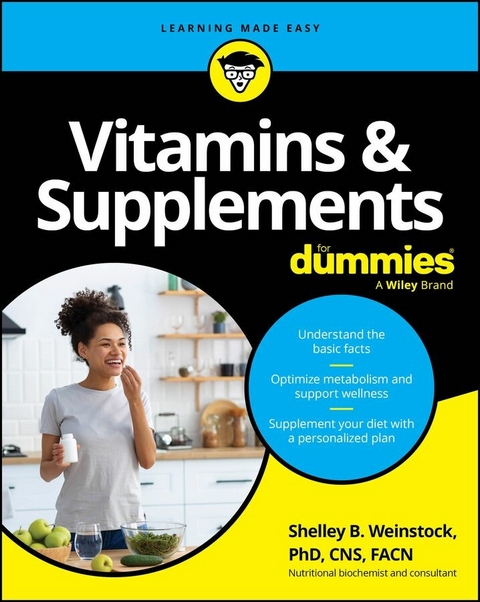
Vitamins & Supplements For Dummies (eBook)
472 Seiten
For Dummies (Verlag)
978-1-394-31151-4 (ISBN)

Confused by vitamins and supplements? Look no further-this honest guide answers your biggest questions
Vitamins & Supplements For Dummies will teach you how to choose the best vitamins, minerals, and supplements to provide nutrition for your mind and body. Inside, you'll find easy-to-follow explanations of what key vitamin and minerals do, so you can make the right choices for your needs. Factors like age, lifestyle, gender, ethnicity, diet, and habits all play a role in determining which vitamins and minerals you need more or less of in your diet. Learn how to get blood tests, keep a diet record, and other methods of finding out where you may benefit from changes to your regimen. With this book, you can follow healing programs that include vitamin, mineral, and herbal supplements and lifestyle tweaks. If you use supplements wisely, they can improve your health, wellness, and longevity. Vitamins & Supplements For Dummies shows you how.
- Learn the basic facts about how vitamins and supplements affect you
- Get answers to your questions about creating a wellness program, longevity, and beyond
- Create a personalized wellness program to optimize your health
- Enhance your memory, mood, and energy levels with supplements
This Dummies guide is a great resource for anyone who wants to learn how to make the best vitamin and supplement choices to improve health, immunity, and appearance.
Shelley B. Weinstock is a Certified Nutrition Specialist (CNS). She earned her PhD in Nutritional Biochemistry and Metabolism at MIT and completed a post-doctoral fellowship at Harvard School of Public Health. She currently has a clinical nutrition practice in New Jersey and New Mexico focusing on assessment of nutritional disorders and their appropriate management through diet, lifestyle, and supplements. She also consults for companies and research institutions on nutrition-related projects.
Confused by vitamins and supplements? Look no further this honest guide answers your biggest questions Vitamins & Supplements For Dummies will teach you how to choose the best vitamins, minerals, and supplements to provide nutrition for your mind and body. Inside, you'll find easy-to-follow explanations of what key vitamin and minerals do, so you can make the right choices for your needs. Factors like age, lifestyle, gender, ethnicity, diet, and habits all play a role in determining which vitamins and minerals you need more or less of in your diet. Learn how to get blood tests, keep a diet record, and other methods of finding out where you may benefit from changes to your regimen. With this book, you can follow healing programs that include vitamin, mineral, and herbal supplements and lifestyle tweaks. If you use supplements wisely, they can improve your health, wellness, and longevity. Vitamins & Supplements For Dummies shows you how. Learn the basic facts about how vitamins and supplements affect you Get answers to your questions about creating a wellness program, longevity, and beyond Create a personalized wellness program to optimize your health Enhance your memory, mood, and energy levels with supplements This Dummies guide is a great resource for anyone who wants to learn how to make the best vitamin and supplement choices to improve health, immunity, and appearance.
Chapter 1
The ABC’s of Vitamins, Minerals, and Supplements
IN THIS CHAPTER
Examining how vitamins and minerals work to improve health
Knowing when to take supplements
Understanding the limitations of supplements
Knowing who to trust when buying dietary supplements
The interest in dietary supplements has grown since the 1970s and has especially picked up since 2020 due to the COVID-19 pandemic. Consequently, the dietary supplement market has become huge. Some estimates predict it will reach more than $200 billion by 2029.
The purpose of dietary supplements is to complement your diet by providing nutrients that may be lacking or insufficient in your normal food intake. They’re intended to help promote overall health and long-term well-being. It’s a broad category of products that contain one or more ingredients such as vitamins, minerals, herbals, botanicals, amino acids, fatty acids, algae, fungi, bacteria, synthetic products, metabolites, and more. They are sold as capsules, soft gels, gelcaps, tablets, powders, gummies, and liquids — any form that’s ingestible. Essential vitamin and mineral supplements are often used along with your food intake to meet daily the Recommended Dietary Allowance (RDA). Other supplements may be consumed to round out your diet to fulfill additional basic nutritional requirements during different life stages, if you’re taking certain medications, or if you’re an athlete — basically, in any situation where a person needs to bring their cellular levels of nutrients to normal levels. However, some people take dietary supplements for a variety of other reasons, such as reducing risk of certain diseases, protecting bodily tissues, enhancing athletic performance, improving mood, and increasing energy.
The increase in intake of dietary supplements may be in part due to their availability in supermarkets, drugstores, convenience stores, and online. They’re everywhere! There are an estimated 80,000 supplement products on the market and a lot of books, websites, publications, and other information to sift through to determine if you need or desire a supplement. In this chapter, I introduce some basics about supplements.
Defining the Terminology
Dietary supplements include vitamins, minerals, herbs, botanicals, amino acids, proteins, fats, and more. There are many terms used throughout this book that are defined in the text, and some are also in the glossary at the end of the book. In this section, I introduce vitamins, minerals, additional supplements, and the regulatory process.
Vitamins
Vitamins are organic compounds, meaning they contain carbon and are produced by plants or animals. The first part of the word vitamin — vita- — is derived from Latin and means life. The rest of the word — -amin — is from amine because researchers originally thought that all vitamins contain amino acids (nitrogen- and carbon-containing molecules that are building blocks of proteins).
Vitamins are essential (necessary) for normal growth and nutrition. You need them in small amounts to maintain various bodily functions such as immune health, energy production, and wound healing. Your body can’t make these compounds, so you must get them from food or supplements.
Vitamins are divided into two categories:
- Fat-soluble vitamins: This group includes vitamins A, D, E, K. These are stored in body fat and in the liver and can accumulate if you have too much.
- Water-soluble vitamins: All the B vitamins and vitamin C are water soluble. Your body doesn’t retain these. Instead, you excrete them in your urine. You need to continuously replenish these by consuming foods rich in them or with supplements.
Minerals
Minerals are naturally occurring, inorganic elements formed in the earth through geological processes. They are vital components in foods that your body needs to develop and function normally. Some minerals are essential (necessary for life) for building bones, facilitating nerve function, regulating water balance, and supporting the immune system.
There are 13 essential minerals summarized in the following list (and covered in more detail later in this book). Some of these are needed in relatively large amounts, and others are considered “trace minerals” that you need in very small amounts.
It’s critical to understand doses of any supplement that you take. Some are measured in milligram doses (mg), and others are in microgram doses (mcg).
These are the essential minerals:
- Calcium: Builds strong bones and teeth and helps in muscle contraction, blood clotting, nerve transmission, cell signaling, and regulation of metabolism
- Chloride: With sodium, maintains the normal fluid balance in the body
- Copper: Trace mineral that participates in energy production and facilitates iron uptake from the gut
- Magnesium: Essential in several biochemical reactions, including synthesis of deoxyribonucleic acid (DA) and some antioxidants
- Iron: Trace mineral necessary for hemoglobin formation, which carries oxygen in the blood
- Iodine: Trace mineral used to produce thyroid hormones and essential for metabolism and physical and mental development
- Manganese: Trace mineral that plays an important role in protein, carbohydrate, and cholesterol breakdown, and cell division, and blood clotting
- Phosphorus: Helps build and repair bones and teeth, facilitates nerve function, and aids in muscle contraction
- Potassium: Maintains fluid balance and aids in muscle contraction and nerve impulse conduction
- Selenium: Trace mineral that helps prevent oxidative damage to the cells and aids in thyroid hormone metabolism
- Sodium: Important in contracting muscles, conducting nerve impulses, and controlling fluid balance in the body
- Sulfur: Has antibacterial properties, helps fight acne-causing bacteria in the skin, and repairs DNA damage
- Zinc: Trace mineral that aids in cell division, immunity, and wound healing
Supplements
Dietary supplements are products that are meant to add nutrients to the diet. Vitamins, minerals, herbs, other botanicals, amino acids, and proteins are included in this category. Supplements can fill any gaps in your intake of nutrients from other sources — mainly food. They are identified by a dietary supplement label and intended to be taken orally. They come in many forms, including tablets, capsules, gummies, powders, drinks, and bars. There are over 80,000 supplements on the market, so this book covers some but certainly not all of the available options.
Supplements should never replace a balanced diet. You should take them with caution to avoid overdosing on certain nutrients. The Supplement Facts label lists active ingredients, dose, fillers, binders, and flavoring. The FDA does not determine whether supplements are effective before they’re produced and marketed. Therefore, safety of taking supplements is in your hands.
Understanding what your nutrient needs are and what constitutes a healthy diet is important when you’re considering supplements. Two good resources are the Dietary Guidelines for Americans (https://dietaryguidelines.gov) and MyPlate (https://myplate.gov) websites. A good source for information on supplements is the Office of Dietary Supplements (ODS) of the National Institutes of Health (NIH) (https://ods.od.nih.gov).
Before taking supplements, it is always important to consult with a healthcare professional so that you can be sure that the supplements support your health concerns, you’re taking the correct nutrients, know the best dose for you, and have no interactions with any medications you’re taking. Also, if you’re undergoing a surgical procedure, you may need to alter your intake temporarily.
Manufacturers may also fortify foods that you eat, so it’s good to be aware of those foods that are fortified so that you can add this to your understanding of your total intake. For example, iron and B vitamins are added to many breakfast cereals, which is a great source for these nutrients. Make sure to consider how much you’re getting if you eat cereal because you may not need to supplement some of these nutrients.
The FDA has established Good Manufacturing Practices (GMP) that companies are required to follow to ensure identity, purity, strength, and composition of supplements. Some products are marked with the GMP symbol to confirm that the manufacturer complies with all FDA standards, procedures, and documentation regarding its identity, strength, purity, and more. These are manufacturing requirements, but the FDA doesn’t test products on these qualities unless there are consumer complaints or issues with the product after production and marketing. The FDA also doesn’t ensure the effectiveness of supplements, so you will need to rely on marketing information and your own research.
There are three major independent or third-party organizations that check the quality, purity, dose stated on the label of supplements. They are ConsumerLab.com, NSF International, and US Pharmacopeia. These are discussed later in...
| Erscheint lt. Verlag | 19.6.2025 |
|---|---|
| Sprache | englisch |
| Themenwelt | Sachbuch/Ratgeber ► Gesundheit / Leben / Psychologie ► Ernährung / Diät / Fasten |
| Medizin / Pharmazie ► Allgemeines / Lexika | |
| Schlagworte | children supplements • depression supplements • mental health supplements • mood supplements • Supplements • supplements longevity • supplements nutrition • vitamin book guide • vitamins • vitamins book • vitamins longevity • vitamins nutrition |
| ISBN-10 | 1-394-31151-6 / 1394311516 |
| ISBN-13 | 978-1-394-31151-4 / 9781394311514 |
| Informationen gemäß Produktsicherheitsverordnung (GPSR) | |
| Haben Sie eine Frage zum Produkt? |
 EPUB (Adobe DRM)
Kopierschutz: Adobe-DRM
Adobe-DRM ist ein Kopierschutz, der das eBook vor Mißbrauch schützen soll. Dabei wird das eBook bereits beim Download auf Ihre persönliche Adobe-ID autorisiert. Lesen können Sie das eBook dann nur auf den Geräten, welche ebenfalls auf Ihre Adobe-ID registriert sind.
Details zum Adobe-DRM
Dateiformat: EPUB (Electronic Publication)
EPUB ist ein offener Standard für eBooks und eignet sich besonders zur Darstellung von Belletristik und Sachbüchern. Der Fließtext wird dynamisch an die Display- und Schriftgröße angepasst. Auch für mobile Lesegeräte ist EPUB daher gut geeignet.
Systemvoraussetzungen:
PC/Mac: Mit einem PC oder Mac können Sie dieses eBook lesen. Sie benötigen eine
eReader: Dieses eBook kann mit (fast) allen eBook-Readern gelesen werden. Mit dem amazon-Kindle ist es aber nicht kompatibel.
Smartphone/Tablet: Egal ob Apple oder Android, dieses eBook können Sie lesen. Sie benötigen eine
Geräteliste und zusätzliche Hinweise
Buying eBooks from abroad
For tax law reasons we can sell eBooks just within Germany and Switzerland. Regrettably we cannot fulfill eBook-orders from other countries.
aus dem Bereich