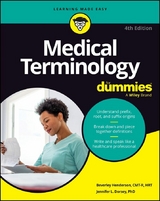
Medical Terminology For Dummies (eBook)
576 Seiten
For Dummies (Verlag)
978-1-394-34810-7 (ISBN)
Become fluent in the standardized language of all medical fields
Medical Terminology For Dummies is a resource for current and prospective healthcare professionals who need to understand medical terms, from common to complex. This book clearly explains how to quickly identify, pronounce, define, and apply medical terms in a healthcare setting. You'll also find ideas for creating mind maps and games to help you study and retain the language of medicine. Pair those study tools with an understanding of the history and origins of key prefixes, suffixes, and roots, and you'll be confident in no time. This updated guide covers the 2022 updates to ICD-10 codes, and it includes added terminology related to public health and infectious diseases. Whatever healthcare field you're in, this book will serve as your glossary of terms and a gateway to future learning opportunities.
- Understand prefixes, roots, and suffixes, so you can confidently work out the meanings of complex terms
- Practice defining medical terms and get help memorizing key vocabulary elements
- Enhance your professional expertise in any healthcare setting
- Improve the safety and accuracy of medical communications
All medical and healthcare related careers require some knowledge of medical terminology. Start off on the right foot-or brush up what you already know-with Medical Terminology For Dummies.
Beverley Henderson, CMT-R, HRT has more than 40 years' experience in medical terminology and transcription. She's helped develop course curricula and has written and produced medical terminology teaching videos.
Jennifer L. Dorsey, PhD is a writer and editor with more than 25 years' experience.
Become fluent in the standardized language of all medical fields Medical Terminology For Dummies is a resource for current and prospective healthcare professionals who need to understand medical terms, from common to complex. This book clearly explains how to quickly identify, pronounce, define, and apply medical terms in a healthcare setting. You'll also find ideas for creating mind maps and games to help you study and retain the language of medicine. Pair those study tools with an understanding of the history and origins of key prefixes, suffixes, and roots, and you'll be confident in no time. This updated guide covers the 2022 updates to ICD-10 codes, and it includes added terminology related to public health and infectious diseases. Whatever healthcare field you're in, this book will serve as your glossary of terms and a gateway to future learning opportunities. Understand prefixes, roots, and suffixes, so you can confidently work out the meanings of complex terms Practice defining medical terms and get help memorizing key vocabulary elements Enhance your professional expertise in any healthcare setting Improve the safety and accuracy of medical communications All medical and healthcare related careers require some knowledge of medical terminology. Start off on the right foot or brush up what you already know with Medical Terminology For Dummies.
Chapter 1
Scrubbing In to Master Medical Terminology
IN THIS CHAPTER
Getting to know the history of medical terminology
Mastering the basics of word building and pronunciation
Familiarizing yourself with basic parts of your anatomy
Discovering the wide range of systems in the body
Did you realize that when you picked up this book, you were beginning a journey into a whole new language? Don’t worry — you haven’t grabbed Greek For Dummies by mistake — it’s all English, or at least “English.” But once you get deep into the world of medical terms, you will find that it is a whole new way of speaking. Your journey will indeed take you to ancient Greece as well as to Rome. You will meet some of the pioneers of the medical world. You will gain entrance into a whole new world: the body.
The Tale behind the Terms
Medical terminology is made up of the terms that describe human anatomy and physiology (body organs, systems, and their functions), body locations, diseases, diagnostic imaging, and laboratory testing, together with clinical procedures, surgeries, and diagnoses.
It’s important for every one of these things to have a specific name — just as it’s important that you have your own unique name — because otherwise how would medical professionals be able to communicate clearly with one another? You may be able to visit your doctor and say, “I have a pain in my shoulder,” and have them solve the mystery of what is causing that pain. But when your doc communicates that information to, say, a surgeon, it’s crucial to be more specific.
The beauty of medical terminology is that it makes such vital communication more succinct and to the point. A medical term usually describes in one word a disease or condition that, under normal circumstances, would take several words to describe. Appendectomy is a one-word medical term to describe “surgical removal of the appendix.” Now that saves you plenty of breath for more important things, like singing in the car or rooting for your favorite sports team.
The foundation of medical terminology is based in both Greek and Latin origins. The Greeks were the founders of modern medicine, but Latin is the basic source of medical terms. With origins in ancient Rome, Latin quickly made its way through the world, solidifying its rep as the language of choice for medicine and science. Building on guidance from the Greek and Latin origins, medical terms began to be professionalized in the mid-1800s. The first medical dictionary appeared in the 1830s shortly after the first edition of Webster’s American Dictionary of the English Language.
Making Terminology Work for You
Thankfully, there are ways to wade through the quagmire of medical terms and figure out how to pronounce and use them like a champ. But you have to start at the beginning by breaking down the parts of each word and then deciphering its meaning. Or, to put it in a fancy-schmancy way, you should use etymology. Etymology helps you find the origin and historical development of a term. You can use etymology to decipher words with Latin and Greek origins, eponyms (words named after people), and acronyms (modern language terms that stand for longer phrases).
Back to those word parts that you’ll break down. There are three you need to know: roots/combining forms, prefixes, and suffixes. Roots are the glue that holds all medical terms together. They are the basic form around which the final word is formed. A combining form is a combining vowel (usually o or i) plus the root word, usually with a prefix or suffix added. Prefixes appear at the beginning of a word and tell the how, why, where, when, how much, how many, position, direction, time, or status. The suffix, always at the end of a word, usually indicates a procedure, a condition, or a disease. Although the prefix gives you a clue into what to expect in a word’s meaning, the suffix tells you what is happening with a specific body part or system. And, usually, it either entails what is wrong with you or the procedure used to diagnose or fix it.
The breaking down of words that you find in this book also helps you with pronunciation. With medical terminology, sounds are not always pronounced the same as in English, and there are no steadfast rules that a combination of specific letters will always be pronounced in the same way.
Building a Foundation of Vocabulary
Getting the basics of word formation and pronunciation down pat is the hard part. Once you can do that, you can move on to building your word vocabulary. Even though medical professionals like to joke that terminology is like a foreign language (sometimes, yes), don’t throw this book out the window just yet. The good news is that you probably already know a lot of medical terms and you can use those to build up the rest of your newfound vocabulary.
Remember your grade school days when you used all kinds of little tricks to remember things like multiplication tables and the state capitals? The same principle applies to new medical terms. You can make lists of word parts, list words by similar sound, map words, or memorize terms by body system. And those are just a few ideas. Do whatever works for you, even if it’s singing terms to the tune of “Defying Gravity” in the shower. We promise not to tell.
In Terms of Anatomy
For your purposes in the land of medical terms, you can compare anatomy to the infrastructure of a building. The walls, floors, bricks, plaster, electrical system, plumbing, and so forth all help keep the building working for the people who inhabit it. Your body’s anatomy is no different, which is why you are going to read about these particular terms first. Once you get the basics of what holds your body together, you can go on to find out about the physiological systems that make your body react to both internal and external circumstances.
First on your anatomy checklist is the skeletal system. This is your body’s frame, much like the frame of a building. This system, along with its joints, works together with the muscles to give you the support and movement you need every day. The bony skeleton provides the jointed framework for the body, giving it shape, protecting vital organs from external injury, and providing attachment points for muscles, ligaments, and tendons.
Working together with the skeleton is the muscular system, in which several different major muscle groups work together. Made up of over 600 muscles and joints, this system is responsible for movement.
Covering all this infrastructure is the integumentary system. Your skin, glands, nails, and hair work like the facade, or outside covering, of a building. They are the things people see when they look at you. The outside of your “building” often shows the world how healthy the rest of your body is. Healthy skin, along with accessory organs, glands, hair, and nails, are the hallmarks of healthy insides, so care for them accordingly.
Your sensory system is all the fun stuff in your building. The windows, amenities, sound system, and dining facility all bring aesthetic delight to the building’s inhabitants, and your senses work in a similar fashion.
It may be hard to imagine that words can describe all the amazing things your anatomy can do, but believe us when we say that it’s all possible through terminology. And who knows? Perhaps there’s a word out there that hasn’t been created yet — until you came along.
All Systems Go
Once you get those basic working parts ingrained in your brain, you will move on to the physiology terminology. Physiology deals with the remaining body systems that help your fabulous body do its day-to-day work.
First up is the thing that keeps your blood pumping and your life moving forward each day: your heart. More specifically, the cardiovascular system. Your heart does not work in a vacuum. It has supporting players, namely your blood cells and vessels. These parts all work together to supply your body with fresh, clean, oxygenated blood.
Then there is the separate but complementary lymphatic system that works to flush your body of impurities. Most directly associated with immunity, the lymphatic system works in the same context as the cardiovascular system due to the similar makeup of the system and the fact that, once cleaned by the lymph nodes, lymphatic fluid is released directly into the bloodstream. Lymph vessels are arranged in a similar pattern as the blood vessels.
Speaking of oxygenating your blood, think about how that oxygen finds its way into your body. You may not consciously think about it every day, but breathing makes it all possible. The body’s trillions of cells need oxygen and must get rid of carbon monoxide, and this exchange of gases is accomplished by the respiratory system. External respiration is the repetitive, unconscious exchange of air between the lungs and the external environment.
You have to breathe, but you also have to eat, and eating is way more fun. Your good buddy the gastrointestinal system helps turn those tasty meals and treats into usable energy for your body. Also called the alimentary or digestive tract, this system provides a tubelike passage through a maze of organs and body cavities, beginning at the mouth, the food entrance...
| Erscheint lt. Verlag | 17.6.2025 |
|---|---|
| Sprache | englisch |
| Themenwelt | Medizin / Pharmazie ► Allgemeines / Lexika |
| Medizin / Pharmazie ► Medizinische Fachgebiete | |
| Schlagworte | anatomy and physiology • cpc flash cards • healthcare vocabulary • medical coding • medical coding book • medical terminology • medical terminology flash cards • medical terminology study guide • medical terms • Medical vocabulary • nursing school flash cards • registered nurse book |
| ISBN-10 | 1-394-34810-X / 139434810X |
| ISBN-13 | 978-1-394-34810-7 / 9781394348107 |
| Informationen gemäß Produktsicherheitsverordnung (GPSR) | |
| Haben Sie eine Frage zum Produkt? |
 EPUB (Adobe DRM)
Kopierschutz: Adobe-DRM
Adobe-DRM ist ein Kopierschutz, der das eBook vor Mißbrauch schützen soll. Dabei wird das eBook bereits beim Download auf Ihre persönliche Adobe-ID autorisiert. Lesen können Sie das eBook dann nur auf den Geräten, welche ebenfalls auf Ihre Adobe-ID registriert sind.
Details zum Adobe-DRM
Dateiformat: EPUB (Electronic Publication)
EPUB ist ein offener Standard für eBooks und eignet sich besonders zur Darstellung von Belletristik und Sachbüchern. Der Fließtext wird dynamisch an die Display- und Schriftgröße angepasst. Auch für mobile Lesegeräte ist EPUB daher gut geeignet.
Systemvoraussetzungen:
PC/Mac: Mit einem PC oder Mac können Sie dieses eBook lesen. Sie benötigen eine
eReader: Dieses eBook kann mit (fast) allen eBook-Readern gelesen werden. Mit dem amazon-Kindle ist es aber nicht kompatibel.
Smartphone/Tablet: Egal ob Apple oder Android, dieses eBook können Sie lesen. Sie benötigen eine
Geräteliste und zusätzliche Hinweise
Buying eBooks from abroad
For tax law reasons we can sell eBooks just within Germany and Switzerland. Regrettably we cannot fulfill eBook-orders from other countries.
aus dem Bereich