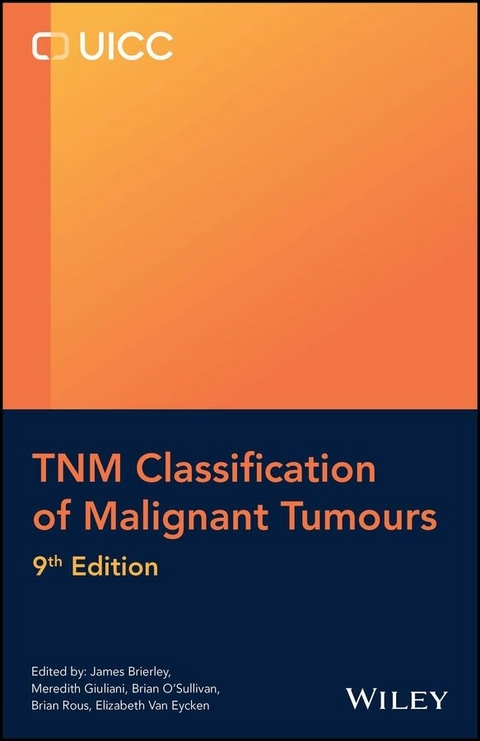
TNM Classification of Malignant Tumours (eBook)
272 Seiten
Wiley (Verlag)
978-1-394-21687-1 (ISBN)
The essential reference on cancer stage returns as a fully revised edition
Describing cancer stage is one of the most important elements of oncological practice. Clinical research and clinical care depend on an accurate assessment of cancer stage and prognostic factors. The TNM Classification of Malignant Tumours serves as the globally recognised standard reference for describing cancer stage and assessing treatment results. Now fully updated to reflect the results of the latest clinical research, it is indispensable for all clinicians, cancer registrars and researchers who work with malignant tumours.
Readers of the ninth edition of TNM Classification of Malignant Tumours will find:
- Updates in many tumour sites including, nasopharynx, HPV associated oropharynx, lung, thymus, mesothelioma, appendix, anal canal, cervix, vulva and prostate carcinoma;
- Revised and updated sections on Essential TNM and paediatric cancer staging;
- New classifications for medulloblastoma, cutaneous lymphoma, parathyroid carcinoma, adrenal medulla and extra-adrenal paraganglia tumours;
- Revised classification of prognostic factors for many malignancies.
TNM Classification of Malignant Tumours is an essential resource for anyone involved in cancer care, research or cancer control.
James Brierley, MBBS, FRCP, FRCPSC, FRCR, is Emeritus Professor of Radiation Oncology, University of Toronto, Canada.
Meredith Giuliani, MBBS, Med, PhD, FRCPC, DRCPSC, is Director at the Cancer Education Princess Margaret Cancer Centre, Canada and Associate Professor at the Department of Radiation Oncology, University of Toronto, Canada
Brian O'Sullivan MB, BCh, FRCPC, FRCPI, FFRRCSI (Hon) is Professor, Department of Radiation Oncology, Centre Hospitalier de l'Universite (CHUM), Montreal, Canada
Brian Rous, MB, Bchir, MA, PhD, FRCPath, is a Consultant Histopathologist at Cambridge University Hospitals NHS Foundation Trust, Cambridge, UK
Elisabeth Van Eycken, MD, is Director of the Belgian Cancer Registry, Brussels, Belgium.
Introduction
The History of the TNM System*
The TNM system for the classification of malignant tumours was developed by Pierre Denoix (France) between the years 1943 and 1952.1
In 1950, the UICC appointed a Committee on Tumour Nomenclature and Statistics. As a basis for its work on clinical stage classification, it adopted the general definitions of local extension of malignant tumours suggested by the World Health Organization (WHO) Sub‐Committee on The Registration of Cases of Cancer as well as Their Statistical Presentation.2
In 1958, the Committee published the first recommendations for the clinical stage classification of cancers of the breast and larynx and for the presentation of results.3
A second publication in 1959 presented revised proposals for the breast, for clinical use and evaluation over a 5‐year period (1960–1964).4 In 1968, a booklet, the Livre de Poche,5 and, a year later, a complementary booklet were published detailing recommendations for the setting‐up of field trials, for the presentation of end results, and for the determination and expression of cancer survival rates.6 The Livre de Poche was subsequently translated into 11 languages. In 1974 and 1978, second and third editions7,8 were published containing new site classifications, and the fourth edition of TNM was published in 1987.9
In 1993, the project published the TNM Supplement10 to promote the uniform use of TNM by providing detailed explanations of the TNM rules with practical examples. Second, third, fourth and fifth editions appeared in 2001, 2003, 2012 and 2019, respectively.11–14
The project also publishes the TNM Atlas: Illustrated Guide to the TNM Classification of Malignant Tumours; the seventh edition was published in 2021 as a companion to the eighth edition of the TNM Classification.15
In 1995, the project published Prognostic Factors in Cancer,16 a compilation and discussion of prognostic factors in cancer, both anatomical and non‐anatomical, at each of the body sites. This was expanded in the second edition in 200117 and the third edition in 2006.18
The current ninth edition of TNM contains rules of classification and staging that correspond with those appearing in the eighth edition of the AJCC Cancer Staging Manual (2017) and subsequent version 9 series.19,20 While the aim of the UICC and AJCC is to have identical classifications, small differences exist and are identified as footnotes to the text. Wherever possible, the classifications are based on published evidence‐based recommendation and analysis of databases that reflect contemporary management.
To develop and sustain a classification system acceptable to all requires the closest liaison between national and international organisations. As noted, while the classification is based on published evidence, in areas where high‐level evidence is not available, it is based on international consensus. The continuing objective of the UICC is to present the classification of anatomical extent of cancer for global use in high‐, middle‐ and low‐income countries.
Note
* A more detailed history is available on the website at www.uicc.org.
The Principles of the TNM System
The determination of the extent of any malignancy is a prerequisite to determine both prognosis and appropriate treatment for any patient with cancer. The practice of classifying cancer cases into groups according to anatomical extent, termed ‘stage’, arose from the observation that survival rates were higher for cases in which the disease was localised than for those in which the disease had extended beyond the organ of origin. The stage of disease at the time of diagnosis is a reflection of not only the rate of growth and extension of the neoplasm but also the type of tumour and the tumour–host relationship.
It is important to record accurate information on the anatomical extent of the disease for each site at the time of diagnosis, to meet the following objectives:
- to aid the clinician in the planning of treatment
- to give some indication of prognosis for survival
- to assist in the evaluation of the results of treatment
- to facilitate the exchange of information between treatment centres and regions
- to contribute to the continuing investigation of human cancer
- to support cancer control activities.
Cancer staging is essential to patient care, research and cancer control. Cancer control activities include direct patient‐care‐related activities, the development and implementation of clinical practice guidelines and centralised activities such as recording disease extent in cancer registries for surveillance purposes and planning cancer systems. Recording of stage is essential for the evaluation of outcomes of clinical practice and cancer programmes, including screening. However, in order to evaluate the long‐term outcomes of populations, it is ideal if the classification remains stable. There is therefore a conflict between a classification that is updated to include the most current forms of medical knowledge and a classification that facilitates longitudinal studies. The UICC TNM Project aims to address both needs.
International agreement on the classification of cancer by the extent of disease provides a method of conveying disease extent to others without ambiguity.
There are many axes of tumour classification: for example, the anatomical site and the clinical and pathological extent of disease, the duration of symptoms or signs, the gender, age, comorbidities and performance status of the patient, and the histological type and grade of the tumour and relevant molecular and genetic markers. All of these have an influence on the outcome of the disease and need to be considered in tailoring the treatment for an individual patient. Classification by the anatomical extent of disease is the one with which the UICC TNM system primarily deals.
The clinician’s immediate task when meeting a patient with a new diagnosis of cancer is to make a judgement as to prognosis and decide on the most effective course of treatment. This judgement and decision require, among other things, an objective assessment of the anatomical extent of the disease.
The General Rules of the TNM System*
The TNM system for describing the anatomical extent of disease is based on the assessment of three components:
| T – | the extent of the primary tumour |
| N – | the absence or presence and extent of regional lymph node metastasis |
| M – | the absence or presence, extent and the site of distant metastasis |
The addition of Arabic numerals determines the categories for each of these three components, which indicate the extent of the malignant disease:
- T0, T1, T2, T3, T4, N0, N1, N2, N3, M0, M1
In effect, the system is a ‘shorthand notation’ for describing the extent of a particular malignant tumour.
The general rules applicable to all sites are as follows:
- All cases should be confirmed microscopically. Any cases not so proved must be analysed and reported separately.
Two classifications are described for each site.
- Clinical classification: the pre‐treatment clinical classification, designated cTNM, is essential to select and evaluate therapy. This is based on evidence acquired before any treatment. Such evidence is gathered from physical examination, imaging, endoscopy, biopsy, surgical exploration and other relevant examinations.
- Pathological classification: the postsurgical histopathological classification, designated pTNM, is based on evidence acquired before treatment, supplemented or modified by additional evidence acquired from surgery and from pathological examination. It is used to provide additional data to estimate prognosis and assessment for any additional treatment. The pathological assessment of the primary tumour (pT) entails resection of the primary tumour or biopsy adequate to confirm the highest pT category. Following two surgical procedures for a single lesion, the pTNM classification should be a composite of the histological examination of the specimens from both operations.
- The pathological assessment of regional lymph nodes requires examination of at least one lymph node and the pathological assessment of the primary tumour (pT), except in cases of unknown primary (T0). If a biopsy confirms the highest N category, the use of pN is appropriate. An excisional biopsy of a lymph node without pathological assessment of the primary tumour (pT) is insufficient to fully evaluate the pN category and is a clinical N category and stage, except in the case of an unknown primary (T0). The pathological assessment of distant metastasis (pM) entails microscopic examination of metastatic deposit. However, if both the highest T and N categories or the M1 category are confirmed microscopically including biopsy without removal of the primary, the criteria for pathological staging are considered satisfied.
- After assigning cT, cN and cM and/or pT, pN and pM categories, these...
| Erscheint lt. Verlag | 29.5.2025 |
|---|---|
| Reihe/Serie | UICC |
| Sprache | englisch |
| Themenwelt | Medizin / Pharmazie ► Medizinische Fachgebiete ► Onkologie |
| Schlagworte | adrenal cortex • bone tumour • brain tumour • Breast tumour • digestive system tumour • gynecological tumour • Head and Neck Tumours • Hodgkin lymphoma • lung tumour • Non-Hodgkin lymphoma • ophthalmic tumour • paediatric tumour • soft tissue tumour • spinal tumour • urological tumour |
| ISBN-10 | 1-394-21687-4 / 1394216874 |
| ISBN-13 | 978-1-394-21687-1 / 9781394216871 |
| Informationen gemäß Produktsicherheitsverordnung (GPSR) | |
| Haben Sie eine Frage zum Produkt? |
 EPUB (Adobe DRM)
Kopierschutz: Adobe-DRM
Adobe-DRM ist ein Kopierschutz, der das eBook vor Mißbrauch schützen soll. Dabei wird das eBook bereits beim Download auf Ihre persönliche Adobe-ID autorisiert. Lesen können Sie das eBook dann nur auf den Geräten, welche ebenfalls auf Ihre Adobe-ID registriert sind.
Details zum Adobe-DRM
Dateiformat: EPUB (Electronic Publication)
EPUB ist ein offener Standard für eBooks und eignet sich besonders zur Darstellung von Belletristik und Sachbüchern. Der Fließtext wird dynamisch an die Display- und Schriftgröße angepasst. Auch für mobile Lesegeräte ist EPUB daher gut geeignet.
Systemvoraussetzungen:
PC/Mac: Mit einem PC oder Mac können Sie dieses eBook lesen. Sie benötigen eine
eReader: Dieses eBook kann mit (fast) allen eBook-Readern gelesen werden. Mit dem amazon-Kindle ist es aber nicht kompatibel.
Smartphone/Tablet: Egal ob Apple oder Android, dieses eBook können Sie lesen. Sie benötigen eine
Geräteliste und zusätzliche Hinweise
Buying eBooks from abroad
For tax law reasons we can sell eBooks just within Germany and Switzerland. Regrettably we cannot fulfill eBook-orders from other countries.
aus dem Bereich