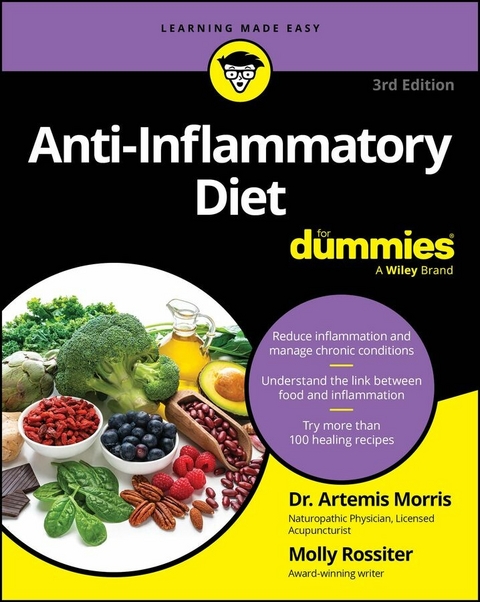
Anti-Inflammatory Diet For Dummies (eBook)
488 Seiten
For Dummies (Verlag)
978-1-394-34084-2 (ISBN)
Practical tips and recipes for avoiding chronic inflammation and maintaining your long-term health
Anti-Inflammatory Diet For Dummies equips you with the latest information on how to avoid chronic inflammation and reduce your risk of associated health conditions. Inflammation is linked to arthritis, stroke, cancer, obesity, and beyond. You can keep inflammation under control by focusing on foods and lifestyle factors that have been shown to help. This accessible and straightforward guide explains how it all works, and offers over 100 tasty and nourishing recipes that can have a real impact on your health-today and into the future. Updated with the latest research and an expanded focus on gut health, this new edition gives you what you need to keep inflammation in check.
- Find out what causes inflammation, and how reducing inflammation can keep you healthy
- Discover the basic anti-inflammatory ingredients and great recipes that keep inflammation down
- Learn what the latest science is saying about inflammation and conditions like breast cancer, Alzheimer's, and dementia
- Get relief from inflammatory symptoms and keep chronic disease at bay
It's never too early or too late to start shifting to an anti-inflammatory diet and improving your long-term health. Anti-Inflammatory Diet For Dummies makes it easy.
Dr. Artemis Morris is a leading expert on anti-inflammatory nutrition, an internationally recognized educator in integrative medicine, and the medical director of Artemis Wellness Center.
Molly Rossiter is an award-winning writer who covers new research in science and self-improvement. She has more than 34 years of news and feature writing experience.
Practical tips and recipes for avoiding chronic inflammation and maintaining your long-term health Anti-Inflammatory Diet For Dummies equips you with the latest information on how to avoid chronic inflammation and reduce your risk of associated health conditions. Inflammation is linked to arthritis, stroke, cancer, obesity, and beyond. You can keep inflammation under control by focusing on foods and lifestyle factors that have been shown to help. This accessible and straightforward guide explains how it all works, and offers over 100 tasty and nourishing recipes that can have a real impact on your health today and into the future. Updated with the latest research and an expanded focus on gut health, this new edition gives you what you need to keep inflammation in check. Find out what causes inflammation, and how reducing inflammation can keep you healthy Discover the basic anti-inflammatory ingredients and great recipes that keep inflammation down Learn what the latest science is saying about inflammation and conditions like breast cancer, Alzheimer's, and dementia Get relief from inflammatory symptoms and keep chronic disease at bay It's never too early or too late to start shifting to an anti-inflammatory diet and improving your long-term health. Anti-Inflammatory Diet For Dummies makes it easy.
Chapter 1
Inflammation, Food, and You
IN THIS CHAPTER
Understanding how inflammation fits into the immune system
Using nutrition to decrease inflammation
Making lifestyle changes
If you ever fell off your bike or out of a tree, you’re familiar with inflammation surrounding an injury. In most cases, inflammation surrounds minor cuts and bruises in the form of swelling and protects the injured area until it heals. Since the late 1980s, however, research has also linked inflammation to outside sources, such as diet and internal imbalances. These inflammatory responses may become so severe and long-lasting that they lead to chronic illness, such as diabetes, arthritis, heart disease, and cancer, as well as neurological and cognitive issues, such as Alzheimer’s, dementia, depression, and stress.
In this chapter, you get a better idea of just what inflammation is — both the good and the bad — as well as how it’s defined and what to look for. Throughout the remainder of this book, you discover foods that may contribute to the problem as well as those foods, vitamins, and supplements that may lessen the effects of inflammation.
Defining What Inflammation Is
Keep in mind that not all inflammation is bad; in fact, inflammation plays a vital role in keeping you healthy. Inflammation is the body’s way of protecting itself from harmful bacteria, viruses, and injury. This short-term inflammatory response was helpful when people were living and eating in the wild; however, in modern day, more often than not, inflammation becomes a long-term, or chronic, issue that your body may need help to resolve. In some cases inflammation causes the body to turn on itself, attacking healthy cells and organs. In this section, we take a look at the various kinds of inflammation and identify how things can go wrong.
Understanding how the immune system works
The immune system is a complicated association of organs, tissues, and cells that work together to protect the body. The immune system uses inflammation as a protective mechanism when it feels the body is in danger of infection or injury.
There are three kinds of immunity:
- Passive: Passive immunity is a temporary immunity that comes from another body, such as from the mother to a fetus through the placenta or to an infant through breast milk. Passive immunity typically disappears 6 to 12 months after birth.
- Innate: Innate immunity is the immunity you were born with and your first line of defense against potentially harmful invaders. Innate immunity includes barriers that keep invaders from entering your body, as well as inflammatory responses — coughing; producing tears, sweat, mucus, and additional stomach acid; swelling; and so on.
- Acquired: Acquired immunity, also known as adaptive immunity, develops in the presence of certain antigens. It develops as your body builds defenses against specific invaders, such as viruses that cause chicken pox and the common cold. Acquired immunity can develop naturally, such as by catching a cold and recovering, or artificially, by receiving a vaccine.
In this section, we cover innate and acquired immunity, the two immune systems that stick around through adulthood. We discuss inflammation as part of the innate immune system, and we cover the invader-specific defenses of the acquired immune system.
Innate immunity: Providing general protection with inflammation
Inflammation is part of your body’s innate response to invaders. The inflammatory response takes over when harmful bacteria, viruses, toxins, or other elements make their way into your tissues and cause damage. Those damaged cells release chemicals called prostaglandins and histamines, which cause blood vessels to leak fluid into the tissues and create swelling.
The resulting inflammation — characterized by redness, swelling, heat, and pain — serves as a physical barrier against the spread of infection (in the case of illness) or against further injury (which would delay the healing process). Chemical factors released during inflammation ward off or sensitize pain signals, creating a more suitable environment for healing.
Meanwhile, the immune system, sensing danger, sends backup. Various parts of the immune system respond by directing traffic, isolating and killing the invaders, and destroying and clearing out infected cells. The cells communicate with each other through a variety of substances or proteins, including cytokines, C-reactive protein (CRP), acute-phase proteins, prostaglandins, and more. Understanding this response is helpful for healthcare providers because these inflammatory markers — CRP, acute-phase proteins, and prostaglandins, for instance — indicate where the problem is and how severe it may be. Researchers examine the immune system’s response to determine what triggers inflammation and find ways to control it — such as through diet — when things go wrong or get out of control, creating a cytokine storm. A cytokine storm happens when your immune system produces too many pro-inflammatory cytokines in response to an infection or attack, leading to uncontrolled inflammation.
Acquired immunity: Attacking specific invaders from past encounters
The acquired, or adaptive, immune system is the one you develop based on what you do, where you go, and what you’re exposed to. The more bugs and viruses you come in contact with, the more complex your acquired immune system becomes and potentially the more protected you are.
Through a process called immune response, the immune system calls upon its network — cells, tissues, and organs — to combat illness and infection. Leukocytes, or white blood cells, seek out and destroy infectious organisms and substances. There are two kinds of leukocytes:
- Phagocytes, which are the hungry leukocytes that eat the invaders
- Lymphocytes, which help the body identify and recognize attackers so it knows what to watch for later
Here’s what happens: When your body detects antigens (the foreign substances), a group of cells get together and form a type of cell army to attack the invader. Some of these cells produce antibodies that can lock onto the specific antigens. The antibodies serve as tags, identifying the invader as an enemy and targeting it for destruction.
Some of the antibodies continue to live in your body so they can immediately attack if the same antigen is detected. The next time the antibodies encounter that antigen, they lock on and initiate an inflammatory response.
Seeing where inflammation goes wrong
When inflammation works right, it attacks the irritant — the virus, harmful bacteria, or damaged cells. Sometimes, however, the body kicks into overdrive and launches an offensive on normal, healthy tissue. For example, if you have the autoimmune disorder rheumatoid arthritis, you may experience some redness and some swelling in the joints, with joint pain and stiffness. This reaction is a sign that your body is trying to attack your joint tissue, which your body mistakenly perceives as unfriendly.
Say your house is being overtaken by mosquitoes. You get some mosquito spray, light a citronella candle, and keep a rolled-up newspaper handy. You’re handling the irritant and the irritant only. Now say you’ve gone a little bit overboard. Instead of a rolled-up newspaper, you take a baseball bat and try to kill that mosquito on the wall. The problem is that the mosquito wasn’t a mosquito at all; it was just a shadow, and now you have a hole in the wall. In the same way, the immune system can overreact to perceived threats and damage the body.
The way your body responds to inflammation partially depends on your genetics and environmental factors. Most generally healthy people respond to a cut or bruise in the same way, but how the immune system responds to a virus, a bacteria, or different foods can differ from person to person. The differences in the way your immune system responds depends on several factors, including:
- Your genes
- Factors influencing your gene expression, called epigenetics
- Your general physical and emotional state of health
- The health of major organs of immune function, such as the gastrointestinal tract
- Your nutrient status of vitamins, phytonutrients, antioxidants, and minerals
- Dietary influences on health, including nutrients and toxins in food
- Environmental toxins, such as pesticides
- Blood sugar and insulin dysregulation
- Stress factors (stress weakens the immune system)
A major underlying factor in the different ways people are affected by inflammation is an imbalance in their acquired immune systems. In a healthy immune system, the helper T cells (those that are part of the immune response and attack) are in balance working against various threats — one cell to attack blood-borne parasites, the other to attack invaders such as bacteria. As the immune system becomes overstimulated, the helper cells find themselves in a self-perpetuating imbalance, causing the helper cells to attack the body. As long as whatever is causing the inflammation is still present, the imbalance remains.
Inflammation can also go on too long. The innate and the acquired immune systems communicate...
| Erscheint lt. Verlag | 28.5.2025 |
|---|---|
| Sprache | englisch |
| Themenwelt | Medizin / Pharmazie ► Allgemeines / Lexika |
| Schlagworte | anti-inflammation cookbook • anti-inflammation diet • anti-inflammation protocol • anti-inflammatory • Anti-Inflammatory cooking • Anti-Inflammatory recipes • Antioxidant • Antioxidant Foods • gut health cookbook • inflammation |
| ISBN-10 | 1-394-34084-2 / 1394340842 |
| ISBN-13 | 978-1-394-34084-2 / 9781394340842 |
| Informationen gemäß Produktsicherheitsverordnung (GPSR) | |
| Haben Sie eine Frage zum Produkt? |
 EPUB (Adobe DRM)
Kopierschutz: Adobe-DRM
Adobe-DRM ist ein Kopierschutz, der das eBook vor Mißbrauch schützen soll. Dabei wird das eBook bereits beim Download auf Ihre persönliche Adobe-ID autorisiert. Lesen können Sie das eBook dann nur auf den Geräten, welche ebenfalls auf Ihre Adobe-ID registriert sind.
Details zum Adobe-DRM
Dateiformat: EPUB (Electronic Publication)
EPUB ist ein offener Standard für eBooks und eignet sich besonders zur Darstellung von Belletristik und Sachbüchern. Der Fließtext wird dynamisch an die Display- und Schriftgröße angepasst. Auch für mobile Lesegeräte ist EPUB daher gut geeignet.
Systemvoraussetzungen:
PC/Mac: Mit einem PC oder Mac können Sie dieses eBook lesen. Sie benötigen eine
eReader: Dieses eBook kann mit (fast) allen eBook-Readern gelesen werden. Mit dem amazon-Kindle ist es aber nicht kompatibel.
Smartphone/Tablet: Egal ob Apple oder Android, dieses eBook können Sie lesen. Sie benötigen eine
Geräteliste und zusätzliche Hinweise
Buying eBooks from abroad
For tax law reasons we can sell eBooks just within Germany and Switzerland. Regrettably we cannot fulfill eBook-orders from other countries.
aus dem Bereich