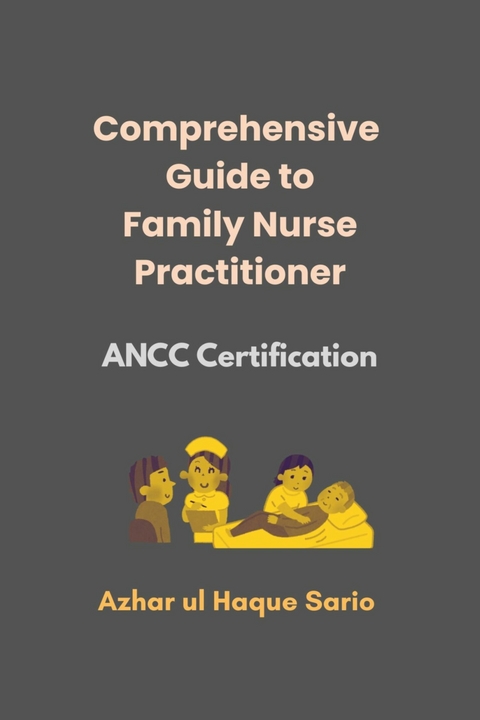
Comprehensive Guide to Family Nurse Practitioner (eBook)
184 Seiten
Royal Co. (Verlag)
978-3-384-61475-9 (ISBN)
Are you ready to crush the ANCC certification exam and step confidently into your role as a Family Nurse Practitioner? This book, Comprehensive Guide to Family Nurse Practitioner ANCC Certification, is your go-to resource for mastering the exam and beyond. It's split into five clear parts. Part I covers assessment basics like population health and clinical exams. Part II digs into diagnostics, exploring disease processes and testing skills. Part III focuses on care planning, including prevention and drug therapy. Part IV tackles putting plans into action, with legal and ethical know-how. Part V wraps up with evaluation strategies for top-notch care. Each section has chapters packed with subtopics. You'll find practical tips and deep insights. Everything's backed by solid research. It's all laid out to match the ANCC Test Content Outline perfectly.
So, why pick this book over others? It's laser-focused on the ANCC exam, covering every angle you'll face on test day. Other books might skim the surface, but this one dives deep with evidence-based info you can trust. It's not just about passing-it's about building real skills for your FNP career. From holistic assessments to smart care strategies, it gives you an edge with its all-in-one approach. Plus, it's written in plain, friendly English, so it's easy to follow. Whether you're studying or brushing up for practice, this guide stands out as a reliable, standout tool.
Disclaimer: This book is an independently produced resource and is not affiliated with the American Nurses Credentialing Center (ANCC). It is intended for educational purposes under nominative fair use.
PART I: Foundations of Assessment in Family Practice
Population Health Imperatives and Evidence-Based Screening in Diverse Family Practice
Weaving the Well-being of Many: How Family Doctors Become Architects of Healthier Communities
Imagine, for a moment, stepping back from the one-on-one of the exam room. Picture instead the entire neighborhood, the town, the bustling city district your practice calls home. This wider lens, this vibrant, ever-shifting panorama of shared health—that’s the soul of Population Health Dynamics. It’s about understanding that the health of Mrs. Rodriguez down the street is intricately connected to the air her grandchildren breathe, the freshness of food at the local market, and the safety of the park where they play.
For us, as family physicians, this isn't some lofty academic theory; it’s the very earth beneath our feet, the air we breathe professionally. It’s about recognizing that our role extends beyond prescriptions and procedures. We are uniquely positioned to become architects of healthier communities, using evidence not as rigid blueprints, but as living tools to nurture well-being, one thoughtful strategy at a time.
Think of it like this: foundational ideas, such as the social-ecological model, remind us that a person’s health is like a complex, beautiful plant. Its vitality depends not just on its own genetic makeup (the individual), but on the quality of the soil (family and social ties), the amount of sunlight and rain (community resources and norms), and even the broader climate (public policies). It’s a profoundly hopeful perspective because it shows us so many points where we can nurture growth. Indeed, when researchers like Schroeder (2007, N Engl J Med) tell us that these wider social determinants of health (SDOH) can paint up to 55% of the picture of our health outcomes—far more than medical interventions alone—it’s a powerful call to action. It tells us that advocating for better housing or accessible green spaces is practicing medicine.
Listening to the Heartbeat of the Community: Trends as Stories
A cornerstone of this approach is learning to listen to the collective heartbeat of our communities, to decipher the stories hidden within health trends. We, in family practice, are often the first to hear the whispers of emerging health challenges. Epidemiological research acts as our stethoscope, helping us understand these murmurs.
Take diabetes, a global wave affecting an estimated 537 million adults (International Diabetes Federation, 2021). When we see those numbers reflected, or even rising, in our own practice, it's not just a statistic. It’s a call to tailor our conversations, our screening, and our support for the families we serve. The landmark Global Burden of Disease study (The Lancet, 2019) painted a stark picture of the relentless rise of non-communicable diseases. This isn’t just data; it’s a mandate for primary care to become the vanguard of prevention, to look at the patterns within our patient families – not just diagnoses, but the prevalence of smoking, the struggles with weight, the silent creep of inactivity. Each of these is a thread, and epidemiological studies consistently show how they weave together to impact health. When the CDC (2020) reminds us that cigarette smoking tragically claims over 480,000 lives annually in the U.S. alone, it ignites an urgency to make every conversation about quitting count.
From Reaction to Co-Creation: Building Health Together
Embracing these principles means shifting our rhythm from simply reacting to illness to proactively cultivating wellness. Models like Community-Oriented Primary Care (COPC) offer us a way to dance to this new rhythm. COPC isn’t just a framework; it’s a promise to truly see our community, to walk alongside it. It means first understanding who we are serving, then using tools like community health assessments – not as sterile surveys, but as genuine conversations – to uncover their unique health stories and challenges. From there, we co-create solutions, hand-in-hand with community members, and then, together, we watch and learn, adjusting our steps as we go.
The Agency for Healthcare Research and Quality (AHRQ) has seen how practices that embrace this partnership can help patients gain better control over chronic conditions like hypertension. Imagine a hypertension program in a quiet rural town. A community conversation might reveal that folks struggle with getting to appointments or affording healthy food. Suddenly, our "intervention" blossoms: perhaps it’s telehealth check-ins, a partnership with the local food pantry to deliver fresh produce, or cooking classes that celebrate local traditions while being heart-healthy. This isn't just wishful thinking. A robust meta-analysis in the American Journal of Preventive Medicine (2021) confirmed that when we layer these kinds of supportive actions, we see real, significant improvements in blood pressure control.
Real People, Real Change: Stories from the Field
Let’s walk into a clinic in a vibrant urban center, a first stop for many immigrant families. Through community health assessments – perhaps lively focus groups filled with shared stories, or thoughtfully crafted surveys (a technique Health Promotion Practice champions for its power to reveal the nuanced truths of a community) – the practice uncovers a silent current of undiagnosed depression and anxiety. It’s tangled with the understandable stress of navigating a new life, compounded by cultural views on mental health and language barriers.
What does a population health-minded response look like? It’s not just about adding another service. It’s about weaving solutions into the existing fabric: perhaps hiring bilingual community health workers who are trusted faces, gently integrating mental health screenings into every routine visit (a strategy championed by the USPSTF), and partnering with local cultural centers to host workshops that reframe mental wellness in a way that resonates deeply. And the impact? Studies, like one in the Journal of General Internal Medicine (2018), show that when we bring behavioral health into the heart of primary care, we open doors. We see access improve, and we witness tangible healing, with some collaborative care models boasting a 20-30% improvement in depression remission. That’s not just a number; it’s lives reclaimed.
Or picture a family practice nestled in a neighborhood where the joyful shouts of children playing are too often interrupted by the tight wheeze of asthma. Looking at local health data might reveal a painful pattern: a connection between flare-ups and older, damp housing, or proximity to industrial zones. Armed with this insight, the practice doesn’t just prescribe inhalers. It becomes a catalyst. It partners with local housing authorities, community advocates, and even legal aid to champion healthier homes. This could mean teaching families simple ways to reduce triggers, connecting them with resources for home assessments, or even lending their trusted voice to calls for policy changes. This isn't just good intentions; research in Pediatrics (2016) has demonstrated that practical, home-based support like this can dramatically cut down asthma-related emergency visits and hospital stays, sometimes by as much as half. That’s childhoods made healthier, breathing easier.
The Heart of the Matter: Cultivating Thriving Human Landscapes
Ultimately, understanding population health dynamics gives us, as family physicians, a more profound sense of agency. It allows us to be more than healers of individual ailments; it empowers us to become cultivators of community well-being. By embracing these foundational ideas, by becoming skilled listeners to the health narratives of our communities (through that epidemiological lens), and by creatively applying strategies rooted in partnership and evidence, we move beyond the clinic walls. We begin to build, brick by brick, a foundation for sustained health and vitality, in every unique community we are privileged to serve.
This isn't just a new methodology; it's a return to the deepest roots of medicine: a human-centered, data-informed, and heart-driven approach to nurturing the health of the people who trust us with their lives and the lives of their families. It’s how we truly weave a stronger, healthier future, together.
More Than Just a Timeline: Weaving Wellness Through the Seasons of Life
Think about it – life isn't a flat line, is it? It’s a vibrant, ever-changing tapestry. What lights up a five-year-old is worlds away from what motivates a teenager, a busy parent, or a cherished elder.
The Budding Years (0-5): Picture tiny humans, sponges soaking up the world. Here, we're not talking to them directly, but to their grown-ups – the loving hands that guide them. We’re whispering secrets of good food and protective shields (like immunizations) that build a fortress of health for life. It’s like laying the strongest, most beautiful foundation stones for a house; get these right, and you can slash the risk of future storms (chronic diseases) by a whopping 40%!
The Wild Bloom of Youth (Adolescence): Now, our saplings are reaching for the sky, exploring, sometimes teetering on risky branches like smoking or feeling the weight of the world on their shoulders. This is where their tribe, their peers, become their sunshine and rain. Imagine programs where cool,...
| Erscheint lt. Verlag | 21.5.2025 |
|---|---|
| Sprache | englisch |
| Themenwelt | Medizin / Pharmazie ► Pflege |
| Schlagworte | ANCC • Family Nurse Practitioner Exam Preparation • Family Nursing • FNP • Nurse Practitioner • Nursing Certification • Primary Care health |
| ISBN-10 | 3-384-61475-5 / 3384614755 |
| ISBN-13 | 978-3-384-61475-9 / 9783384614759 |
| Informationen gemäß Produktsicherheitsverordnung (GPSR) | |
| Haben Sie eine Frage zum Produkt? |
 EPUB (Ohne DRM)
Digital Rights Management: ohne DRM
Dieses eBook enthält kein DRM oder Kopierschutz. Eine Weitergabe an Dritte ist jedoch rechtlich nicht zulässig, weil Sie beim Kauf nur die Rechte an der persönlichen Nutzung erwerben.
Dateiformat: EPUB (Electronic Publication)
EPUB ist ein offener Standard für eBooks und eignet sich besonders zur Darstellung von Belletristik und Sachbüchern. Der Fließtext wird dynamisch an die Display- und Schriftgröße angepasst. Auch für mobile Lesegeräte ist EPUB daher gut geeignet.
Systemvoraussetzungen:
PC/Mac: Mit einem PC oder Mac können Sie dieses eBook lesen. Sie benötigen dafür die kostenlose Software Adobe Digital Editions.
eReader: Dieses eBook kann mit (fast) allen eBook-Readern gelesen werden. Mit dem amazon-Kindle ist es aber nicht kompatibel.
Smartphone/Tablet: Egal ob Apple oder Android, dieses eBook können Sie lesen. Sie benötigen dafür eine kostenlose App.
Geräteliste und zusätzliche Hinweise
Buying eBooks from abroad
For tax law reasons we can sell eBooks just within Germany and Switzerland. Regrettably we cannot fulfill eBook-orders from other countries.
aus dem Bereich