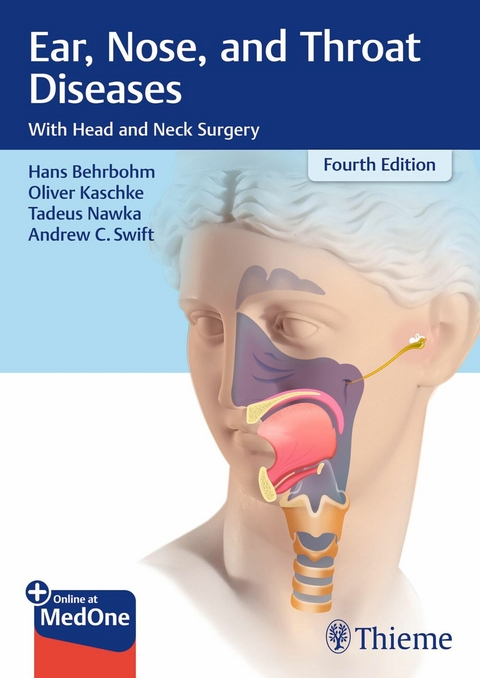
Ear, Nose, and Throat Diseases (eBook)
1466 Seiten
Thieme (Verlag)
978-3-13-257937-8 (ISBN)
1 Ear
1.1 Applied Anatomy and Physiology
1.1.1 Embryology
Inner ear: The sensory organs for hearing and balance develop from ectoderm. The membranous labyrinth develops from the ectodermal otic placode. Embryonic mesenchymal tissue surrounding the membranous labyrinth is converted into cartilage and also, by a process of vacuolization, into a fine reticular network that forms the inner layer of the perilymphatic space. The outer layer of the cartilage forms the labyrinthine capsule.
Middle ear: The eustachian tube and the mucosa of the middle ear arise from a diverticulum of the first pharyngeal pouch (endoderm).
The malleus and incus develop from Meckel cartilage, which emerges from the first branchial arch and is supplied by the trigeminal nerve. The stapes develops from the second branchial arch and is supplied by the facial nerve.
Myxomatous embryonic connective tissue lies between the ectodermal and endodermal ingrowths and makes a preformed middle ear cavity. If this myxomatous tissue does not involute properly after birth, the epitympanic recess remains as a narrow cleft. This is easily occluded by inflammation and creates a predisposition for chronic ear disease to develop.
External ear: The external meatus and the tympanic membrane develop from an ectodermal diverticulum between the first and second branchial arches. Developmental disorders may therefore cause deformities of both the external and middle ears. Bilateral lesions causing severe conductive deafness or a psychologically unacceptable deformity should be corrected, for both esthetic and functional reasons (see ▶ p. 53 and ▶ p. 106) ( ▶ Fig. 1.1 and ▶ Fig. 1.2).
Fig. 1.1 Development of the external ear. (a) An 11-mm embryo, lateral view. (b) Development of the outer ear from six hillocks arising from the first and second branchial arches. 1, Tragus; 2, crus helicis; 3, helix; 4, crus anthelicis; 5, antihelix; 6, antitragus; 7, first branchial arch; 8, branchial cleft; 9, second branchial arch; 10, auricular plate.
Fig. 1.2 Developmental stages of the external auditory canal, middle ear, and labyrinth. The epithelial auditory canal pouch with the tympanic plate opens through epithelial necrolysis (apoptosis) in the seventh month. The mesenchyme of the stapes develops from the second visceral arch; the remaining structures of the middle ear develop from the first visceral arch. (a) Approx. 8th week. 1, Otic vesicle; 2, primary auditory canal; 3, tubotympanic recess; 4, mesenchymal condensation; 5, acousticofacial ganglion. (b) Approx. 7th month. 2, Primary auditory canal; 6, primordium of the auditory ossicles; 7, tympanic cavity; 8, primordium for the labyrinth.
1.1.2 Basic Anatomy
The hearing and balance systems consist of the peripheral receptor apparatus (i.e., the ear in the strict sense), neurological pathways, and centers in the central nervous system. Two main subdivisions can therefore be distinguished:
Peripheral part:
-
The external, middle, and inner ear.
-
Vestibulocochlear nerve with its two parts, the cochlear and the vestibular divisions.
Central part:
-
Central auditory pathways.
-
Subcortical and cortical auditory centers.
-
Central balance mechanism.
The anatomic boundary between the peripheral and central parts is the point of entry of the eighth cranial nerve into the brainstem (the cerebellopontine angle [CPA]), at which point the peripheral part of the vestibulocochlear nerve passes into the central part, interspersed with glial cells. In functional terms, however, the peripheral neurons end in the primary centers.
1.1.2.1 External Ear
The auricle consists of a framework of elastic cartilage covered by skin ( ▶ Fig. 1.3), located between the temporomandibular joint anteriorly and the mastoid process posteriorly. The skin adheres tightly to the perichondrium on the anterior surface, but is more loosely attached posteriorly. For this reason, contusions of the anterior surface often lead to detachment of the skin-perichondrial layer and to the formation of a hematoma (see ▶ p. 60).
Fig. 1.3 Topography of the external ear structures. 1, Helix; 2, antihelix (2a: inferior crus, 2b: superior crus); 3, scaphoid fossa; 4, cymba conchae; 5, cavum conchae; 6, tragus; 7, antitragus; 8, triangular fossa; 9, earlobe.
The external meatus is ≈3 cm long, consisting of an outer cartilaginous part and an inner bony part. The cartilaginous meatus is curved and lies at an angle to the bony part. The tympanic membrane and the middle ear lying beyond it are thus protected from direct trauma.
Note: For an otoscope to be introduced accurately, the curved cartilaginous mobile part of the external auditory meatus has to be drawn upward and posteriorly to bring it into the same axis as the bony part.
The cartilaginous part is attached firmly to the rim of the bony meatus by connective tissue. The bony canal is covered by a thin layer of skin that adheres to the periosteum. It contains no accessory structures, in contrast to the cartilaginous part of the meatus, which has numerous hair follicles and ceruminous glands that form wax (epidermis scale, sebaceous matter, pigment) (see ▶ p. 61).
The external meatus narrows medially. Foreign bodies may therefore become impacted at the junction of the cartilaginous and bony meatus. The meatal cartilage does not form a closed tube, but rather a channel closed superiorly by fibrous tissue. The cartilage contains several fissures (Santorini fissures), which provide a pathway for the spread of severe bacterial infection to the parotid space, the infratemporal fossa, and the base of the skull.
The auricle and the cartilaginous meatus have very rich lymphatic drainage to an extensive regional lymphatic network consisting of parotid, retroauricular, infra-auricular, and superior deep cervical nodes. Infections of the external meatus with regional lymphadenitis can thus cause extensive swelling in these areas.
The sensory innervation is supplied by the trigeminal, great auricular, and vagus nerves and the sensory fibers of the facial nerve. Irritation of the posterior meatal wall stimulates the vagus and induces the cough reflex. Hypoesthesia of the posterosuperior meatal wall occurs with facial nerve impingement from a vestibular schwannoma (see the discussion of Hitselberger sign, ▶ p. 14 and ▶ p. 103).
Relations ( ▶ Fig. 1.4): The cartilaginous meatus abuts anteriorly on the parotid gland, allowing the spread of infection or malignant tumors.
Fig. 1.4 Overview of the three sections of the ear. External ear: 1, auricle; 2, external ear canal; 3, tympanic membrane. Middle ear: 4, tympanic cavity; 5, eustachian tube. Inner ear: 6 and 7, labyrinth with inner ear canal and vestibulocochlear nerve; 8, internal carotid artery; 9, cartilage of eustachian tube; 10, levator veli palatini muscle; 11, tensor veli palatini muscle; 12, tensor tympani muscle (Toynbee muscle).
The posterosuperior wall of the bony meatus forms part of the lateral attic wall (the partition between the external auditory meatus and the attic), the mastoid antrum, and the adjacent pneumatic system of the mastoid process. A middle ear infection can thus break through into the external auditory meatus, causing swelling of the posterosuperior wall or a fistula in acute mastoiditis. Destruction of the lateral attic wall by cholesteatoma may also lead to an open communication between the external auditory meatus and the attic or mastoid antrum. The anterior wall of the bony meatus forms part of the temporomandibular joint. There is therefore a risk of fracture resulting from a blow to the chin.
1.1.2.2 Middle Ear and Pneumatic System
The middle ear cavity consists of an...
| Erscheint lt. Verlag | 21.5.2025 |
|---|---|
| Sprache | englisch |
| Themenwelt | Medizinische Fachgebiete ► Innere Medizin ► Pneumologie |
| Schlagworte | Cochlea • Cochlear Implant • Gastroesophageal Reflux • Head and Neck Surgery • Speech • visual diagnosis • Voice |
| ISBN-10 | 3-13-257937-8 / 3132579378 |
| ISBN-13 | 978-3-13-257937-8 / 9783132579378 |
| Informationen gemäß Produktsicherheitsverordnung (GPSR) | |
| Haben Sie eine Frage zum Produkt? |
 EPUB (Wasserzeichen)
DRM: Digitales Wasserzeichen
Dieses eBook enthält ein digitales Wasserzeichen und ist damit für Sie personalisiert. Bei einer missbräuchlichen Weitergabe des eBooks an Dritte ist eine Rückverfolgung an die Quelle möglich.
Dateiformat: EPUB (Electronic Publication)
EPUB ist ein offener Standard für eBooks und eignet sich besonders zur Darstellung von Belletristik und Sachbüchern. Der Fließtext wird dynamisch an die Display- und Schriftgröße angepasst. Auch für mobile Lesegeräte ist EPUB daher gut geeignet.
Systemvoraussetzungen:
PC/Mac: Mit einem PC oder Mac können Sie dieses eBook lesen. Sie benötigen dafür die kostenlose Software Adobe Digital Editions.
eReader: Dieses eBook kann mit (fast) allen eBook-Readern gelesen werden. Mit dem amazon-Kindle ist es aber nicht kompatibel.
Smartphone/Tablet: Egal ob Apple oder Android, dieses eBook können Sie lesen. Sie benötigen dafür eine kostenlose App.
Geräteliste und zusätzliche Hinweise
Buying eBooks from abroad
For tax law reasons we can sell eBooks just within Germany and Switzerland. Regrettably we cannot fulfill eBook-orders from other countries.
aus dem Bereich