


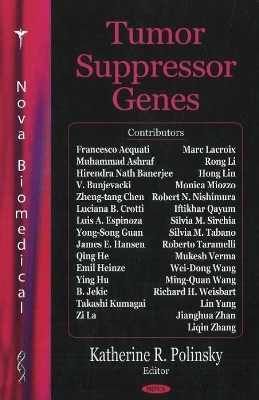
Tumor Suppressor Genes
Seiten
2007
Nova Science Publishers Inc (Verlag)
978-1-60021-693-0 (ISBN)
Nova Science Publishers Inc (Verlag)
978-1-60021-693-0 (ISBN)
A tumour suppressor gene is a gene that reduces the probability that a cell in a multicellular organism will turn into a tumor cell. A mutation or deletion of such a gene will increase the probability of the formation of a tumor. This book presents important research from throughout the world on tumor suppressor genes.
A tumour suppressor gene is a gene that reduces the probability that a cell in a multicellular organism will turn into a tumor cell. A mutation or deletion of such a gene will increase the probability of the formation of a tumor. Unlike oncogenes, tumor suppressor genes generally follow the 'two-hit hypothesis', which implies that both alleles that code for a particular gene must be affected before an effect is manifested. This is due to the fact that if only one allele for the gene is damaged, the second can still produce the correct protein. However, there are cases where mutations in only one allele will cause an effect. A notable example is the gene that codes for p53. Tumor suppressor genes, or more precisely, the proteins for which they code, either have a dampening or repressive effect on the regulation of the cell cycle or promote apoptosis, and sometimes do both. This book presents new and important research from throughout the world.
A tumour suppressor gene is a gene that reduces the probability that a cell in a multicellular organism will turn into a tumor cell. A mutation or deletion of such a gene will increase the probability of the formation of a tumor. Unlike oncogenes, tumor suppressor genes generally follow the 'two-hit hypothesis', which implies that both alleles that code for a particular gene must be affected before an effect is manifested. This is due to the fact that if only one allele for the gene is damaged, the second can still produce the correct protein. However, there are cases where mutations in only one allele will cause an effect. A notable example is the gene that codes for p53. Tumor suppressor genes, or more precisely, the proteins for which they code, either have a dampening or repressive effect on the regulation of the cell cycle or promote apoptosis, and sometimes do both. This book presents new and important research from throughout the world.
Preface; Are Tumour Suppresser Genes Playing a Role in the Deregulation of Tissue Organisation in Cancer?; Preventive Genes; The Relationships are between the Neuroblastome and Caspases; Tumour Suppresser Genes; Roles of PARP-1 and p53 in the Maintenance of Genome Integrity; Fv-p53 Protein Therapy Presents an Alternative to Gene Therapy; The p53 Gene; Tumour Supresser Gene P53 Molecular Biology Pronostic and Therapeutic Strategies for Human Cancers; An Update on Tumor Suppresser Genes in Breast Cancer; DNA Methylation and Tumor Suppression Tumour Suppresser Genes in Myelodysplastic Syndromes; Index.
| Erscheint lt. Verlag | 23.2.2007 |
|---|---|
| Verlagsort | New York |
| Sprache | englisch |
| Maße | 260 x 180 mm |
| Gewicht | 868 g |
| Themenwelt | Medizin / Pharmazie ► Medizinische Fachgebiete ► Onkologie |
| Studium ► 2. Studienabschnitt (Klinik) ► Humangenetik | |
| ISBN-10 | 1-60021-693-5 / 1600216935 |
| ISBN-13 | 978-1-60021-693-0 / 9781600216930 |
| Zustand | Neuware |
| Informationen gemäß Produktsicherheitsverordnung (GPSR) | |
| Haben Sie eine Frage zum Produkt? |
Mehr entdecken
aus dem Bereich


aus dem Bereich
An International System for Human Cytogenomic Nomenclature (2024)
Buch | Hardcover (2024)
Karger (Verlag)
CHF 119,00
Eine sehr persönliche Geschichte | Der New York Times-Bestseller
Buch | Softcover (2023)
Ullstein Taschenbuch Verlag
CHF 30,75
Buch | Softcover (2022)
John Wiley & Sons Inc (Verlag)
CHF 169,95


