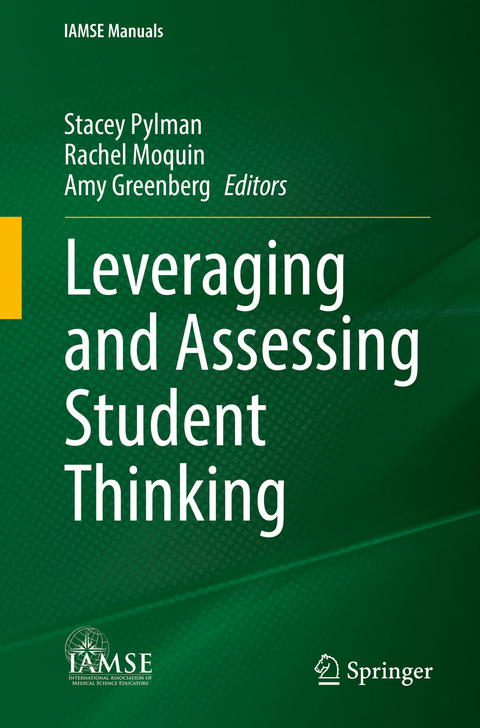
Leveraging and Assessing Student Thinking (eBook)
140 Seiten
Springer Nature Switzerland (Verlag)
978-3-031-89714-6 (ISBN)
This book is a compilation of teaching theories and strategies for eliciting and interpreting student thinking to adapt to educational settings.
Medical education is no longer about simply providing students with knowledge, as it was in Flexner’s day. Modern medical education is focused on shaping how students understand, define, and move the practice of medicine forward. Modern medical schools focus on building student’s ability to reason clinically and develop their own identity as professionals while integrating those pieces of their identity with their emerging content knowledge.
This level of high-quality education requires medical educators to understand their learners and see their learners as more than repositories for knowledge. A medical educator must understand who the learner is, what the learner already knows, and what misunderstandings the learner has. Hence, educators must learn to be skilled not simply at conveying information, but rather at eliciting student thinking and understanding to discern what and how to best teach the learner. Faculty often think of teaching this way as complex and time-consuming. However, in this manual we reveal that once the theoretical underpinnings of why leveraging and assessing student thinking matters are understood, educators can enact the theory by building specific teaching skills.
This manual is written by authors steeped in educational theory and with a background in teacher education. Other manuals and book chapters have looked at active learning and rubrics which are part of learner-centered instruction. This manual is the first of its kind to help medical educators practice what it means to teach in a learner-centered way by leveraging student thinking.
The manual is written using educational theory and literature, includes vignettes for illustrative purpose, and provides practical steps in enacting strategies to elicit student thinking. In the first section of this manual, we define the practices of eliciting and interpreting student thinking and explain why student thinking matters, introduce readers to gradual release theories of learning, and showcase the benefits of using students’ experiences, background, and prior knowledge. In the second section of the manual, we explain in further detail how to leverage and assess student thinking. We describe, illustrate with vignettes, and provide step by step guides on the skills of questioning, giving feedback, debriefing clinical experiences, analyzing student work, and assessing student thinking and understanding in the medical education context.
| Erscheint lt. Verlag | 16.5.2025 |
|---|---|
| Reihe/Serie | IAMSE Manuals |
| Zusatzinfo | XVII, 140 p. 19 illus. |
| Sprache | englisch |
| Themenwelt | Medizin / Pharmazie ► Studium |
| Sozialwissenschaften ► Pädagogik ► Erwachsenenbildung | |
| Schlagworte | Eliciting student thinking in medical education • Interpreting student thinking in medical education • Leveraging and assessing student thinking in medical education • Questioning student prior experience and background • Student thinking in medical education |
| ISBN-10 | 3-031-89714-5 / 3031897145 |
| ISBN-13 | 978-3-031-89714-6 / 9783031897146 |
| Informationen gemäß Produktsicherheitsverordnung (GPSR) | |
| Haben Sie eine Frage zum Produkt? |
 PDF (Wasserzeichen)
DRM: Digitales Wasserzeichen
Dieses eBook enthält ein digitales Wasserzeichen und ist damit für Sie personalisiert. Bei einer missbräuchlichen Weitergabe des eBooks an Dritte ist eine Rückverfolgung an die Quelle möglich.
Dateiformat: PDF (Portable Document Format)
Mit einem festen Seitenlayout eignet sich die PDF besonders für Fachbücher mit Spalten, Tabellen und Abbildungen. Eine PDF kann auf fast allen Geräten angezeigt werden, ist aber für kleine Displays (Smartphone, eReader) nur eingeschränkt geeignet.
Systemvoraussetzungen:
PC/Mac: Mit einem PC oder Mac können Sie dieses eBook lesen. Sie benötigen dafür einen PDF-Viewer - z.B. den Adobe Reader oder Adobe Digital Editions.
eReader: Dieses eBook kann mit (fast) allen eBook-Readern gelesen werden. Mit dem amazon-Kindle ist es aber nicht kompatibel.
Smartphone/Tablet: Egal ob Apple oder Android, dieses eBook können Sie lesen. Sie benötigen dafür einen PDF-Viewer - z.B. die kostenlose Adobe Digital Editions-App.
Buying eBooks from abroad
For tax law reasons we can sell eBooks just within Germany and Switzerland. Regrettably we cannot fulfill eBook-orders from other countries.
aus dem Bereich