


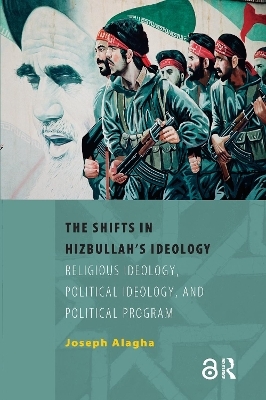
The Shifts in Hizbullah’s Ideology
Religious Ideology, Political Ideology, and Political Program
Seiten
2006
Pallas Publications (Verlag)
978-90-5356-910-8 (ISBN)
Pallas Publications (Verlag)
978-90-5356-910-8 (ISBN)
The Lebanese Shi‘ite resistance movement, Hizbullah, is going through a remarkable political and ideological transformation. This book analyses of the political and ideological transformation of Hizbullah.
The Lebanese Shi‘ite resistance movement, Hizbullah, is going through a remarkable political and ideological transformation. Hizbullah was founded in 1978 by various sectors of Lebanese Shi‘ite clergy and cadres, and with Iranian backing as an Islamic movement protesting against social and political conditions. Over the years 1984/85 to 1991, Hizbullah became a full-fledged social movement in the sense of having a broad overall organization, structure, and ideology aiming at social change and social justice, as it claimed. Starting in 1992, it became a mainstream political party working within the narrow confines of its pragmatic political program. The line of argument in this dissertation is that Hizbullah has been adjusting its identity in the three previously mentioned stages by shifting emphasis among its three components: (1) from propagating an exclusivist religious ideology (2) to a more encompassing political ideology, and (3) to a down-to-earth political program.
The Lebanese Shi‘ite resistance movement, Hizbullah, is going through a remarkable political and ideological transformation. Hizbullah was founded in 1978 by various sectors of Lebanese Shi‘ite clergy and cadres, and with Iranian backing as an Islamic movement protesting against social and political conditions. Over the years 1984/85 to 1991, Hizbullah became a full-fledged social movement in the sense of having a broad overall organization, structure, and ideology aiming at social change and social justice, as it claimed. Starting in 1992, it became a mainstream political party working within the narrow confines of its pragmatic political program. The line of argument in this dissertation is that Hizbullah has been adjusting its identity in the three previously mentioned stages by shifting emphasis among its three components: (1) from propagating an exclusivist religious ideology (2) to a more encompassing political ideology, and (3) to a down-to-earth political program.
Joseph Alagha is professor in Political Science & Intercultural Studies at Haigazian University, Beirut, Lebanon.
A Note on Transliteration, Acknowledgements, Prologue, Preface, 1. A Survey of Hizbullah’s History (1978 -2005), 2. The Saliency of Hizbullah’s Religious Ideology (1978-1984/5), 3. The Prominence of Hizbullah’s Political Ideology (1984/5-1990), 4. Primacy to Political Program (1991 to 2005), 5. A Specific Perspective on the General Shifts, 6. Epilogue: Conclusion and Implications, 7. Appendices, Notes, English Summary, Dutch Summary (Nederlandse samenvatting)
| Reihe/Serie | ISIM Dissertations |
|---|---|
| Sprache | englisch |
| Maße | 156 x 234 mm |
| Gewicht | 700 g |
| Themenwelt | Geisteswissenschaften ► Religion / Theologie |
| Medizin / Pharmazie ► Allgemeines / Lexika | |
| Sozialwissenschaften ► Politik / Verwaltung ► Politische Systeme | |
| ISBN-10 | 90-5356-910-3 / 9053569103 |
| ISBN-13 | 978-90-5356-910-8 / 9789053569108 |
| Zustand | Neuware |
| Informationen gemäß Produktsicherheitsverordnung (GPSR) | |
| Haben Sie eine Frage zum Produkt? |
Mehr entdecken
aus dem Bereich


aus dem Bereich
Das politische System der USA und die Zukunft der Demokratie
Buch | Hardcover (2025)
C.H.Beck (Verlag)
CHF 39,20
Russland, Europa, Amerika
Buch | Softcover (2025)
C.H.Beck (Verlag)
CHF 25,20


