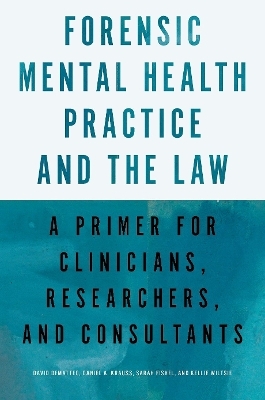
Forensic Mental Health Practice and the Law
Oxford University Press Inc (Verlag)
978-0-19-768656-0 (ISBN)
David DeMatteo is a Professor of Psychology in the Department of Psychological and Brain Sciences at Drexel University, a Professor of Law at the Thomas R. Kline School of Law at Drexel University, and Director of Drexel University's JD/PhD Program in Law and Psychology. He is a licensed psychologist in Pennsylvania, where he provides forensic mental health assessments and consultation, and he is board certified in forensic psychology by the American Board of Professional Psychology. He is a former President of both the American Psychology-Law Society (American Psychological Association Division 41) and the American Board of Forensic Psychology. He is also a Fellow of the American Psychological Association (Divisions 1, 12, and 41) and the American Academy of Forensic Psychology. He is Chair of the Committee that is revising the APA Specialty Guidelines for Forensic Psychology, and he is the Editor-in-Chief of Law and Human Behavior. Daniel A. Krauss is the Crown Professor of Psychology and George R. Roberts Fellow in the Department of Psychological Sciences at Claremont McKenna College. He completed a joint-degree program in psychology and law at the University of Arizona, receiving his JD and then his PhD in clinical psychology and psychology, policy, and law. He is licensed to practice law in Arizona, is a member of the United States Supreme Court Bar and has served as the United States Supreme Court Fellow to the U.S. Sentencing Commission. He is a licensed psychologist in California, and a diplomate in forensic psychology, board certified by the American Board of Professional Psychology. He was awarded the Early Career Research Award by the Western Psychological Association and is a Master Lecturer of the American Psychological Association. He is a Fellow of the American Psychological Association (Div. 41; American Psychology-Law Society), Association of Psychological Science, the Society for Empirical Legal Studies, and the Western Psychological Association. He served on the Board of Directors of the American Board of Forensic Psychology (ABFP), and he served as President of ABFP in 2022. Sarah Fishel is a Postdoctoral Fellow in Forensic Psychology at the University of Virginia's Institute of Law, Psychiatry, and Public Policy. She received a law degree from the Drexel University Thomas R. Kline School of Law and a PhD in Clinical Psychology from Drexel University. She is licensed to practice both law and psychology in Virginia. Her research interests include the trajectory of delinquency and criminal legal involvement across the lifespan, identifying and understanding "bias" and "noise" in the legal processes, and legal and psychological policy and reform. She is a co-chair of the Professional Development of Women Committee for the American Psychology-Law Society (American Psychological Association Division 41). Kellie Wiltsie is a JD/PhD student at Drexel University. She received her JD from Drexel University's Thomas R. Kline School of Law and her MS in clinical psychology (forensic concentration) from Drexel University. She anticipates receiving her PhD in September 2025 from Drexel. Her research interests include the impact of biases on judicial decision-making, reentry and diversion courts, and the intersection of forensic psychology research and policy. Her clinical experiences include working with individuals with a variety of presenting problems, including coping with justice-involvement and reentry needs, severe mental illness, and mood and anxiety disorders in both inpatient and outpatient settings. She has worked with numerous legal institutions, including the United States Attorney's Office for the Eastern District of Pennsylvania, the Legal Aid Society of Southeastern Pennsylvania, and in the chambers of Judge L. Felipe Restrepo in the United States Court of Appeals for the Third Circuit. She also served on the Moot Court Board while in law school and participated in multiple oral advocacy competitions. She is completing her doctoral internship with the Wisconsin Department of Corrections.
Preface
1: United States Legal System: Structure and Function
2: Forensic Mental Health Professionals and the Law
3: Discovery
4: Legal Bases for Expert Testimony
5: Admissibility Standards for Expert Testimony-Part 1
6: Admissibility Standards for Expert Testimony-Part 2
7: Considerations Related to Expert Testimony
8: Legal and Ethical Requirements and Considerations Relevant to Forensic Practice
9: Emerging Areas of Forensic Practice Regulation
Notes
References
Index
| Erscheinungsdatum | 03.08.2025 |
|---|---|
| Verlagsort | New York |
| Sprache | englisch |
| Maße | 157 x 232 mm |
| Gewicht | 399 g |
| Themenwelt | Geisteswissenschaften ► Psychologie ► Klinische Psychologie |
| Studium ► 2. Studienabschnitt (Klinik) ► Rechtsmedizin | |
| Recht / Steuern ► EU / Internationales Recht | |
| Recht / Steuern ► Privatrecht / Bürgerliches Recht ► Medizinrecht | |
| ISBN-10 | 0-19-768656-7 / 0197686567 |
| ISBN-13 | 978-0-19-768656-0 / 9780197686560 |
| Zustand | Neuware |
| Informationen gemäß Produktsicherheitsverordnung (GPSR) | |
| Haben Sie eine Frage zum Produkt? |
aus dem Bereich