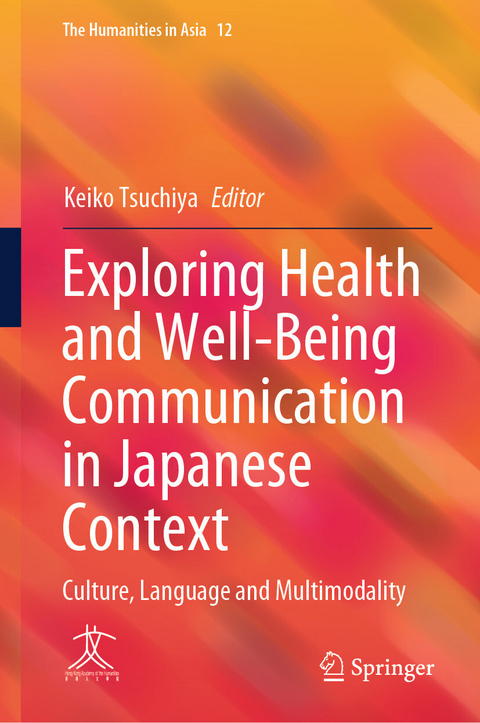
Exploring Health and Well-Being Communication in Japanese Context (eBook)
179 Seiten
Springer Nature Singapore (Verlag)
978-981-97-9338-9 (ISBN)
This book is a selection of linguistic and multimodal research on healthcare and well-being communication in Japan. This volume offers unique perspectives to the field of healthcare communication research, where studies in the West is still dominant, providing a missing piece of the whole picture. Multiculturality and multimodality in interactions in healthcare and well-being are the themes in this volume. Culture here is not limited to ethnic groups, including any sociocultural groups from different professional disciplines to atypical individuals. Two research principles are addressed: (1) multiculturality: how are inter/cross-cultural encounters or issues among different sociocultural groups addressed, and what practices are embodied in a particular sociocultural setting?, and (2) multimodality: what semiotic resources are included in the analysis, how are those data collected and transcribed? The first chapter (Tsuchiya) provides a concise overview of healthcare communication research in Japan and Europe, introducing the themes and chapters in this volume. The introductory chapter is followed by case studies in a range of research fields in healthcare and well-being in Japan: Chapter 2 (Aizaki) employs a discourse analytic approach to examine framing in a first-encounter interaction among a Japanese adult with ASD and other three non-ASD Japanese adults. The context of Nukuto's ethnographic discourse research (Chapter 3) was set in a classroom at a Japanese university, where a special education teacher was teaching crafting (monodukuri) to prospective teachers, highlighting materials as a communicative medium for grounding. Chapter 4 (Sekine, Takashima, Oka, Yano, and Suzuki) investigates how Deaf children who use Japanese Sign Language adjust their expressions of a special location in interactions with those in different age groups. Chapter 5 (Yohena) analyses discourses in Christian coaching between an American coach and a Japanese client from a cross-cultural perspective. The last two chapters are studies in hospital. Kuroshima's conversation analytic research (Chapter 6) provides a detailed description of doctors' use of patient's medical records during consultations. Chapter 7 (Tsuchiya, Nakamura and Coffey) captures a moment when a trauma team leader rejects a member's proposal in simulation in the UK and Japan. The concluding chapter (Chapter 8, Tsuchiya) recapitulates themes, theories and methods which the chapter authors employed in the previous chapters, encouraging publications in health and well-being communication research in Asia and beyond.
This book is a selection of linguistic and multimodal research on healthcare and well-being communication in Japan. This volume offers unique perspectives to the field of healthcare communication research, where studies in the West is still dominant, providing a missing piece of the whole picture. Multiculturality and multimodality in interactions in healthcare and well-being are the themes in this volume. Culture here is not limited to ethnic groups, including any sociocultural groups from different professional disciplines to atypical individuals. Two research principles are addressed: (1) multiculturality: how are inter/cross-cultural encounters or issues among different sociocultural groups addressed, and what practices are embodied in a particular sociocultural setting?, and (2) multimodality: what semiotic resources are included in the analysis, how are those data collected and transcribed? The first chapter (Tsuchiya) provides a concise overview of healthcare communication research in Japan and Europe, introducing the themes and chapters in this volume. The introductory chapter is followed by case studies in a range of research fields in healthcare and well-being in Japan: Chapter 2 (Aizaki) employs a discourse analytic approach to examine framing in a first-encounter interaction among a Japanese adult with ASD and other three non-ASD Japanese adults. The context of Nukuto's ethnographic discourse research (Chapter 3) was set in a classroom at a Japanese university, where a special education teacher was teaching crafting (monodukuri) to prospective teachers, highlighting materials as a communicative medium for grounding. Chapter 4 (Sekine, Takashima, Oka, Yano, and Suzuki) investigates how Deaf children who use Japanese Sign Language adjust their expressions of a special location in interactions with those in different age groups. Chapter 5 (Yohena) analyses discourses in Christian coaching between an American coach and a Japanese client from a cross-cultural perspective. The last two chapters are studies in hospital. Kuroshima's conversation analytic research (Chapter 6) provides a detailed description of doctors' use of patient's medical records during consultations. Chapter 7 (Tsuchiya, Nakamura and Coffey) captures a moment when a trauma team leader rejects a member's proposal in simulation in the UK and Japan. The concluding chapter (Chapter 8, Tsuchiya) recapitulates themes, theories and methods which the chapter authors employed in the previous chapters, encouraging publications in health and well-being communication research in Asia and beyond.
| Erscheint lt. Verlag | 18.4.2025 |
|---|---|
| Reihe/Serie | The Humanities in Asia |
| Zusatzinfo | XVI, 179 p. 87 illus., 44 illus. in color. |
| Sprache | englisch |
| Themenwelt | Geisteswissenschaften ► Sprach- / Literaturwissenschaft ► Sprachwissenschaft |
| Medizin / Pharmazie ► Gesundheitsfachberufe ► Logopädie | |
| Sozialwissenschaften ► Ethnologie | |
| Sozialwissenschaften ► Kommunikation / Medien ► Kommunikationswissenschaft | |
| Sozialwissenschaften ► Kommunikation / Medien ► Medienwissenschaft | |
| Sozialwissenschaften ► Politik / Verwaltung | |
| Sozialwissenschaften ► Soziologie | |
| Schlagworte | conversation analysis • Cross-Cultural Communication • Culturally embedded practices • Discourse analysis • diverse populations • ethnography • healthcare communication • Japanese context • multimodal analysis • well-being |
| ISBN-10 | 981-97-9338-6 / 9819793386 |
| ISBN-13 | 978-981-97-9338-9 / 9789819793389 |
| Informationen gemäß Produktsicherheitsverordnung (GPSR) | |
| Haben Sie eine Frage zum Produkt? |
 PDF (Wasserzeichen)
DRM: Digitales Wasserzeichen
Dieses eBook enthält ein digitales Wasserzeichen und ist damit für Sie personalisiert. Bei einer missbräuchlichen Weitergabe des eBooks an Dritte ist eine Rückverfolgung an die Quelle möglich.
Dateiformat: PDF (Portable Document Format)
Mit einem festen Seitenlayout eignet sich die PDF besonders für Fachbücher mit Spalten, Tabellen und Abbildungen. Eine PDF kann auf fast allen Geräten angezeigt werden, ist aber für kleine Displays (Smartphone, eReader) nur eingeschränkt geeignet.
Systemvoraussetzungen:
PC/Mac: Mit einem PC oder Mac können Sie dieses eBook lesen. Sie benötigen dafür einen PDF-Viewer - z.B. den Adobe Reader oder Adobe Digital Editions.
eReader: Dieses eBook kann mit (fast) allen eBook-Readern gelesen werden. Mit dem amazon-Kindle ist es aber nicht kompatibel.
Smartphone/Tablet: Egal ob Apple oder Android, dieses eBook können Sie lesen. Sie benötigen dafür einen PDF-Viewer - z.B. die kostenlose Adobe Digital Editions-App.
Buying eBooks from abroad
For tax law reasons we can sell eBooks just within Germany and Switzerland. Regrettably we cannot fulfill eBook-orders from other countries.
aus dem Bereich